The Etiquette of Cigar Tasting: Tips and Suggestions for Smoking Cigars in Different Occasions
The Etiquette of Cigar Tasting: Tips and Suggestions for Smoking Cigars in Different Occasions
As the editor of "Cigar Bible," I am often asked by beginners: Is cigar smoking a personal taste or a social language? My answer is both. Knowing how to smoke is just the beginning; understanding how to manage time, aroma, rhythm, and respect for others in different occasions is the first lesson for a mature cigar enthusiast.
Unlike champagne that must be poured once opened, or coffee that can be finished in five minutes, a Robusto cigar often takes 45 minutes, and a Churchill can take over 90 minutes. The size you choose, the timing of lighting, and the distance of your conversation often reveal more about your taste than the brand name you mention.
Understanding "Occasion": Cigar Etiquette is Not About Showing Off, But Making People Comfortable
The core of cigar etiquette is not about how well you know Cohiba, Montecristo, or Partagás, but about understanding whether "this moment is appropriate." In 2016, I hosted a novice entrepreneur who brought a Cohiba Siglo VI to a post-dinner gathering. The cigar itself was excellent, but there were non-smokers and pregnant women present, so he chose to put it away, earning the respect of everyone at the table. True taste is knowing when not to light a cigar.
Judging the occasion can start with three things: whether the space allows it, whether the companions accept it, and whether there is enough time. A typical Robusto is about 124 mm with a ring gauge of 50, usually requiring 45 to 60 minutes; if only 20 minutes are left, it's not suitable to forcefully light a large cigar. An H. Upmann Half Corona, about 90 mm, with a shorter rhythm, is more suitable for a quick post-meal moment.
Beginners often make the mistake of treating cigars as a social business card eager to display. In European and American traditions, cigars often appear after meals, when the conversation enters a relaxed phase; in cities like Hong Kong, Taipei, and Singapore, due to indoor regulations and public space restrictions, it's even more important to confirm the venue rules first. The first step of etiquette is to respect people first, then respect the cigar.
My advice is simple: if you're unsure, don't light it; if the host or organizer clearly arranges a suitable area, then consider the size and strength. The charm of cigar culture lies in its ability to extend conversations, not interrupt them. Once you grasp this principle, cutting, lighting, and pairing drinks will naturally follow.
Private Gatherings: Bringing Cigars Requires Discretion, Sharing Needs Understanding Boundaries
The most common scenario in private gatherings is dinner at a friend's house, birthdays, pre-wedding parties, or year-end gatherings. If you want to bring cigars, please ask the host first: "Is there a suitable outdoor or ventilated area on site?" This question is more polite than directly taking out a cigar. In 2019, I attended an eight-person dinner where the host prepared a terrace with fans, and everyone moved outdoors after the meal, making the atmosphere much more natural.
Bringing cigars is not about bringing the most expensive ones, but about matching the number of people and the rhythm. If there are three friends who are beginners, I usually wouldn't choose a strong, peppery Partagás Serie D No.4 as the first cigar, but would consider something smoother like Hoyo de Monterrey Epicure No.2 or Romeo y Julieta Short Churchill. The focus of private gatherings is not to dominate, but to allow both conversation and cigars to continue comfortably.
When sharing, avoid making decisions for others. Some people just want to enjoy the aroma without smoking, and some just want to drink whiskey and chat, which are all normal choices. You can prepare an extra cigar cutter and lighter, but don't actively hand a cigar to someone. Cigars contain nicotine and aroma, and it's polite to let the other person choose for themselves, especially when dinner already includes red wine and spirits, reminding them to slow down the pace.
I use a simple checklist to determine if a private gathering is suitable for cigars:
- Has the host agreed, and is there a legal and compliant space?
- Is there enough time, at least 40 minutes?
- Is there a separate ashtray, long matches, or a torch prepared?
- Is anyone clearly bothered by the aroma or physically uncomfortable?
- Is the choice not overly strong and burns steadily?
By doing these, cigars will become the background music of the gathering, not the main attraction.
Business Occasions: Don't Rush to Light, First Understand the Other's Rhythm
In business occasions, cigars are most easily misused. Some people think that taking out an expensive cigar can show strength, but true mature business etiquette is to see if the other party is willing to move the meeting into a private, relaxed area. After the 2008 financial crisis, I saw many business gatherings become more conservative, with cigars no longer being props at the negotiation table, but an extension after transactions, meetings, or dinners.
If it's the first meeting, I don't recommend actively suggesting cigars. A better approach is to naturally extend when the other party mentions whiskey, cigar bars, or collection experiences after the meal. If the other party only drinks tea or has a meeting early the next morning, there's no need to force it. The etiquette of business cigars is to leave the choice to the other party and the leadership to the occasion.
Size selection is also crucial. If there's only an hour after finishing a case, a Robusto or Petit Robusto is more suitable; if there's a complete rest period after a formal business dinner, then consider a Double Corona or Churchill. A Montecristo No.2 requires more time and a stable rhythm; smoking it while rushing will waste its complexity.
In business occasions, avoid talking about cigar prices. Discussing origins is fine, discussing preservation is fine, but don't start with "this one is hard to get" or "this box is expensive." If it involves collection perspectives, I always add: collecting appreciation does not guarantee appreciation, it still depends on origin, preservation, and market. This is not just a conservative statement but also respect for the other party's risk judgment.
Formal Banquets: Pre-Meal, Post-Meal, and Dress Details Must Be Considered
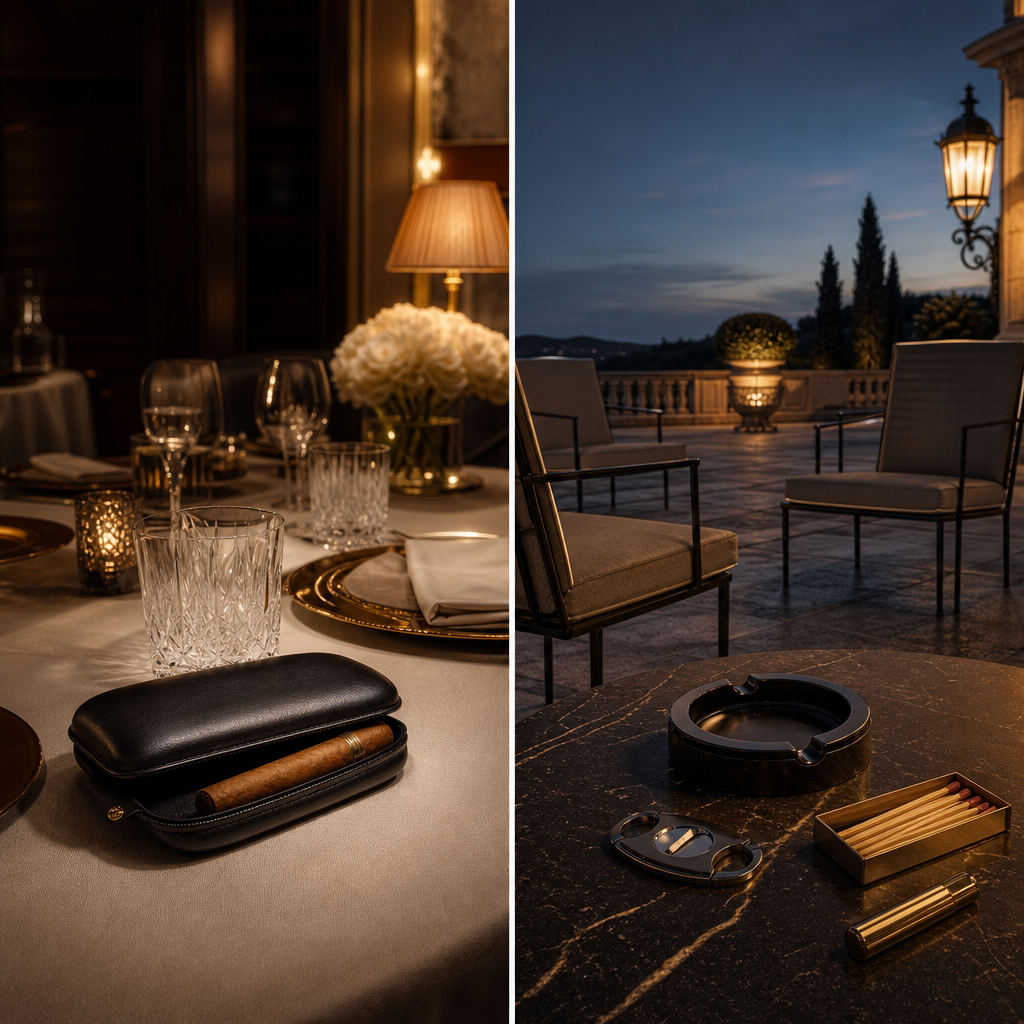
The biggest fear in formal banquets is timing errors. Cigars are usually not suitable to start before meals, as the strength and aroma may affect the taste, especially if the menu includes oysters, steamed fish, white truffles, or delicate white wines, the woody, leathery, and peppery aroma of cigars will overpower the dishes. Traditionally, cigars are more suitable to appear after dessert, coffee, cognac, or whiskey.
I once saw two completely different approaches after a black-tie dinner in 2022: one guest lit up directly at the exit in a tuxedo, blowing smoke towards the waiting crowd; another asked the staff if there was a designated area and then moved to a ventilated terrace. The cigars of the two were of similar grade, but the impression left on people was vastly different. In formal occasions, cigars are not about displaying freedom, but demonstrating self-control.
Clothing also affects cigar etiquette. Dark wool suits, silk ties, and evening jackets easily absorb aromas, so if you need to return indoors or travel with others after the banquet, it's best to prepare a light jacket or stay in a ventilated area for a few minutes. Using perfume to cover smoke odor is not clever; strong perfume combined with cigar aftertaste often makes others more uncomfortable.
In terms of pairing drinks, formal banquets don't need to pursue complexity. Cognac XO, vintage rum, bourbon, and single malt are common, but water is equally important. If smoking a Bolivar or Ramón Allones with a thicker style, please slow down the pace, about one puff per minute. Smoking too fast will overheat the cigar body, increase bitterness, and easily appear anxious in formal occasions.
Cigar Bars and Clubs: Respect Space Rules and Professional Service
In cigar bars or clubs, beginners often think that as long as they enter a suitable venue, they can completely relax. In fact, the more professional the space, the more rules need to be respected. Different places have different arrangements for storage, corkage, using self-brought cigars, and seating time; understanding the regulations before sitting down is basic courtesy. From my years of observation, the most popular guests are often not those who know the most about brands, but those who understand discretion the best.
When choosing cigars in such spaces, you can first state the time, strength, and flavor you want, rather than just asking "which one is the best." For example, you can say: "I have 60 minutes, want medium strength, with obvious woody and creamy notes." This way, the staff can suggest more accurately, such as H. Upmann Magnum 46, Punch Punch, or Trinidad Reyes. Clearly stating your needs is more like a mature cigar enthusiast than reciting rare models.
Below is a table of occasion choices I often give to beginner friends:
| Occasion | Suggested Size | Time Estimate | Flavor Direction | Etiquette Focus |
|---|---|---|---|---|
| Short Post-Meal Gathering | Petit Corona / Half Corona | 25–40 minutes | Light to Medium | Don't delay the host's rhythm |
| Business Post-Meal | Robusto | 45–60 minutes | Medium, Stable | Confirm the other party's willingness first |
| After Formal Banquet | Churchill / Toro | 75–90 minutes | Rounded, Layered | Use designated area |
| Outdoor Leisure | Corona Gorda | 50–70 minutes | Refreshing or Woody | Pay attention to wind direction and ash |
| Deep Communication | Pirámides / Double Corona | Over 80 minutes | Complex, Full-bodied | Leave enough complete time |
When using scissors, lighters, or ashtrays in a cigar bar, return them to their original place after use, don't point the flame at others or the leather tabletop. If requesting in-store assistance for storage, understand that humidity is usually between 65% to 70% RH, and temperature is about 18 to 21°C, with different management methods in each store. Respecting professionalism means making your experience more stable.
Outdoors, Travel, and Cigars: Wind, Humidity, and Time Will Change the Flavor
Outdoor cigar smoking is most easily underestimated. At the beach, terrace, golf course, yacht, or mountain area, air movement will speed up the burning rate, and the wrapper is more prone to cracking. In 2023, I encountered sub-zero temperatures in Hokkaido, Japan, where the same Robusto smoked indoors could last 55 minutes, but in strong outdoor winds, it became noticeably overheated in less than 40 minutes, with bitterness appearing early in the final third.
Preservation during travel is especially important. If bringing only 2 to 3 cigars, use a hard-shell travel case with a 65% or 69% humidity pack; if over a week, it's recommended to use a travel humidor with better sealing. Cuban cigars like Cohiba, Partagás, and Hoyo de Monterrey are quite sensitive to changes in humidity, and large temperature differences will cause the wrapper to shrink and burn unevenly. The key to outdoor cigars is not smoking boldly, but controlling variables.
Wind direction is also etiquette. Even in open spaces, don't stand upwind to let smoke blow directly at others. If it's a golf cart, yacht seat, or hotel terrace, it's best to choose a corner position and prepare a covered ashtray or deep ash cup. Cigar ash is longer and heavier than cigarette ash, and a gust of wind can easily fall on clothing or tableware.
In outdoor occasions, I prefer sizes with stable burning and not too small a ring gauge. Lonsdale and Lancero, though elegant, tend to burn unevenly in strong winds; Robusto and Corona Gorda are usually more stable. If you want to preserve delicate aromas, don't choose too precious or vintage cigars in strong winds. A good cigar needs a good environment, which is often more important than the brand.
Cutting, Lighting, Ash, and Extinguishing: Small Actions Reveal Cultivation
Cutting is the first public action of a cigar. If cut too deep, the cap will fall off, and the wrapper will loosen; if cut too shallow, the draw will be too tight. For a round-headed cigar, just cut off the top of the cap about 1 to 2 mm, ensuring a flat opening. For torpedo shapes like Montecristo No.2 or Diplomaticos No.2, you can cut a little at first, then adjust according to the draw, without cutting all the way at once.
When lighting, don't let the flame directly scorch the foot of the cigar. You can first use a long match or torch to slowly toast at a distance of about 1 to 2 cm from the flame, rotating the foot until the edges are evenly red, then lightly puff to confirm burning. If you puff hard at the start, the temperature rises too quickly, and the front section is prone to a burnt bitter taste. A cigar is not just about lighting it, but letting it evenly enter the state.
Ash also has etiquette. Don't deliberately leave the ash long to show off; naturally place it on the edge of the ashtray at 3 to 4 cm. Tapping a cigar like a cigarette often damages the burn line and easily flicks ash onto the table. If the burn is uneven, you can slow down the pace, rotate the slower-burning side down, and only make small fire adjustments if necessary.
When extinguishing a cigar, don't crush it like a cigarette. Cigars contain more natural tobacco leaves, and crushing releases a strong odor. The best way is to lay it flat on the ashtray and let it extinguish naturally. If only a third is left and the taste turns bitter, it's time to end; knowing when to stop is respect for both the cigar and those around you.
Frequently Asked Questions
Can I bring my own cigars to a friend's gathering?
Yes, but you should first obtain the host's consent and confirm if there is a suitable space. Don't assume balconies, terraces, or gardens can be used, as residential regulations, neighbor distance, and wind direction can affect others. If the host hasn't arranged it, save the cigar for the next suitable occasion. Bringing cigars appropriately is more important than bringing expensive ones.
Is it appropriate to give cigars in business occasions?
It can be a mature gesture, but you must be very cautious. You must confirm that the other party already has a cigar habit and understand their preferences. Giving a box that's too strong or with unclear preservation may not add points. If discussing collection value, remember: collecting appreciation does not guarantee appreciation, it still depends on origin, preservation, and market.
What size is safer for beginners to choose after a formal banquet?
If the time is about 45 to 60 minutes, a Robusto is a safe choice, such as Romeo y Julieta Short Churchill or Hoyo de Monterrey Epicure No.2. If only half an hour, consider a Half Corona. Don't choose a Churchill for the sake of face and then rush to leave midway, which is impolite.
Should a cigar always be held in hand?
No need. During conversations, you can place the cigar on the ashtray groove to avoid large gestures causing ash to fall. Pointing with a cigar, passing things over plates, and exhaling a lot of smoke while talking are not elegant. When holding a cigar, movements should be slower and more stable than usual.
Can I help others cut or light their cigars?
Unless the other person explicitly asks for your help, there's no need to take the initiative. Cutting depth, draw preference, and lighting method all have personal habits. If the other person is a novice, you can first demonstrate your method, then hand over the tools. Assisting does not mean taking over, which is a subtle point in cigar etiquette.
If a cigar goes out midway, is it impolite to relight it?
It's not impolite, but it depends on the time. If it goes out for less than 5 to 10 minutes, gently blow the foot, clear the remaining ash, and then re-toast; if left for more than half an hour, the taste is likely to have become muddled. In formal occasions, if the cigar has clearly changed flavor, it's better to end naturally rather than forcefully finish it.
How to talk about brands and vintages in a cigar bar without showing off?
Share experiences instead of comparing prices. For example, saying "I think some box-preserved H. Upmann from around 2014 has honey and woody notes" is more substantial than saying "this one is hard to find now." The most charming part of discussing cigars is talking about flavors, preservation, occasions, and memories, not just comparing rarity.
Cigar etiquette, to me, is an ability to slow down. Understanding brands, vintages, and preservation can certainly take you deeper; but what truly makes people willing to spend an evening with you is whether you can take care of others' feelings. A good cigar is not only on the tongue but also in the discretion. May every beginner start by respecting the occasion and gradually develop their own style.
—Cigar Prince Wilson Tsai
Smoking is harmful to health. Smoking is prohibited for those under twenty. Quitline: 0800-636363. This article is intended for adults over the age of twenty as a reference for cigar culture, preservation, and regulatory knowledge, not as an advertisement, promotion, or purchase suggestion.