The Psychology of Cigar Appreciation: The Interplay of Senses and Emotions
The Psychology of Cigar Appreciation: The Interplay of Senses and Emotions
The allure of cigars lies not only in descriptors like wood, leather, cocoa, and pepper, but in how the same cigar can present a completely different face at different times, moods, and seats. As an editor of the "Cigar Bible," I often view cigars as a lesson in sensory psychology.
For beginners who already understand the basics of tasting and exhaling, the next step is not to rush to memorize more flavor terms, but to learn to recognize how they are influenced by light, music, the drink in their glass, anticipation, and memories. When you understand these psychological factors, appreciation shifts from "finding answers" to "understanding yourself."
Anticipation: The Flavor Begins Before the First Puff
Many people think the flavor of a cigar starts from the moment it is lit, but in fact, from the moment you see the box label, hear the brand story, and pick up the ring gauge and length, psychological anticipation is already shaping your perception. Cohiba, originating in Cuban diplomatic occasions in 1966 and officially entering the market in 1982, has a history that subconsciously leads many to expect it to be more refined and elegant. Anticipation is not an illusion but a framework pre-established by the brain for sensory interpretation.
Take the Cohiba Siglo VI as an example, launched in 2002, with a size of about 52 ring gauge and 150 mm, often associated with cream, grass, honey, and fine wood. If a beginner first hears descriptors like "flagship" and "classic," they are likely to actively search for smoothness in the first puff; conversely, if they blind test with the appearance and brand concealed, attention might shift to burn rate, spiciness, or the cleanliness of the finish.
I suggest beginners try a simple exercise: record the same brand at different times, once with background information and once without, only noting their feelings. You'll find that brand narratives illuminate certain flavors while possibly obscuring other details. Mature appreciation is not about eliminating anticipation but knowing that anticipation is influencing you.
Smell and Memory: Why a Hint of Wood Can Evoke an Old Study
A large part of cigar flavor is not "tasted" by the tongue but completed by the nose and memory. Human olfactory signals are closely related to the limbic system, which is why scents like cedar, leather, coffee, and damp earth can quickly evoke images. The Partagás Serie D No.4, with a size of about 50 ring gauge and 124 mm, is often described as having earthy, peppery, and roasted notes; for some, it resembles a rain-soaked stone path, while for others, it is like dark toasted bread.
The most common mistake beginners make is rushing to judge "whether I smell the standard answer." In fact, everyone's scent vocabulary comes from life experiences: friends who grew up in Taiwan might more easily use oolong tea stems, longan wood, herbal ointment, and temple incense to describe; European cigar enthusiasts might say hay, stables, and oak barrels. Flavor descriptions have no single language; what truly matters is whether the description can be consistently repeated.
I often suggest building a "20-slot scent memory bank": coffee grounds, dark chocolate, white pepper, cinnamon, almonds, cedar chips, leather, hay, honey, roasted nuts, etc., smelling 3 types weekly and writing 10-word impressions. After three months, your descriptions will evolve from "very fragrant" and "very strong" to "the front is like roasted almonds, the middle turns to cedar and cocoa." This ability is more practical than memorizing brand ratings.
Emotional State: A Good Cigar Fears a Bad Mood
The same H. Upmann Magnum 46, with a size of about 46 ring gauge and 143 mm, can feel completely different on a Friday night versus a Monday afternoon. It's not the cigar that has changed, but your physical state. Lack of sleep, excessive coffee, work stress, and hunger can amplify bitterness and irritation, making the originally delicate creamy wood taste dry. Cigar appreciation is not purely objective measurement; it always includes the present you.
In 2019, I made a small record: the same box of Romeo y Julieta Short Churchills, enjoyed in different situations. 40 minutes after a meal, when relaxed, the records were mostly tea, nuts, and slightly sweet wood; when rushed and checking messages, the records turned to spicy, short, dry, and unstable burn. This reminded me that attention itself is part of the flavor.
A practical approach for beginners is to add an "emotional and physical field" at the beginning of notes:
- Sleep: less than 6 hours, 6 to 8 hours, more than 8 hours
- Diet: empty stomach, 30 minutes after a meal, 90 minutes after a meal
- Emotion: relaxed, anxious, tired, excited
- Environment: indoor, outdoor, windy, music volume
When you accumulate 20 records, you'll see your pattern. Some are most sensitive 60 minutes after a meal, others find bitterness more easily after 10 PM. Knowing how to arrange your state is respecting the cigar and respecting yourself.
Rhythm Psychology: Slow Down, and the Flavor Will Unfold
One of the biggest differences between cigars and cigarettes is that cigars are not suitable for haste. Beginners often smoke and exhale frequently due to nervousness, resulting in increased temperature, spicy smoke, and a burnt bitter finish, mistakenly thinking the cigar quality is poor. For a Robusto size, like the Ramón Allones Specially Selected, about 50 ring gauge and 124 mm, the full time often falls between 45 to 70 minutes. The steadier the rhythm, the more the cigar can display layers; the faster the rhythm, the more you taste heat and bitterness.
I usually recommend one puff every 45 to 60 seconds, observing the burn line, smoke volume, and mouthfeel in the front section without rushing to conclusions. In the middle section, see if sweetness, woodiness, and spiciness increase; in the final section, evaluate whether strength rises and balance is maintained. This three-stage observation is closer to the true character of a cigar than "whether the first puff is good."
Different sizes also affect psychological perception. Lancero is slender, focusing attention on aromatic lines; Churchill is long-lasting, like a slow conversation; Petit Corona is suitable for training quick structure recognition. Beginners can use 3 practices to compare different sizes of the same brand, such as Montecristo No.4 and Montecristo No.2: the former is about 42 ring gauge and 129 mm, the latter about 52 ring gauge and 156 mm, with different airflow, rhythm, and psychological expectations.
Environmental Cues: Lighting, Seating, and What's in the Glass Can Change Judgment
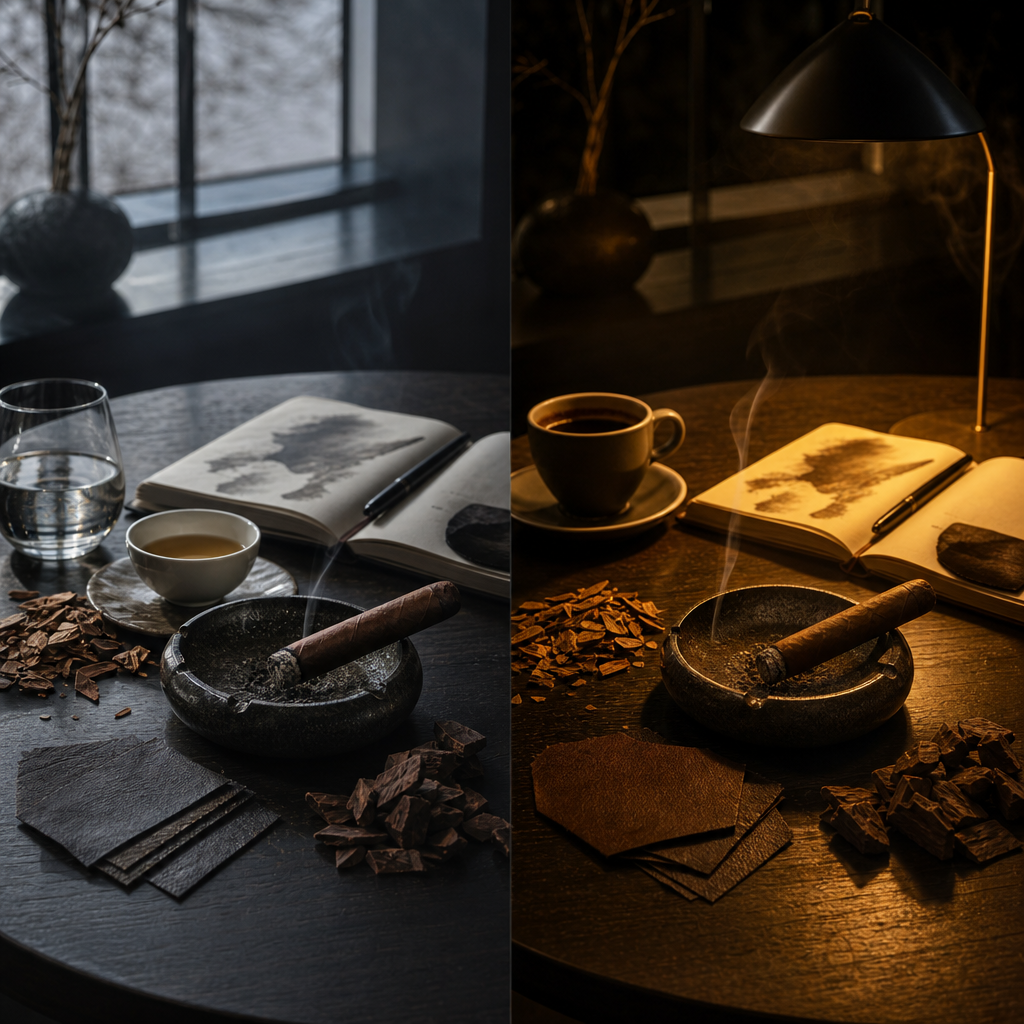
The environment can quietly rewrite the senses. Yellow lighting makes things feel sweet and moist, strong white light can make one more analytical; loud music can scatter attention, and overly cold air conditioning can dry out the mouth. Since 2010, many international cigar bars have paid more attention to seating distance, ventilation, and lighting, not just for comfort, but to create stable sensory conditions. A good environment is not decoration but a framework that prevents sensory interference.
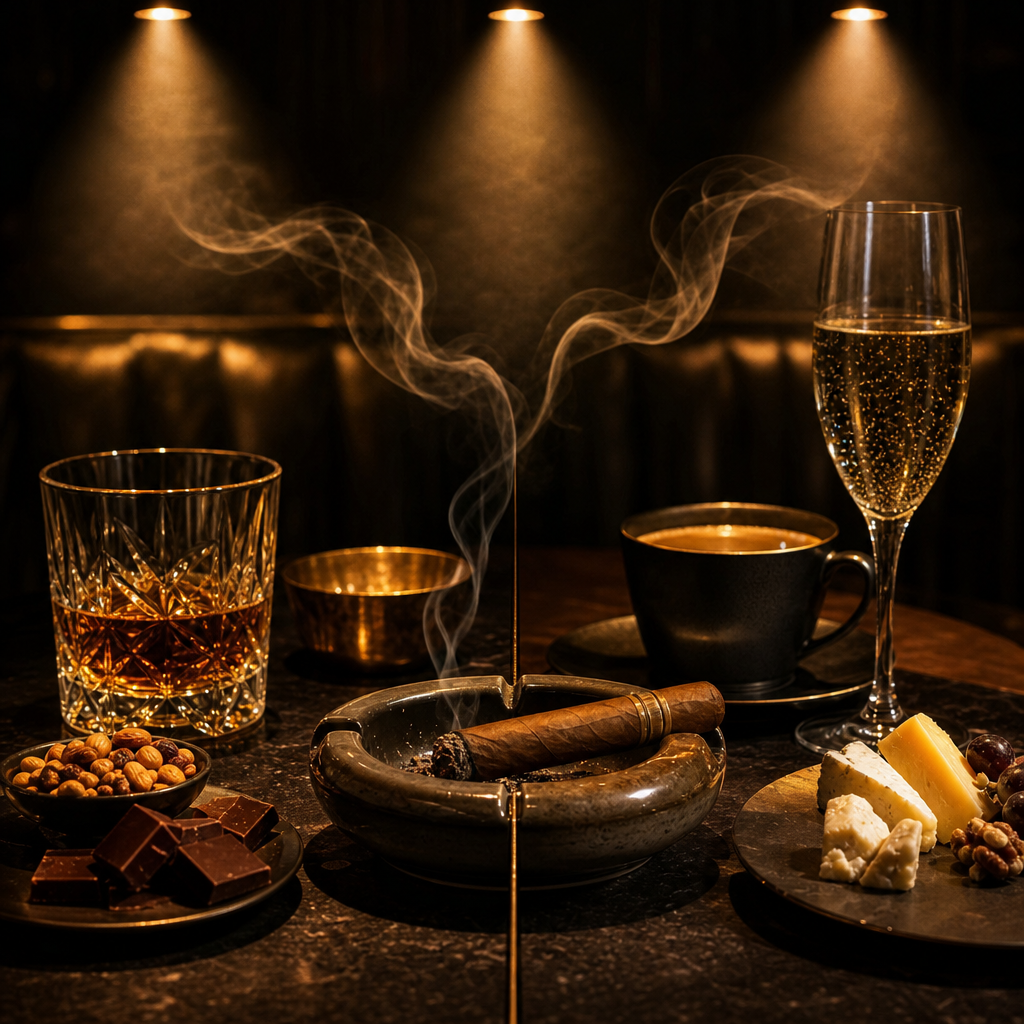
What's in the glass is also an important source of psychological cues. Dark rum can lead one to expect caramel and vanilla, single malt whiskey might direct attention to oak and smoke, while unsweetened black tea can clearly highlight the woodiness and astringency of the cigar. If you want to train more objectively, you can first complete the first third with room temperature water, then add a drink to compare differences.
| Environmental Factors | Possible Perception Shift | Suggested Practice |
|---|---|---|
| Yellow warm light | Increased sweetness and warmth | Suitable for relaxed recording |
| Strong white light | Increased analytical sense, more obvious flaws | Suitable for checking burn |
| Loud music | Scattered attention | Lower volume or shorten recording |
| Empty stomach with spirits | Increased spiciness and dizziness | Eat first and hydrate |
| Outdoor with wind | Accelerated burn, unstable temperature | Choose a wind-sheltered spot |
My habit is to fix a set of "calibration conditions": 60 minutes after dinner, room temperature about 23 to 25 degrees, comfortable humidity, and the first drink only water. When conditions are stable, you can more easily distinguish whether it's the cigar changing or the environment speaking.
Etiquette Psychology: Elegance Is Not About Many Rules, But Making Each Other Comfortable
The core of cigar etiquette is not flaunting how many rules you know, but reducing others' discomfort. Beginners often worry about cutting wrong, lighting wrong, or holding wrong, but as long as a few principles are mastered, one can appear composed. Don't cut too deep, let the flame gently approach the foot when lighting, avoid inserting the cigar directly into the flame; don't wave the cigar dramatically while talking, and don't blow smoke in others' directions. The essence of etiquette is to ensure sensory enjoyment doesn't become social pressure.
In gentleman cigar lounge settings, I've observed that truly seasoned individuals speak less. They are not quick to judge others' choices, nor do they make brand prices the center of conversation. Some choose the Padrón 1964 Anniversary released in 1994, others prefer the Fuente Fuente OpusX launched in 1995; different origins, different styles, there's no need to conclude with "who is more premium."
Beginners can remember three social principles:
- Do not actively comment on others' cutting or lighting methods unless asked
- Do not flick ash everywhere, gently place it before it falls naturally
- Do not use rarity to pressure others, discussing feelings is more graceful than discussing status
When discussing collections and markets, remain calm. Some limited or discontinued editions do attract attention, but collection appreciation does not guarantee value increase, still depending on source preservation and market. Cigars are primarily a cultural and sensory experience, not to be solely bound by investment language.
Frequently Asked Questions
Why do I often only feel spiciness and can't taste cocoa or nuts?
It mostly relates to rhythm, humidity, and an empty stomach state. First, reduce the frequency to one puff every 45 to 60 seconds, and conduct it 30 to 90 minutes after a meal. If the cigar is too dry or burns too hot, spiciness will overshadow the details. Control the rhythm first, then discuss flavor terms, which is more effective than forcing answers.
Do I need to remember many brands and vintages at the start?
No need. First, choose 3 stable brands to establish a reference, such as Montecristo, H. Upmann, Partagás, and record each 3 times, which is more helpful than encountering 20 names at once. Vintage stories are interesting, but sensory foundation is more important.
Why does the same box of cigars perform differently?
Handmade long-filler cigars are made from natural tobacco leaves, even within the same box, they may vary due to rolling, moisture, and leaf position. You can record box numbers, storage humidity, and enjoyment dates to observe if there is a common trend, rather than concluding with a single stick.
Is pairing with alcohol always better?
Not necessarily. Spirits can amplify sweetness but may also numb details. At the beginner stage, I recommend first using water, unsweetened tea, or black coffee for comparison. Once you can distinguish the front, middle, and end sections, then add rum, whiskey, or port wine to clearly understand what changes pairing brings.
How to make notes more useful?
Consistently write 5 items each time: date, cigar name and size, physical state, front, middle, and end flavors, and a summary sentence. Don't pursue fancy words, pursue repeatability. After 3 months, you'll find your taste map is forming.
The psychology of cigar appreciation, in the end, is about learning to honestly face your senses. Brand, vintage, origin, and size are all important, but they must intersect with your emotions, memories, and rhythm to become a true experience. I like to treat each cigar as a mirror: it reflects the tobacco leaves and the present me. Knowing how to slow down, record, and respect the occasion, beginners are already on the right path.
—Cigar Prince Wilson Tsai
Smoking is harmful to health. Smoking is prohibited for those under twenty. Quitline: 0800-636363. This article is intended for adults over twenty as a reference for cigar culture, preservation, and regulations, not as an advertisement, promotion, or purchase suggestion.