Advanced Flavor Evaluation of Cigars: A Comprehensive Analysis from Aroma to Taste
Advanced Flavor Evaluation of Cigars: A Comprehensive Analysis from Aroma to Taste
In cigar evaluation, understanding the diversity of aroma, taste, and structure is crucial. Advanced evaluation is not just "strong, smooth, sweet, spicy," but involves creating a flavor evaluation coordinate to analyze aroma layers, taste texture, and structural balance. The initial impression of cold aroma and the beginning should be treated with caution, as environmental factors can affect the evaluation. Experienced individuals should learn to shift from single descriptions to family classifications and emphasize the impact of retrohaling on taste. Through the analysis of three-stage evolution, one can more comprehensively understand the characteristics and changes of cigars, enhancing tasting ability.
Experienced cigar evaluators should not stop at the four words "strong, smooth, sweet, spicy." The truly interesting part is placing aroma, taste, burn, aging state, and personal rhythm on the same map to understand why a cigar presents different characteristics at the 20th minute and the 60th minute.
As an editor of the "Cigar Bible," the question I am most often asked by senior friends over the years is not "which one is the best," but "how can I describe it more accurately." This article is not about introductory terms but advanced evaluation methods: allowing you to transform familiar brand preferences into replicable, comparable, and verifiable tasting abilities.
Establishing Flavor Evaluation Coordinates: The Three Axes of Aroma, Taste, and Structure
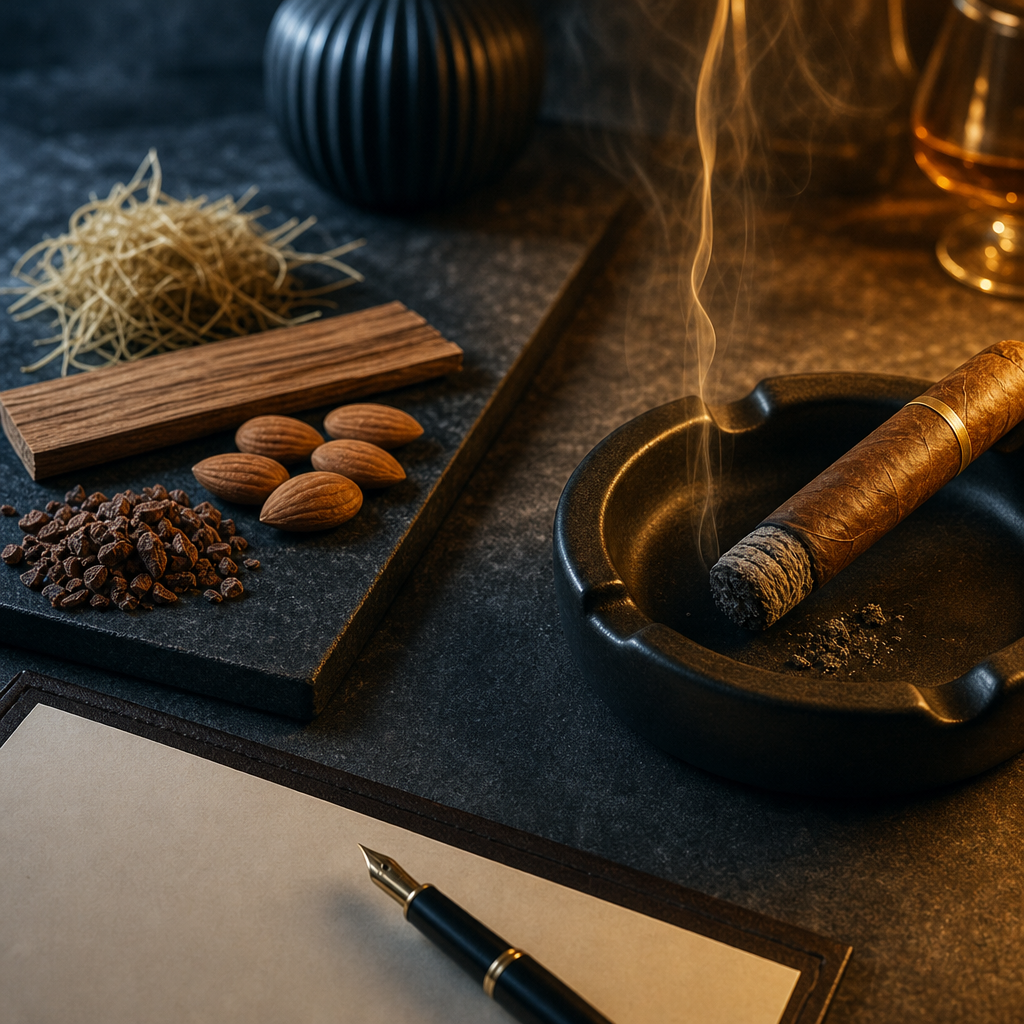
The first step in advanced evaluation is not to call all sensations "taste." The flavor of a cigar can be broken down into at least three axes: aroma is the wood, nut, cocoa, and floral scents received by the nasal cavity; taste is the sweetness, bitterness, saltiness, oiliness, and stimulation felt by the tongue and mouth; structure is the strength, richness, balance, and aftertaste. Take Cohiba Siglo VI as an example, which has been regarded as one of the representatives of medium to large ring gauge Cuban cigars since its launch in 2002. Its aroma often includes grass, cream, honey, and wood, but structural evaluation should not only look at the beautiful aroma but also observe whether there is support in the middle section.
The goal of advanced evaluation is not to find out "good or bad," but to deconstruct how a cigar changes over time, temperature, and rhythm. I would suggest that experienced individuals break down 100 points into several fixed items instead of scoring based on the final impression. Below is a practical framework that can be used to compare classics like Partagás Serie D No.4, Montecristo No.2, and H. Upmann Magnum 46.
| Evaluation Item | Suggested Weight | Key Observations |
|---|---|---|
| Aroma Layers | 25% | Changes in cold aroma, after lighting, and retrohaling |
| Taste Texture | 25% | Coordination of sweet, bitter, salty, oily, and astringent sensations |
| Structural Balance | 20% | Matching of strength and richness |
| Burn Performance | 15% | Burn line, ash column, temperature, draw resistance |
| Aftertaste and Evolution | 15% | Three-stage changes and cleanliness of the finish |
Cold Aroma and the Beginning: First Impressions Should Not Be Concluded Too Quickly
Cold aroma is an aspect that many experienced individuals easily overlook or overinterpret. Before lighting, the wrapper may present barn, cedar, cocoa powder, hay, and leather, while the foot is closer to the blend of filler aromas. Take Hoyo de Monterrey Epicure No.2 as an example, which often has cream, hay, and a faint sweetness in its fresh state; if well-preserved for 3 to 5 years, it may turn to honey, almond, and softer wood. These signals are not predictions but establish a baseline for subsequent evaluation.
In the first 5 minutes after lighting, I usually do not rush to conclusions because the beginning is greatly affected by the fire source, cut, humidity, and personal rhythm. When in good condition, Romeo y Julieta Short Churchills often have redwood, mild spices, and toasted bread in the early stages; but if the humidity is high, the entry may seem stuffy, and bitterness may emerge prematurely. Cold aroma provides direction, the beginning provides state, but a meaningful evaluation must wait until the burn stabilizes.
Practically, I record three time points: 3 minutes after lighting, 10 minutes, and before the end of the first section. If the draw is still too tight and the smoke is thin with a stuffy aroma after 10 minutes, the problem may be with the rolling or preservation; if there is a slight ammonia sensation in the first 3 minutes that dissipates after 10 minutes, it may just be that the age is still young or the initial burn was unstable. This ability to distinguish is the key to advanced expertise.
Aroma Layers: From Single Descriptions to Family Classifications
Most people initially describe "woody," "coffee," or "sweet," but experienced individuals should be more detailed. Wood can be divided into cedar, sandalwood, oak, and damp wooden boxes; coffee can be divided into lightly roasted beans, espresso, caramelized coffee grounds; sweetness can also be divided into honey, brown sugar, malt, and raisins. For Montecristo No.2, when in good condition, it often has cocoa, coffee, earth, and dried fruit; but different years and box conditions vary significantly, with some batches around 2016 being heavier, and after 2020, if preserved cleaner, the aroma lines will be brighter.
The more precise the aroma description, the better you can judge whether you like the brand personality, size ratio, or specific year condition. For example, Partagás is often described as earthy, peppery, leathery, and dark sweet, but the short and thick rhythm of Serie D No.4 is completely different from the long-time unfolding of Lusitanias. The former may advance quickly within 40 to 55 minutes, while the latter often requires more than 90 minutes, with a significant difference in aroma unfolding.
I suggest establishing "aroma family" notes instead of scattered adjectives. They can be divided into wood, nut, dairy, floral, fruit, spice, mineral, fermentation, baking, and soil categories. Each time, choose only 3 main aromas and 2 secondary aromas to avoid stuffing all vocabulary into the same cigar. A truly mature evaluation is not about having more words but about capturing the main axis and transitions.
Taste Texture: The Proportion of Sweet, Bitter, Salty, Sour, and Oily
Aroma is often written romantically, but taste can reveal the true state of a cigar. The sweetness felt by the tongue is not necessarily candy sweet; it may be malt, cream, or woody sweet; bitterness is not necessarily a flaw, as high cocoa, coffee, and roasted nuts all carry necessary bitter notes. The key is proportion. The Davidoff Grand Cru series often has delicate cream, herbal, and nutty sensations, with low strength, but if preserved too dry, the oily sensation decreases, and the bitterness in the tail section becomes sharp.
The sense of luxury in taste usually comes from the balance between oiliness, sweetness, and bitterness, rather than simply pursuing intensity. The Nicaragua region, like Padrón 1964 Anniversary, often has cocoa, espresso, black pepper, and substantial sweetness; the Dominican style, like Arturo Fuente Hemingway, often achieves a softer curve between wood, spice, and dried fruit. There is no superiority between the two, only different structural purposes.
When evaluating taste, I pay attention to four indicators. The first is the weight of the entry, whether it is light, full, or heavy; the second is the residue on the tongue, whether it is creamy coverage or dry astringency; the third is the texture of the smoke, whether it is dense, loose, or has a noticeable graininess; the fourth is whether the aftertaste is clean. If a cigar is sweet in the early stages but starts to taste bitter at the root of the tongue and dry in the mouth in the middle section, it usually indicates a problem with burn temperature, humidity, or rhythm, rather than just flavor personality.
The Relationship Between Aroma and Taste: Retrohaling is the Advanced Watershed
Experienced individuals who want to improve evaluation accuracy must understand the importance of retrohaling. When cigar smoke stays in the mouth, the tongue can only recognize limited basic tastes; a large amount of complex aroma actually comes from retronasal olfaction. This is why the same Bolivar Belicosos Finos may be perceived as intensely spicy by some, while others can distinguish leather, cocoa, black earth, roasted nuts, and mineral sensations. The difference lies not only in experience but also in whether one knows how to let the aroma return to the nasal cavity for recognition.
The operation does not require force; the key is small, slow, and intermittent. Let the smoke stay in the mouth for 2 to 3 seconds, exhale most of it, and let a tiny amount of breath bring it out through the nasal cavity. If the nasal cavity stings or the eye sockets heat up, it means the amount is too large or the cigar is too young and strong. Retrohaling is not a performance skill but a tool to confirm whether aroma and taste are consistent.
For example, if Trinidad Fundadores is in good condition, the mouth may experience cream, wood, and faint sweetness; retrohaling may add floral, tea, and delicate spice. If the taste says "soft," but the nasal cavity is full of sharp ammonia, it means the condition may not be mature. Conversely, if the mouth feels bland but the nasal cavity has clear layers, it may be that your smoking rhythm is too slow or the drink pairing suppresses the tongue's perception.
Three-Stage Evolution: How to Establish Evaluation for the Front, Middle, and Back Sections
I am accustomed to dividing a cigar into three sections, but not mechanically into three equal parts by length, but by flavor transitions. The front section is self-introduction, the middle section is the core character, and the back section tests balance and heat resistance. For a Robusto size with about a 50 ring gauge and 124 mm, the full time often falls between 45 to 70 minutes; a Churchill size like Romeo y Julieta Churchill may require more than 90 minutes. Insufficient time can distort many back-section evaluations.
The middle section usually best represents the true level of a cigar, while the back section best reveals whether the rolling, preservation, and smoking rhythm are in place. For example, when Cohiba Robustos is in good condition, the front section may have grass, cream, and honey, the middle section may show coffee, cedar, and nuts, and the back section may turn to spices and deeper wood. If the back section only has burnt bitterness and spiciness, check first if you are smoking too fast, rather than immediately denying the whole cigar.
Practical recording can be done with brief notes every 15 minutes. Do not analyze every puff, as it will disrupt the rhythm and easily lead to overinterpretation. You can note "main aroma," "taste," "strength," "burn," and "aftertaste," each with 1 to 2 sentences. Looking back after six months, you will find that you are particularly sensitive to certain sizes, such as preferring a 46 to 52 ring gauge or appreciating the aroma concentration of Lancero-type slender sizes.
Preservation, Humidity, and Aging: Flavor Interpretation Cannot Be Separated from Condition
Many flavor disputes are not brand differences but condition differences. Relative humidity of 65% and 72% can present different aspects of the same cigar. Around 65% usually burns more cleanly, with clearer aromas, but if too dry, it will lose oiliness; around 70%, the taste is rounder, but in high ambient temperatures, it tends to smolder. For Cuban cigars, I personally often keep long-term preservation at 65% to 68% relative humidity, about 18 to 20°C, and adjust slightly according to the season.
Aging is not magic but the combined effect of time, environment, and raw materials. Some H. Upmann Sir Winston from 2008, after good preservation, can exhibit honey, tea, cream, and delicate wood; but the same year, if subjected to temperature or humidity fluctuations, may become flat, sour, and moldy. The year itself is not a guarantee; box condition, source, preservation records, and post-opening management are the core basis for flavor interpretation.
If discussing collection and market prices, one must remain calm. Some discontinued or limited editions do attract attention due to rarity, such as some Edición Limitada from the 2010s in the secondary market, but collection appreciation does not guarantee value increase; it still depends on source preservation and market. From a flavor perspective, experienced individuals should ask: Is this cigar in its best drinking window? Are its oiliness, aroma, and structure still intact? This is more practical than just looking at the year.
Pairing and Environment: Beverages, Temperature, and Rhythm Can Rewrite Answers
For accurate cigar evaluation, the environment should be as controllable as possible. Strong winds can raise burn temperature, low temperatures can dull mouth perception, and strong perfumes or food odors can interfere with the nasal cavity. Beverages can also rewrite flavors: unsweetened coffee can amplify roasting and bitterness, rum may enhance molasses, vanilla, and dried fruit, while single malt whisky may bring out oak, smoke, and honey. But pairing is not about being stronger; otherwise, the beverage will overshadow the cigar itself.
I often use a two-round method for evaluation. The first round is paired only with room temperature water to establish the original profile of the cigar; the second round adds a beverage to observe interaction. Pairing Padrón 1926 No.9 with high cocoa chocolate or espresso can elevate thickness; but if paired with a refreshing highball with Hoyo Epicure No.2, it may better highlight cream and wood. A good pairing is not about making the cigar stronger but about revealing hidden layers.
In terms of rhythm, I suggest experienced individuals use "45 to 60 seconds per puff" as a starting point and adjust according to size. Lancero-type slender sizes, if smoked too quickly, heat up quickly; large ring gauges, if too slow, may extinguish or break the flavor. When you find the same cigar enchanting in the first half and rough in the second half, first recall rhythm, environment, and beverage before rushing to blame the brand.
Establishing Personal Evaluation Files: Turning Preferences into Traceable Data
The most valuable thing for experienced individuals is not how many brands they have smoked but whether they can turn experience into judgment. It is recommended to establish personal evaluation files, recording at least brand, size, box code or year, preservation humidity, beverage, time, three-stage flavor changes, and overall evaluation. Calculating 60 cigars a year, three years is 180 data points, enough to see your preferences: whether you like Partagás's thick earthiness or H. Upmann's elegant tea sensation; whether you prefer the concentration of Robusto or the unfolding of Double Corona.
The record does not have to be like a lab report but should have a fixed format. My simplified version is as follows:
- Basic Information: Brand, model, size, year, or box code
- Condition Information: Preservation humidity, opening time, burn performance
- Flavor Information: 3 keywords for the front, middle, and back sections
- Structural Information: Strength, richness, balance, aftertaste
- Conclusion Information: Whether it meets expectations, suitable scenarios
When your notes accumulate to a certain number, preferences are no longer just feelings but become a verifiable flavor map. For example, you may find that you do not dislike strong cigars but dislike uncontrolled bitterness in the back section; you may also find that you do not prefer all products of a brand but specific ring gauges and aging windows. This data-driven thinking makes each evaluation more directional and avoids being led by reputation.
Common Questions
Are "strength" and "richness" the same in cigars?
No, they are not. Strength often refers to nicotine sensation and body impact, while richness is the density of aroma and taste. Some Dominican cigars are rich but not heavy, while some Nicaraguan cigars have high strength but are not necessarily complex.
Why do cigars from the same box perform differently?
Handmade cigars naturally have individual differences; filler ratio, rolling tightness, and preservation position all affect the result. It is not uncommon for 2 to 3 out of 25 cigars in a box to perform slightly differently.
Is retrohaling necessary during evaluation?
Advanced evaluation can use a small amount of retrohaling but should not be forced. The key is low volume, slow speed, and intermittence; if it stings, it means it is beyond the suitable range.
Are older cigars always better?
Not necessarily. Aging has peaks and may also lose vitality past the best window. The year should be judged together with preservation, brand, size, and raw material strength.
Should every cigar be scored?
You can, but scores are just an aid. More important than 90 or 92 points is whether you can clearly articulate why it stands in aroma, taste, structure, and evolution.
The maturity of an experienced individual is not in using more adjectives but in being able to consistently, calmly, and repeatably judge the state and character of a cigar.
I have always believed that the most fascinating part of cigars is not the fame on the label but the conversation it has with you through aroma, temperature, time, and rhythm every time it is lit. What experienced individuals should truly pursue is not always finding more expensive, rarer styles but honing their senses more finely and seeing preferences more clearly. When you can discern the cause and effect of aroma and taste, you are closer to the core joy of the cigar world.
—Cigar Prince Wilson Tsai
Smoking is harmful to health. No smoking under twenty years old. Quitline: 0800-636363. This article is intended for adults over the age of twenty as a reference for cigar culture, preservation, and regulations, not as tobacco advertising, promotion, or purchase advice.