Storage and Environmental Control of Cigars: Scientific Methods and Best Practices
Storage and Environmental Control of Cigars: Scientific Methods and Best Practices
Cigars truly begin their journey once they leave the place of origin. Many beginners already know how to cut, light, and taste cigars, and understand that the same cigar can have different flavors in the beginning, middle, and end. However, if the storage environment is unstable, the flavor can be consumed by temperature and humidity before it even reaches the table.
As the editor of the "Cigar Bible," I often say: Cigars are not just put into a box and left alone; a repeatable, monitorable, and adjustable environmental management system must be established. In this article, I will discuss temperature, humidity, containers, instruments, and long-term aging using scientific methods and practical experience.
Temperature: More Impactful on Combustion and Pest Control Than You Think
The recommended storage temperature for cigars is often between 18 to 21 degrees Celsius. This is not just a ritual but a way to slow down the evaporation of tobacco oils and inhibit the risks of mold and tobacco beetles. The traditional "70/70" saying comes from 70 degrees Fahrenheit and 70% relative humidity, which converts to about 21.1 degrees Celsius. However, in humid and hot summer regions like Hong Kong and Taiwan, I prefer 18 to 20 degrees Celsius paired with 65% to 68% humidity.
Stability in temperature is more important than chasing a single perfect number. For example, in 2018, I compared the same batch of Partagás Serie D No.4, with one group placed in a living room cabinet with a 6-degree day-night temperature difference, and another in a constant temperature cabinet. After three months, the former had drier wrappers and skewed burn lines, while the latter had noticeably stable oil sheen and elasticity.
Tobacco beetle eggs hatch more easily in high-temperature environments, with many sources mentioning increased risks above 24 degrees. If you collect early 2000s boxed Cuban cigars, such as the 2003 Cohiba Siglo VI or 2005 H. Upmann Magnum 46, avoid prolonged high temperatures, as the older leaf fibers are more brittle, and repeated thermal expansion and contraction can cause the wrapper to crack.
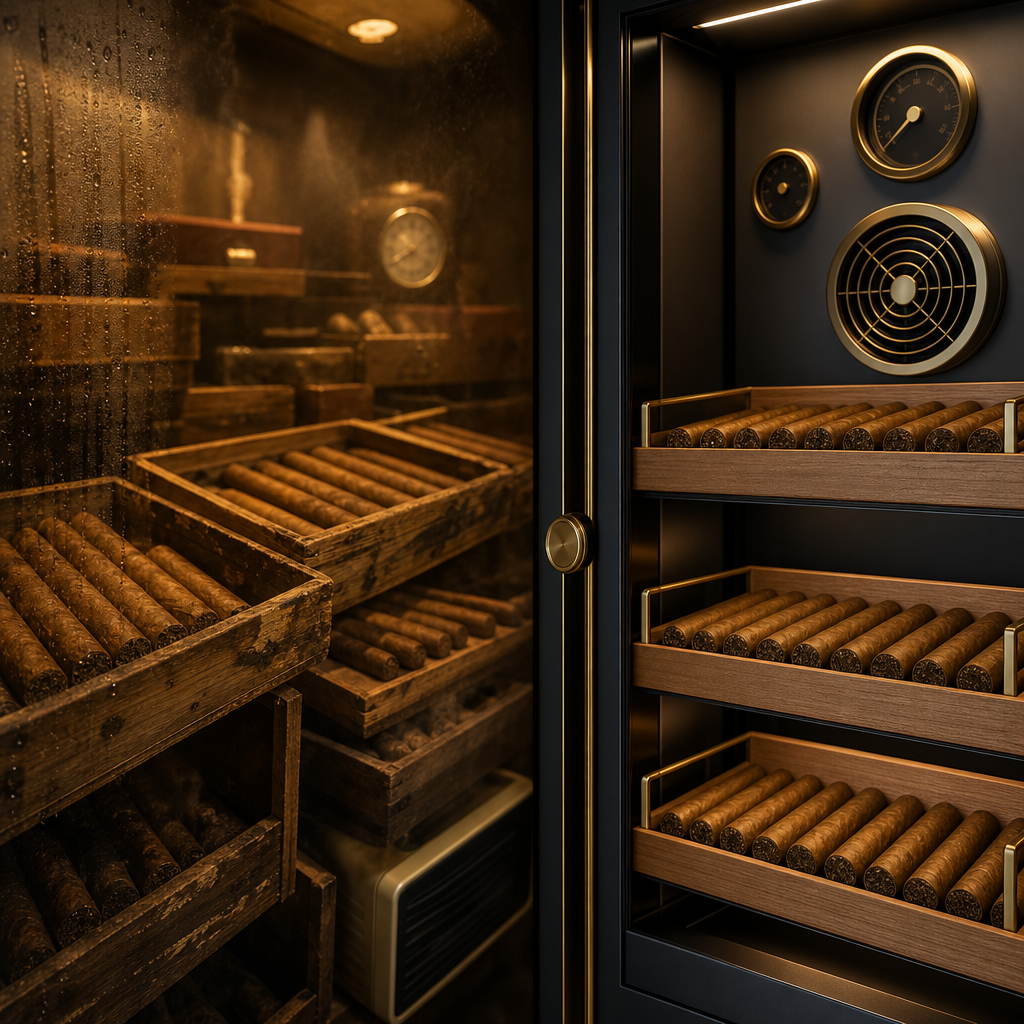
Practically, I recommend placing cigar cabinets in locations without direct sunlight and away from kitchens and bathrooms. If using a compressor-type cigar cabinet, ensure that humidity is not drastically lowered during cooling. If using a modified wine cabinet, pay attention to fan circulation and humidity compensation; otherwise, the temperature may look good, but the cigars could slowly dry out.
Humidity: How to Choose Between 65%, 69%, and 72%?
Relative humidity is not necessarily better when higher. Cigars consist of filler, binder, and wrapper, and their moisture absorption rates are not consistent. When the outer layer absorbs water too quickly while the inside remains dry, it can cause swelling, cracking, or smoldering when lit. Beginners often make the mistake of increasing humidity to 72% or higher when they see the cigar surface not oily enough, resulting in mold spots or tighter draws.
For general daily storage, I prefer 65% to 69%; thicker ring gauges and short-term turnover can be slightly higher, while long-term aging should be more conservative. For example, cigars with larger ring gauges like Montecristo No.2 and Romeo y Julieta Wide Churchills will have better elasticity at 69% if enjoyed within a month or two. If planning to store for over three years, 65% to 67% is often cleaner.
Different brands also have variations. Non-Cuban cigars like Padrón 1964 Anniversary and Arturo Fuente Don Carlos, often matured in more stable factory environments, burn cleanly at around 65%. Some newer Cuban cigars, such as those from 2021 to 2023, benefit from being stored around 68% for a few months to balance humidity.
Judging humidity cannot rely solely on hygrometers. In terms of feel, cigars should have a slight rebound and should not feel like a sponge or a pencil. If the foot has a pungent ammonia smell, it still needs time; if it smells like a damp cardboard box, it may be too wet. Adjustments should be made in 1% to 2% increments, observing for two weeks, which is much more reliable than making large changes in a single day.
Choosing Storage Containers: Wooden Boxes, Plastic Containers, and Electronic Cabinets Each Have Their Place
Spanish cedar humidors are the most classic containers, with the advantage of buffering humidity, adding a faint wood aroma, and absorbing some odors. The downside is that new boxes need to be seasoned, as the wood itself absorbs water. If not pre-treated for 7 to 14 days, placing cigars in them can easily lower humidity, especially in desktop humidors with a capacity of over 25 cigars.
| Container Type | Suitable Quantity | Advantages | Considerations |
|---|---|---|---|
| Spanish Cedar Box | 20–100 cigars | Good humidity buffering, high ritual sense | New boxes need seasoning, avoid over-watering |
| Sealed Plastic Container | 5–80 cigars | Low cost, stable seal | Need to place cedar sheets to avoid plastic smell |
| Electronic Cigar Cabinet | Over 80 cigars | Good temperature management, large capacity | Need to calibrate humidity and fan circulation |
| Original Box Storage | Multiples of 25 cigars | Good for vintage management | Outer box also needs to be in a stable environment |
There is no absolute high or low in containers, only whether they fit your quantity, environment, and management habits. If you have around 10 cigars, a sealed plastic container with 65% or 69% two-way humidity packs often works better than a luxurious wooden box that hasn't been seasoned. If you collect over 150 cigars, the temperature control value of an electronic cabinet becomes apparent.
I once saw a friend place 2016 Bolivar Belicosos Finos in the corner of a large wooden box, with central humidity at 68% but only 61% in the corner, leading to significant differences in cigar condition two years later. This reminds us that the larger the capacity, the more layered monitoring is needed, and not to trust numbers from a single location. The more advanced the container, the more basic checks should not be omitted.
Humidity Systems and Instruments: Calibrate First, Then Trust
Common humidity sources include distilled water sponges, propylene glycol solutions, polymer crystals, electronic humidifiers, and two-way humidity packs like Boveda and Integra Boost. For beginners, I usually recommend starting with two-way humidity packs because they can absorb and release moisture, making management simple, especially for collections of 10 to 80 cigars.
If a hygrometer is not calibrated, the numbers are just a comfort. Common digital hygrometers on the market often have errors of ±3% to ±5%. If it shows 69%, the actual may be 64% or 74%. You can use a salt test: place salt with a small amount of water to form a wet sand-like consistency in a bottle cap, place it with the hygrometer in a sealed bag for 8 to 12 hours, and the theoretical value is about 75%, then record the deviation.
When establishing an instrument system, I suggest:
- At least one hygrometer per container, with one on each level if over 80 cigars.
- Calibrate or cross-check every three months.
- Replace or supplement humidity packs with the same specification when they become more than half hard.
- Use distilled water as the main source for electronic humidifiers to avoid mineral residue.
In 2019, I tested three small hygrometers, placing them in a sealed box with a 69% humidity pack for 48 hours. The readings were 66%, 70%, and 72%. This is not to make you anxious but to understand that "trends" are more important than single points: if the same gauge slowly drops from 68% to 62%, it means the system is losing moisture and needs to be addressed.
Pre-Box Placement: Don't Rush to Mix New Cigars
Newly acquired cigars need rest and observation. Whether Cuban, Nicaraguan, Dominican, or Honduran cigars, after transportation, storage, and temperature changes, internal and external humidity may not be consistent. Especially during cross-country transport in winter or high-temperature delivery in summer, cigars may look normal on the outside but may be too dry or too wet inside.
It's recommended to isolate new cigars for 7 to 14 days before merging them with the main collection. During this time, you can use a small sealed box, cedar sheets, and the same specification humidity pack to observe if the wrapper shows abnormal white spots, green spots, cracks, or excessive swelling. If it's a whole box of 25 cigars like the 2022 Hoyo de Monterrey Epicure No.2, I would place the original wooden box in the isolation area.
Mixing also needs to consider aroma. Stronger flavored cigars like Liga Privada No.9 and My Father Le Bijou 1922, if placed long-term with more delicate cigars like Trinidad Reyes and Por Larrañaga Petit Coronas, may cause aroma interference. It's not that they can't be in the same cabinet, but it's best to separate them with original boxes, cedar dividers, or sealed bags.
If you receive cigars that seem dry, don't rescue them with high humidity. Start with 62% for a week, then switch to 65%, and finally to 69%, allowing the leaves to gradually regain elasticity. Conversely, if they are too wet, place them in a 65% environment without using air conditioning or sun exposure; rapid dehydration can cause the wrapper to shrink and crack when lit later.
Long-term Aging: Vintage, Records, and Flavor Curve
Long-term aging is not a myth, nor does every cigar improve with age. Factors affecting the outcome include raw material maturity, fermentation degree, rolling quality, storage stability, and personal taste. Some large ring gauge Cuban cigars from before 2008, if properly stored, often develop layers of wood, honey, dried fruit, and leather; but if they were inconsistently dry and wet in the first five years, it would be hard to compensate later.
The core of aging is a low-fluctuation environment and complete records, not just leaving cigars forgotten in the cabinet. I recommend labeling each box with the brand, size, box code, acquisition date, initial condition, and biannual observations. If collecting rare or vintage cigars, there may be market discussion value, but collection appreciation does not guarantee value increase, still depending on source preservation and market.
The flavor curve can be viewed in three stages: new cigars in the first 6 to 18 months often have grassy, ammonia, or spicy edges; from 2 to 5 years, aromas gradually integrate, and combustion becomes rounder; over 5 years, they may enter a softer, sweeter, and more woody stage. Of course, short filler or mild-sized cigars may not be suitable for long storage.
Practically, I would sample one cigar from the same box every 6 to 12 months, recording burn, draw, aroma, and aftertaste. If a 2017 Ramón Allones Specially Selected performs best in the 4th year, there's no need to insist on keeping it until the 10th year. A mature collection view knows when to appreciate rather than just chasing vintage numbers.
Mold, Bloom, and Abnormalities: How to Judge and Handle
White crystalline surfaces on cigars are often referred to as plume or bloom, but practically, true oil crystallization is not common, and most white fuzz is more likely mold. The judgment can be based on form: if it's powdery, shiny, adheres to the leaf surface, and doesn't penetrate the foot, the risk is lower; if it's fuzzy, three-dimensional, spreads to the foot, or has blue-green color, it needs serious handling.
Suspect situations should be isolated, don't use your nose or optimistic mindset to back it up. When abnormalities are found, separate the affected cigar from others in the same compartment, check if the container's humidity has been consistently above 72%, and inspect corners, cedar sheets, and humidifiers for mold spots. If mold has penetrated deep into the foot, it is advisable not to keep it to avoid contaminating other collections.
If white spots are only light on the wrapper surface, you can gently brush them with a clean soft brush and lower the environment to 65% to 67% for two weeks. But if you smell mold, basement odor, or rotten smell, don't force it. Cigar aromas should be woody, spicy, coffee, cocoa, or hay, not damp walls.
Pest damage will leave round small holes and fine powder. If tobacco beetle traces are found, immediately isolate the entire box and check cigars in the same cabinet. Some collectors use freezing treatment, but it must be sealed, with phased cooling and warming to avoid condensation damaging the wrapper. Long-term temperature control below 21 degrees is more practical than post-event remedies.
Common Questions
Can cigars be stored in the refrigerator?
Not recommended. Household refrigerators have low humidity and complex odors, and compressor start-stop can cause temperature fluctuations. Cigars easily absorb onion, dairy, or cooked food smells, and condensation may occur when removed from low temperatures. If it's just a short-term emergency, it's better to use a sealed box, cedar sheets, and two-way humidity packs, and place them in a cool place.
Which is more suitable for beginners, 65% or 69%?
If you live in a humid area and prefer clean combustion, 65% is very safe; if the environment is drier or the cigar ring gauge is larger, 69% will have better elasticity. Choosing a stable number for a month is more effective than changing settings daily. Observe burn lines, draw, and wrapper elasticity, then adjust by 1% to 2%.
Can dry cigars be restored?
It can be attempted, but slowly. First, place them in a 62% environment for 7 to 10 days, then raise to 65%, and finally to 69% based on the condition. If the wrapper has large cracks or the foot is fragmented, the taste is usually hard to fully recover. Successful rehydration is marked by elasticity when pressed, no overheating during combustion, and no sharp aromas.
Should the original box be unsealed?
If you plan long-term aging, original box storage helps with aroma consistency and vintage management; but still, check the internal humidity and for abnormalities regularly. Aluminum tube cigars like H. Upmann Coronas Major can have the tube cap slightly opened for humidity exchange. If completely sealed for years, the condition may differ from the cabinet reading.
How many humidity packs should be used?
It depends on the brand specifications, with common recommendations being one 60g humidity pack per 25 cigars. Poorly sealed wooden boxes may require an additional pack. The key is not more is better, but whether it can stably meet the standard. If humidity packs harden quickly, it indicates container leakage or the wooden box is still absorbing water, which needs to be addressed first.
Does the cigar cabinet need frequent ventilation?
Frequent opening is not necessary. Daily opening and closing cause fluctuations. If it's a sealed plastic container, it can be briefly opened every two weeks for inspection; electronic cabinets depend on fan circulation design. Stability, cleanliness, and low interference are the three most reliable principles for cigar storage.
Cigar storage is a slow craft: it's not about believing in a magical number but understanding the relationship between leaves, air, wood, and time. My standard is simple: let every cigar maintain its elasticity, aroma, and dignity before being lit. When you start recording temperature, humidity, vintage, and flavor changes, you'll find that collecting is not just "placing," but cooperating with time.
—Cigar Prince Wilson Tsai
Smoking is harmful to health. Smoking is prohibited for those under 20 years old. Quitline: 0800-636363. This article is intended for adults over 20 years old as a reference for cigar culture, preservation, and regulatory knowledge, not as a tobacco advertisement, promotion, or purchase suggestion.