Cigar Packaging and Design: Brand Image and Consumer Psychology Analysis
Cigar Packaging and Design: Brand Image and Consumer Psychology Analysis
Many beginners already know how to cut, light, and savor a cigar slowly. The next question often asked is: why do some cigars feel solid just by looking at the box, while others look like works of art? As the editor of the "Cigar Bible," when I look at packaging, I never just look at its beauty, but how it conveys the region, grade, history, and trust.
Cigar packaging is a discipline that combines printing, woodworking, color psychology, and brand storytelling. From a single cigar band to a box of 25, the design influences our judgment: is it worth collecting, suitable for gifting, and does it match one's taste?
From Wooden Boxes to Cigar Bands: The Historical Language of Cigar Packaging
In the mid-19th century, Havana cigars began to be exported in large quantities to Europe and North America. Wooden boxes were not just transport containers but also became brand identifiers. Partagás was founded in 1845, and Romeo y Julieta in 1875. These old brands often feature intricate lithographs on the inside of the box lid, depicting factories, emblems, goddesses, or medals, not just for decoration but to inform buyers "I have history."
By the 20th century, brand names, factory codes, and size concepts gradually became standardized. Montecristo, appearing in 1935, created a strong memory point with its crossed swords and fleur-de-lis; Cohiba, born in 1966, became a very distinct visual symbol with its black and yellow checkerboard pattern. These designs allow consumers to form quality expectations without opening the box.
The primary function of cigar packaging is to condense brand history into a quickly recognizable visual language. Beginners who learn to look at the box surface, cigar band, and seal can understand the character a brand wants to convey: is it regal, workshop-like, modern luxury, or classical and stable.
Colors, Fonts, and Emblems: How Brand Image Enters the Mind
Color is the fastest element to enter the consumer's mind. Cohiba's black, white, and yellow easily evoke order and high recognition; Montecristo's yellow-brown background has a classical paper feel; Partagás often uses a red, gold, and black combination, conveying power and tradition. These colors are not chosen randomly but are brand assets accumulated over many years.
Fonts are equally important. Davidoff's white background with gold lettering and simple layout convey Swiss precision and restraint; Padrón 1964 Anniversary series uses a dark box, gold lines, and year markings to emphasize family commemoration and mature style. Emblems, medals, crowns, and shields subconsciously connect to authority, heritage, and rarity.
Good cigar packaging doesn't shout loudly but builds trust with colors and fonts. Beginners can practice observing three things: whether the main color is stable, whether the font matches the brand positioning, and whether the emblem has historical context, rather than just looking at how much gold there is or how shiny the box is.
Printing Technology and Anti-counterfeiting: Details Determine Credibility
Common printing techniques in cigar packaging include lithography, hot stamping, embossing, microprinting, and laser anti-counterfeiting labels. Taking Cuban cigars as an example, the complexity of anti-counterfeiting on box surfaces, seals, and guarantee stamps has been increasing in recent years to reduce the circulation of counterfeit products. Around 2009, some guarantee stamps began to incorporate barcode and serial number inquiry concepts, making box information easier to track.
The cigar band itself is also worth a close look. Since the official launch of Cohiba Behike in 2010, the layering, hot stamping precision, and three-dimensionality of the cigar band have become market discussion points; if you encounter blurred edges, uneven gold lines, strange letter spacing, or soft paper, you need to be vigilant. Non-Cuban brands like Arturo Fuente OpusX also establish high recognition with luxurious hot stamping and intricate labels.
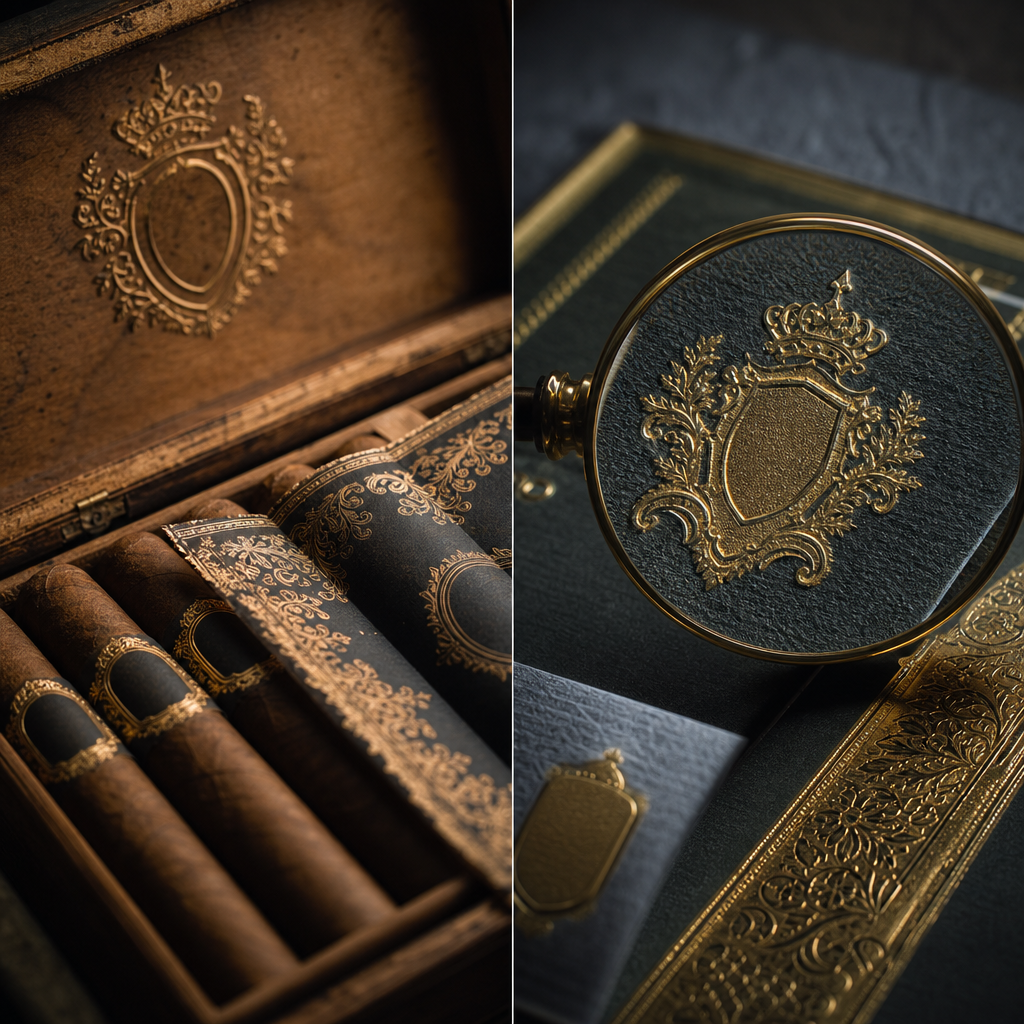
More complex printing doesn't necessarily mean better cigars; but rough printing is often a signal that the source needs to be rechecked. Beginners can use a magnifying glass to look at three places: whether the fine print is clear, whether the hot stamping overflows, and whether the pattern edges are clean. These are not for show but are basic skills for judging packaging credibility.
Wood, Paper, and Protection: Packaging Is Not Just for Looks
Cigar boxes often use Spanish cedar because it has fragrance, insect resistance, and relatively stable humidity regulation. Traditional boxes of 25 provide basic protection and prevent excessive collision during transport and storage. Some packaging of 10, 3 aluminum tubes, or paper boxes focuses more on portability and short-term protection.
Material choice affects consumer psychology. A solid wooden box gives a "worth long-term storage" feeling; aluminum tubes seem suitable for travel; lacquered boxes and limited-edition numbered boxes are easily seen as collectible items. However, I often remind friends: collectible value does not guarantee appreciation; it still depends on source preservation and market. No matter how beautiful the packaging, if the humidity control is long-term out of control, the value will be greatly reduced.
The protective nature of packaging must be viewed alongside storage conditions, not just whether the outer box is luxurious. I recommend beginners remember two numbers: relative humidity of about 65% to 70% and temperature of about 18°C to 21°C. This is the more stable storage range for most cigars; the box is just the first layer of protection, while constant temperature and humidity are the keys to long-term quality.
Consumer Psychology: Why Limited Edition and Commemorative Boxes Are Particularly Attractive
People are very sensitive to "scarcity." When the box surface shows year, number, or commemorative words, consumers easily feel it has a story. For example, Montecristo 80 Aniversario attracted high attention around 2015, partly because it integrated brand year, size setting, and commemorative packaging. This design makes people feel they are buying not just cigars but a brand event.
Another psychology is "gift-giving security." A well-crafted, neatly printed, and neatly arranged cigar box is more likely to be seen as a formal gift than loose cigars. Brands like Davidoff, Cohiba, and Romeo y Julieta understand how to use box proportions, colors, and label positions to make the recipient feel a sense of ceremony before opening.
Packaging amplifies expectations but should not replace judgment on source, preservation, and flavor structure. When facing commemorative boxes, beginners can first ask themselves: what is the significance of the year? Does the size match their rhythm? Does the brand have a stable reputation? If the answers are clear, packaging is a bonus, not the only reason.
Classic Brand Packaging Case Comparison
The following uses several common brands for observation, helping you break down "good looks" into analyzable design elements. This is not a ranking but an understanding of how different brands use packaging to shape character. The most common mistake beginners make is equating gold, red, and thick boxes with high-end; a truly mature judgment should look at whether the design is consistent with brand history.
| Brand/Series | Representative Year | Packaging Features | Psychological Signals |
|---|---|---|---|
| Cohiba | 1966 | Black and yellow checkerboard, clear fonts, strong recognition | Modern, authoritative, rare |
| Montecristo | 1935 | Six-sword logo, classical yellow-brown | Literary, traditional, stable |
| Partagás | 1845 | Red, gold, black, emblem and workshop vibe | Intense, historical, powerful |
| Davidoff | 1968 brand restructuring context | White and gold color scheme, lots of whitespace | Precision, elegance, restraint |
| Padrón 1964 | Launched in 1994 as a commemorative series | Dark box, gold lines, serial number concept | Family heritage, maturity, credibility |
Mature packaging design allows a brand to be recognized in three seconds and tell its story in three minutes. If you want to train your eye, you can compare different brands at the same price: which one relies on historical feel? Which one relies on modernity? Which one uses material thickness to build a sense of security? This has more learning value than just looking at the price.
Seven Checkpoints for Beginners to Look at Packaging
Looking at packaging can follow a simple process; you don't need to understand all the years and versions at first. The first step is to check whether the external box information is consistent, including brand name, series name, number of sticks, size, and seal position. The second step is to check the printing quality, especially fine print, gold lines, and pattern edges. The third step is to check the internal arrangement, whether the cigars are too loose or squeezed.
Next is to smell the box's internal aroma; normal cedar wood scent should be clean. If there is a moldy smell, chemical glue smell, or overly pungent odor, be cautious. Fifth is to check the condition of the cigar wrapper, the oil content, color uniformity, and cracks reflect preservation. Sixth is to verify source documents or channel information. Seventh is to put the packaging and actual flavor records together to build your database.
- Look: fonts, hot stamping, seals, box prints
- Smell: cedar wood aroma, humidity, foreign odors
- Touch: box corners, paper thickness, cigar wrapper elasticity
- Record: year, size, batch, preservation status
Packaging inspection is not about nitpicking but training yourself to turn feelings into evidence. When you can turn "this box looks good" into "clear printing, clean wooden box, consistent information, stable preservation," your cigar eyesight has truly improved.
Etiquette and Collection Display: How Packaging Affects Social Perception
Cigars often carry a sense of ceremony in social occasions, and packaging affects the first impression. When gifting, a complete box is usually more formal than loose packaging; if sharing a personal collection, retaining the original box, inner lining paper, and labels allows the other party to understand the brand background. This is not about showing off but letting the origin of the cigar be traceable, making the exchange more substantial.
When displaying, avoid excessive exposure. Many people like to put beautiful boxes in the study or wine cabinet, but if light, temperature, and humidity are unstable, it harms the cigars. If it's just an empty box display, that's fine; if there are still cigars inside, focus on humidors or stable storage environments. Packaging can create an atmosphere but should not sacrifice condition.
A truly tasteful display lets packaging serve the story, not let the story be overshadowed by packaging. I suggest beginners keep important box labels, purchase dates, and tasting notes, especially for commemorative or special sizes. Looking back years later, these materials will explain your cigar journey better than a single photo.
Frequently Asked Questions
Does a more luxurious cigar box mean higher quality?
Not necessarily. Luxurious packaging may represent brand positioning, commemorative versions, or cost investment, but quality still depends on source, preservation, rolling, and flavor balance. Packaging is a clue, not a conclusion.
Is it necessary to keep the cigar band?
Yes. The cigar band helps record the brand, series, and size, and is convenient for reviewing tasting notes later. If it's a special year or commemorative series, the cigar band can better preserve the version information of that time.
Is paper box packaging inferior to wooden box packaging?
It can't be simplified like that. Paper boxes, aluminum tubes, and wooden boxes each have their uses; paper boxes may be suitable for short-term circulation, while wooden boxes offer more protection and display feel. The key is whether the storage environment is stable.
How to preliminarily judge whether the packaging is suspicious?
Check if the font is blurry, if the hot stamping overflows, if the seal is crooked, if the box print is inconsistent, and then verify the source. A single flaw may not represent a problem, but multiple anomalies appearing simultaneously require caution.
Are limited editions suitable for beginners to collect?
They can be studied, but don't act impulsively just because of the word "limited." Look at the brand background, the significance of the year, preservation status, and personal preference; collectible value does not guarantee appreciation, still depends on source preservation and market.
Will opening the packaging affect its value?
Completeness usually affects the perception of collection, especially seals, inner lining paper, original boxes, and labels. However, if the goal is actual tasting, preservation status and flavor experience are also important, with different orientations.
For me, the most fascinating aspect of cigar packaging is not how expensive it makes the cigar look, but how it condenses a brand's character over decades or even a century into a few square centimeters. If beginners are willing to slowly look at boxes, bands, and materials, they will find that choosing cigars is not just about scores or fame but about reading a story of craftsmanship, time, and taste. May you gain more understanding and composure every time you open a box lid.
—Cigar Prince Wilson Tsai
Smoking is harmful to health. Under 20 years old is not allowed to smoke. Quit smoking hotline: 0800-636363. This article is for reference by adults over 20 years old on cigar culture, preservation, and regulations, not a tobacco advertisement, promotion, or purchase suggestion.