In-depth Analysis of Cigar Flavor Structure: A Panoramic Understanding from Aroma to Taste
In-depth Analysis of Cigar Flavor Structure: A Panoramic Understanding from Aroma to Taste
The flavor of a cigar is not just about whether it is "fragrant" or "strong." Once beginners understand the basics of tasting, the next step is to deconstruct: where does the aroma come from, how does the taste settle on the tongue, how does the mouthfeel change the rhythm, and finally, connect them into a complete flavor line.
As an editor of the "Cigar Bible," I often interpret cigars as a slow structural reading. From the cold aroma of the first puff, the initial phase after lighting, to the transition in the middle phase and the strength in the final phase, every detail can help you judge the relationship between the leaves, craftsmanship, storage, and personal taste.
Aroma, Taste, Mouthfeel: Distinguish the Three
Many beginners mix "aroma, taste, and mouthfeel" when describing cigars, for example, saying "this one is very woody, so the mouthfeel is thick." In fact, the woodiness is mostly an olfactory sensation, while thickness is the tactile sensation of smoke in the mouth. Take Montecristo No.2 as an example, the common cocoa, coffee, and dry wood notes are a mix of aroma and taste; but its oily feel, smoke density, and tongue weight belong to the mouthfeel.
Aroma determines the first impression, mouthfeel decides whether you can read a cigar completely. The human nose can distinguish far more scents than the tongue, which mainly senses sweet, sour, bitter, salty, umami, and irritation; hence, what you perceive as "hazelnut, leather, cedar" is mostly a judgment brought by retronasal olfaction. Relying solely on the tip of the tongue can easily misjudge complex aromas as simple bitterness or spiciness.
I suggest dividing the record into three columns: write "cedar, cream, pepper, cocoa" for aroma; "sweetness, bitterness, sourness, saltiness" for taste; "dry, smooth, oily, thick, coarse" for mouthfeel. For example, Hoyo de Monterrey Epicure No.2 is often softer in the initial phase, with cream and nutty notes; if the storage humidity is too high, the aroma will be stuffy, the mouthfeel sticky, and the sweetness hard to emerge.
Flavor Pyramid: Reading from the First to the Third Layer
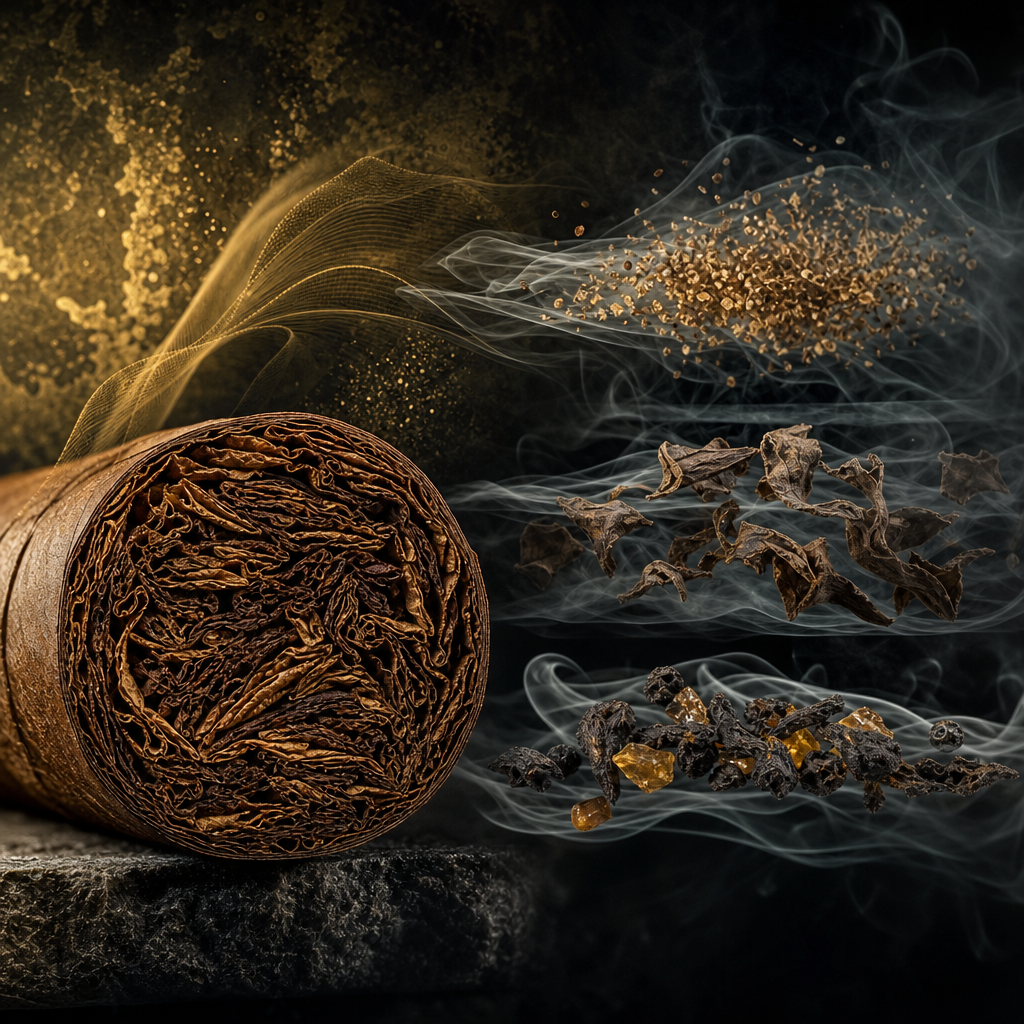
I habitually use the "flavor pyramid" to help beginners establish a framework. The bottom layer is combustion and smoke quality, such as ventilation, burn line, and smoke volume; the middle layer is taste and touch, such as sweetness, spiciness, thickness; the top layer is specific associations, like almond, dark chocolate, leather, hay. If the bottom layer is unstable, even the most beautiful aroma at the top will be distorted.
Stable combustion is the foundation of flavor analysis, not just a technical detail. For example, if the burn line of Partagás Serie D No.4 is too hot, the original soil, pepper, and coffee notes will be overshadowed by charred bitterness; if puffed too quickly, more than 2 to 3 puffs per minute, the smoke temperature rises, making the final phase sharp. Conversely, when the rhythm is stable, the strength is apparent but can retain sweetness and spice.
| Layer | Observation Focus | Common Descriptions | Example |
|---|---|---|---|
| Bottom | Combustion, smoke volume, ventilation | Smooth, stuffy, hot, cold, stable | A skewed burn line can bring bitterness early |
| Middle | Taste, touch, strength | Sweet, bitter, spicy, thick, smooth | Padrón 1964 often has cocoa thickness |
| Top | Aroma associations | Cedar, cream, nut, leather | Davidoff often has hay and creaminess |
In practical practice, there is no need to rush to name twenty aromas. First, determine three things: is the cigar burning stably? Which is most prominent: sweetness, bitterness, or spiciness? Does the mouth leave a dry, oily, or refreshing sensation? Once these three answers are clear, then look for specific aroma names, which will be more accurate than memorizing flavor words from the start.
Roles of Different Leaves: Wrapper, Binder, and Filler
Cigars are usually composed of a wrapper, binder, and filler. The wrapper is the outermost layer, directly affecting visual, tactile, and combustion, often providing a distinct aroma; the binder is responsible for wrapping and structure, affecting combustion stability; the filler determines the main character and strength. In classic Cuban cigars, the Vuelta Abajo region has long been regarded as a key source due to its soil, climate, and cultivation history shaping delicate aromas.
The wrapper is not the only source of flavor, but it is often the first layer perceived. For example, Ecuador Connecticut wrappers often carry cream, hay, and nutty notes; Mexican San Andrés wrappers may have cocoa, soil, and slight sweetness; Cameroon wrappers are often described as having spice, wood, and a faint sweetness. Different brands using the same type of wrapper can show significant differences due to fermentation, grading, and rolling.
The configuration of the filler is more like orchestral arrangement. Ligero leaves are usually higher up, with more sunlight, stronger strength, and spice; Seco leaves are responsible for aroma and delicacy; Volado leaves have good combustibility, often used to maintain stability. Since the 2000s, Nicaraguan regions like Estelí, Jalapa, and Condega have been widely discussed, as Estelí often shows strength, Jalapa is sweet and smooth, and Condega often has balanced herbal and woody notes.
Three-phase Change: How to Interpret the Initial, Middle, and Final Phases
A cigar from lighting to finish can often be divided into the initial, middle, and final phases. The initial phase is about the first 1/3, mainly observing the opening aroma and combustion state; the middle phase is where the flavor is most likely to unfold; the final phase tests whether the structure can withstand temperature and tar accumulation. Take Cohiba Siglo VI as an example, this size launched in 2002 is often discussed for its progression of cream, grass, honey, and woody notes.
True complexity is not about being glamorous at the start, but whether there are reasonable transitions between the three phases. Some cigars have charming aromas in the initial phase but become empty in the middle; others are quiet in the initial phase, with cocoa, nuts, and leather appearing in the middle. Beginners often make the mistake of only remembering the first impression, neglecting the balance of the middle and final phases, resulting in an inability to judge whether a cigar has a complete structure.
I use both time and proportion for recording. For example, a Robusto of about 50 ring gauge, 124 mm might take 45 to 70 minutes; if it enters the final phase in 20 minutes, the rhythm is usually too fast, and the smoke temperature will interfere with the flavor. The record can be written as: "Cedar and cream in the initial phase, cocoa increases in the middle, pepper and coffee bitterness rise in the final phase." This has more analytical value than just writing "good draw, strong."
Retronasal Olfaction and Exhalation: Truly Opening the Aroma
When smoke enters the mouth, aroma molecules can reach the olfactory area through the retronasal passage, which is why sometimes the mouth only feels slightly sweet, but the nose can sense floral, woody, or spicy notes. Beginners who only stay in the mouth and then exhale will miss many top-layer aromas. It is important to note that retronasal exhalation does not need to be large, small, slow, and spaced operations are sufficient, otherwise, it may feel irritating.
The details of cigars are mostly hidden in retronasal olfaction, not on the tongue. For example, the Davidoff Aniversario series is often described as having cream, hay, nuts, and soft woody notes; if retronasal olfaction is not used at all, it may only leave an impression of "mild, smooth." Conversely, when a small amount of smoke is brought out through the nose, the layers become clearer, especially in the middle phase where subtle changes are most easily captured.
Practice can be done in three steps:
- First puff only looks at combustion and smoke volume, without rushing to conclusions.
- Record the taste in the mouth from the second to fourth puff: are sweetness, bitterness, spiciness, and sourness obvious?
- From the fifth puff, start small retronasal exhalation, looking for woody, nutty, floral, or leathery notes.
If encountering cigars with stronger spiciness, such as Oliva Serie V or some Nicaraguan works with a higher Ligero proportion, retronasal exhalation should be slowed down. The goal is not to show off, but to obtain information.
Temperature, Humidity, and Rhythm: The Same Cigar Can Change
Many people think flavor is only determined by the brand, but storage and rhythm have a huge impact. Common long-term storage environment recommendations are around 65% to 70% relative humidity, 18 to 21°C; but different regional climates, airflow within the box, and cigar size will result in different outcomes. When humidity is high, combustion slows, and smoke may be stuffy; when low, combustion is too fast, and spiciness and dryness increase.
The same brand, same size, different storage conditions can make the flavor like two different cigars. I once compared two Robustos from the same box: one placed in a 69% humidity environment for several months, with a thicker mouthfeel but slightly stuffy in the initial phase; another stabilized at 65% to 66% for several weeks, with a cleaner burn line, and clearer cedar and nut notes. This does not mean a certain number is always correct, but understanding how humidity changes combustion.
Rhythm is equally important. If puffed continuously and quickly, the temperature at the smoke head rises, and charred bitterness, ammonia, and spiciness are easily amplified; if the interval is too long, the cigar may go out, and relighting will also bring a charred taste. In most cases, 45 to 75 seconds per puff can be used as a starting point, then adjusted according to size. Lancero, due to its small ring gauge, shows overheating more clearly; Gordo, with a large ring gauge, has thick smoke volume, but details may be masked by thickness.
Establishing a Personal Flavor Profile: Calibrating Taste with Brand Cases
If you want to improve your ability, don't rely solely on memory, establish your own flavor profile. Each record should at least include the date, brand, size, storage humidity, lighting time, three-phase flavor, paired drink, and final comments. For example, in my personal records for 2024, I would compare different sizes of the same brand, such as Montecristo No.4, No.2, and Edmundo, observing how cream, cocoa, wood, and strength change with size.
Flavor ability is not about memorizing adjectives, but establishing calibration points through repeated comparisons. You can choose three typical styles as a benchmark: the wood and cream of classic Cuban, the cocoa and spice commonly found in Nicaraguan, and the soft herbal and nutty notes often seen in Dominican. Like Arturo Fuente OpusX, which has become one of the representatives of high-end Dominican cigars since 1995, its balance of spiciness, wood, and sweetness is often used to discuss regional and craftsmanship breakthroughs.
When recording, avoid equating price or fame directly with flavor. Some limited editions indeed have collectible discussion value, but collection appreciation does not guarantee value increase; it still depends on source preservation and market. For beginners, it is more practical to establish "what I can consistently identify": can you distinguish cocoa from coffee? Is pepper a tongue prick or nasal spice? Does sweetness come from cream, honey, or aged wood? These answers will gradually form your taste map.
Common Questions
Why do I only feel bitterness and can't smell cedar or cocoa?
It is mostly due to too fast a rhythm, too high smoke temperature, or the cigar being too moist. First, slow down to about 60 seconds per puff and observe if the bitterness decreases; then start recording aromas from broad categories, such as wood, nut, coffee, without initially pursuing precision like "cedar wood box" or "70% dark chocolate."
Do beginners need to remember many flavor words?
No need. Mastering 12 common words is enough: cedar, hay, cream, nut, cocoa, coffee, honey, leather, pepper, earth, floral, caramel. Repeated calibration with a small number of words is more valuable than many adjectives that cannot be reproduced.
Why does the same cigar taste sweet to others but spicy to me?
It may be related to puffing rhythm, storage humidity, personal oral condition, or you may have mistaken nasal irritation for taste. It is recommended to record at least 2 to 3 of the same cigar on different dates and then look for commonalities. A single experience can be referenced but should not be taken as a conclusion.
Will drink pairing affect judgment?
Yes. Black coffee will amplify roasting and bitterness, rum may bring out caramel and vanilla, and plain water is the most neutral. If the goal is to learn the flavor structure, it is recommended to drink only water in the first 1/3; try coffee or spirits after the middle phase to better distinguish the differences brought by the cigar itself and the drink.
Does a larger ring gauge mean more complex flavors?
Not necessarily. A large ring gauge has thick smoke volume and a full mouthfeel, but details may be covered by thickness; a small ring gauge like Lancero, with a higher wrapper proportion, often has more direct aroma lines but is also more prone to overheating. When choosing a size, consider whether you want to study concentration, aroma, or three-phase changes.
Will cigars improve just by aging?
Not necessarily. Aging requires a stable source, proper storage, and time, and not all cigars are suitable for long-term storage. Young cigars may have lively spices, turning into soft wood and dried fruit after several years; but if stored poorly, the flavor will only decline and will not automatically improve with time.
When I look at cigar flavors, I emphasize "honest recording." Don't rush to chase fancy vocabulary, and don't be led by brand halos; break down aroma, taste, and mouthfeel, then verify with time, humidity, and rhythm. When you can clearly articulate why a cigar is good, where it is unbalanced, and which segment is the most exciting, that is the true beginning of understanding it. —Cigar Prince Wilson Tsai
Smoking is harmful to health. Under 20 years old is not allowed to smoke. Quitline: 0800-636363. This article is for reference by adults over 20 years old for cigar culture, storage, and regulatory knowledge, not a tobacco advertisement, promotion, or purchase suggestion.