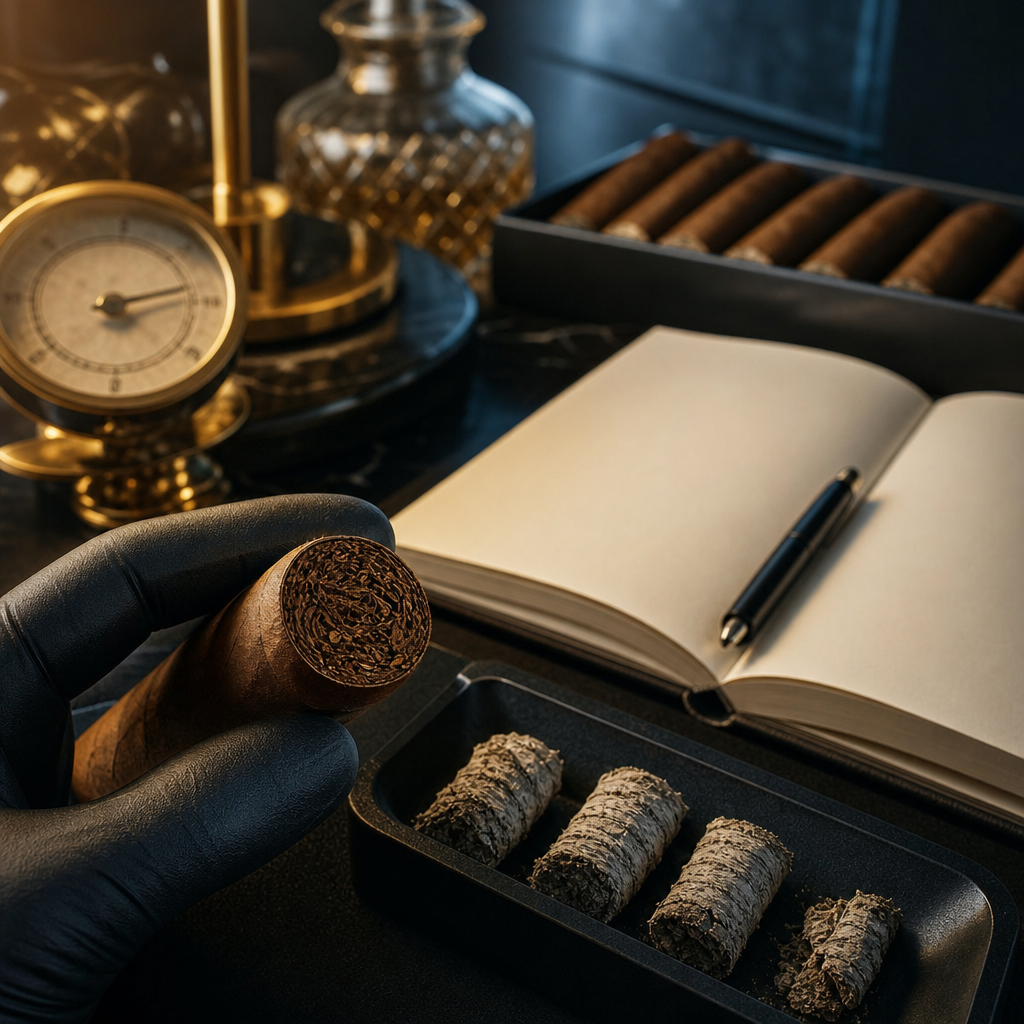
The Art of Cigar Aging: Key Factors Affecting Flavor
Aging cigars is not just about putting the box in a cabinet and waiting for it to grow old. As the editor of the "Cigar Bible," I've seen too many people confuse humidity, temperature, ventilation, and time, only to open the box three years later to find the aroma hasn't become rounder but rather dull, moldy, or imbalanced in draw.
If you already know the basics of cutting, lighting, tasting, and identifying flavors like wood, leather, nuts, and cocoa, the next step is to learn "flavor management." The truly fascinating aspect of aging is that it allows the same cigar to present different expressions in different years, and these changes actually follow a pattern.
The Essence of Aging: Not Stronger, but More Harmonious
The core of cigar aging is the slow balance between the moisture, volatile aromatic compounds, ammonia residue, and oil state within the tobacco leaves. Freshly produced cigars often exhibit herbal, green, spicy, or nasal irritation, especially in some high-yield batches from 2021 and 2022. This doesn't mean poor quality; rather, the tobacco leaves are still integrating. Good aging first seeks to reduce abruptness, not to make the flavor stronger.
Take Partagás Serie D No.4 as an example. When newly acquired, it often has pepper, strong coffee, earth, and dry wood flavors, with the front end possibly rushing quickly. If stored in an environment of 18°C to 20°C and 65% to 68% RH for 12 to 18 months, the pepper will mellow, and the sweetness and roasted nut flavors will become clearer. This change is not magic but rather the gradual dispersion of irritating volatiles, making the burn rhythm more stable.
Many beginners mistakenly believe that the longer the age, the better. In fact, sizes like Robusto, Petit Corona, and Short Churchill usually have a beautiful balance point at 2 to 5 years; while larger ring gauges or longer sizes like Churchill, Double Corona, and Prominentes have more potential to show layers beyond 8 years. Aging is not simply extending time but allowing size, blend, and environment to meet at the right rhythm.
Humidity and Temperature: Two Numbers Determine 80% of the Result
When discussing aging, the most common question is "What temperature and humidity?" My basic guideline is simple: long-term storage should focus on 18°C to 20°C and 65% to 68% RH; for short-term preparation for tasting, adjust to 62% to 65% RH depending on the cigar's condition. In Taiwan's summer, if there is no temperature control indoors, the cabinet can easily exceed 25°C, increasing the risk of cigar beetles and mold, and the flavor may become stuffy, sour, and mixed.
When humidity is too high, cigars feel soft to the touch, the burn line is unstable after lighting, and the smoke is heavy and moist. Common manifestations include suppressed cocoa and wood flavors, leaving only stuffy sweetness and a bitter finish. Conversely, when humidity is too low, the outer wrapper cracks, the burn is too fast, and the spiciness is prominent. For example, if Montecristo No.2 drops below 58% RH, the original cream, coffee, and grain notes are often overshadowed by dryness and spiciness.
I recommend preparing at least two calibrated digital hygrometers, checking them every 6 months using the salt test or calibration packs. If using Boveda 65% or 69%, also pay attention to the cabinet's seal and the number of cigars; a 100-cigar capacity cabinet with only 15 cigars will have more dramatic humidity fluctuations than one with 60 cigars. The aging environment is not about a single day's beautiful numbers but about the stable curve over 30 days.
Time Curve: Differences at 1 Year, 3 Years, 5 Years, and 10 Years
The flavor development of cigars can be roughly divided into four stages. The first year is often the integration period, with the stimulation gradually decreasing; the 2nd to 3rd year enters the smooth period, with wood, nuts, cream, and floral notes beginning to connect; around the 5th year, if well-preserved, the sweetness and finish will be cleaner; beyond 10 years, it enters the old cigar style, possibly exhibiting honey, old books, hay, herbs, and soft leather, but the strength may also decrease.
Take the 2018 Cohiba Siglo VI as an example. When young, it often has bright herbal, cream, citrus peel, and toasted bread notes, but the tail end is slightly spicy. By 2023, if maintained at around 66% RH, the front end will be rounder, the mid-section will have more pronounced sweet wood and cream, and the spiciness in the tail end will be more delicate. Conversely, if stored at 72% RH for five years, the aroma may not deepen but rather appear heavy, sticky, and sluggish in burn.
Different brands have different curves. H. Upmann No.2 often presents honey, almond, and tea notes at 4 to 8 years; Bolívar Royal Corona can smooth out mineral, leather, and black coffee notes at 3 to 6 years; while Trinidad Vigía, due to its large ring gauge and thick smoke, usually requires a longer time to transition from sweet spices to deep wood. Time will amplify strengths and also amplify storage mistakes; age itself is not a guarantee of quality.
Containers, Placement, and Ventilation: A Cigar Cabinet is Not a Safe
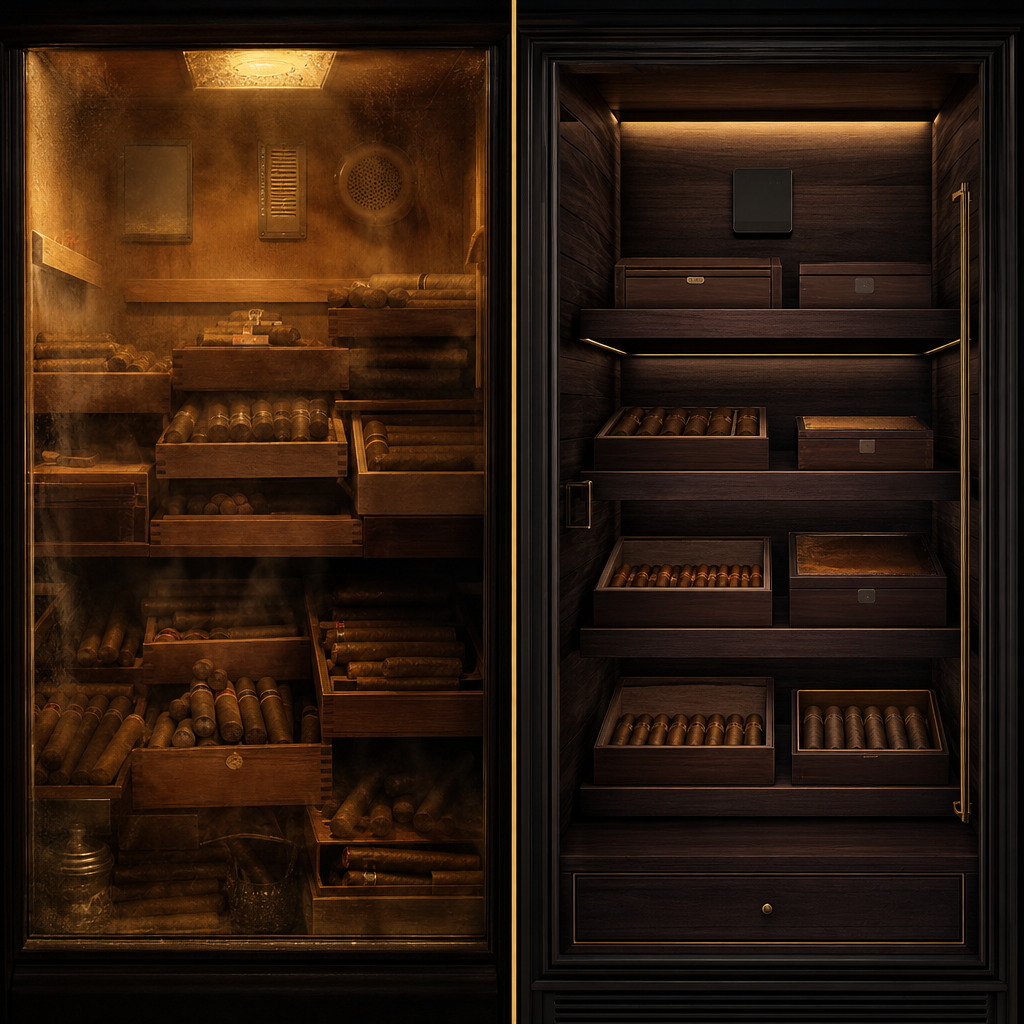
Many people think that buying a beautiful Spanish cedar cabinet means half the aging process is done. In fact, the cabinet's seal, the moisture content of the wood, the density of the cigars, and air circulation are the details that determine long-term performance. New cabinets should be seasoned for at least 7 to 14 days before use to allow the interior wood to reach stable humidity; otherwise, the wood will first absorb the cigar's moisture, leading to dry wrappers while the core leaves remain uneven.
| Storage Method | Suitable Duration | Advantages | Precautions |
|---|---|---|---|
| Original Box Storage | 1 to 10 years | Consistent flavor, less interference | Regularly check corners inside the box |
| Naked Cigar Cabinet Storage | 1 to 24 months | Convenient access, easy observation | Prone to cross-flavor contamination |
| Humidified Container with Humidity Packs | 3 to 18 months | Low cost, high stability | Avoid excessive sealing without circulation |
| Electronic Humidor | Long-term | Good temperature control | Check humidity distribution |
I personally prefer storing important batches in their original boxes, such as the 2016 Hoyo de Monterrey Double Coronas or the 2019 Ramón Allones Specially Selected. Original boxes can preserve the microenvironment of the same batch of cigars and reduce cross-flavor interference between different brands. If storing naked cigars, I recommend separating robust Partagás, Bolívar from more delicate Quai d’Orsay, H. Upmann.
Ventilation is not about opening the cabinet door every day but ensuring the cabinet doesn't remain stagnant for long periods. A brief inspection every 2 to 4 weeks is sufficient, along with slight adjustments to the box positions to make the humidity impact more even on the upper and lower layers. A good storage container should provide stability, not frequent intervention; the busier the hands, the more easily the flavor is disturbed.
Practical Process: Management Methods from Cabinet Entry to Box Opening
I recommend establishing a "batch record" for each batch of cigars you acquire. At least record the brand, model, box code or year, entry date, initial condition, and expected observation time. For example, for a box of 2020 Montecristo Edmundo, you can set to take one cigar each at the 6th month, 18th month, and 36th month for flavor notes, so you know if it's improving, stagnating, or being dragged down by the environment.
In practice, you can manage according to the following process:
- Observe the brightness, elasticity, foot aroma, and any cracks of the wrapper before cabinet entry.
- Avoid significant movement in the first 14 days to allow the cigars to adapt to the new environment.
- Record the highest and lowest temperature and humidity values on the same day each month.
- Adjust the box positions between upper and lower layers every 3 to 6 months.
- If mold spots, wormholes, or odors are found, isolate immediately and investigate humidity and temperature.
Flavor notes should not be too mystical. Use "front/mid/end" to record sweet, bitter, sour, salty, spicy, and aroma types, along with burn, draw, and smoke volume. Suppose a 2022 Romeo y Julieta Wide Churchills, after 12 months at 67% RH, transitions from herbal to sweet wood in the front, almond appears in the mid-section, and bitterness decreases in the end; this is trackable progress.
Most importantly, don't rush to judge a box of cigars. A single cigar's condition may be affected by transportation, position, and humidity fluctuations; at least compare 2 to 3 cigars before evaluating the aging direction of the batch. The purpose of aging management is to replace guesswork with records and impulsiveness with cycles.
Flavor Development and Etiquette: How to Determine the "Optimal Tasting Point"
The optimal tasting point is not the oldest day but the stage where the flavor is complete, the burn is stable, and the finish is clean. For beginners, observe three signals: first, the first 1 cm after lighting is no longer sharp; second, the mid-section aroma transitions, such as from wood to nuts, coffee, or floral; third, the bitterness in the end is acceptable, not just charred spiciness.
For example, the 2015 H. Upmann Magnum 46, when well-preserved, often has beautiful tea, honey, and roasted almond notes between 2020 and 2024, with not necessarily high strength but fine layers. Conversely, some cigars over 10 years old, if stored too dry, may smell like old wooden boxes but are empty, thin, and short when lit, which is not ideal.
In terms of etiquette, when sharing aged cigars, don't just flaunt the age; explain the storage environment and current condition. If comparing different ages at a gathering, start with the lighter, younger ones before moving to richer or older versions; beverages can include room temperature water, unsweetened tea, black coffee, or whiskey with not too high alcohol content to avoid masking delicate aromas.
Also remember, collectible value and tasting value are not the same thing. Some limited editions, commemorative editions, or discontinued models may attract market attention, but that doesn't guarantee appreciation; it still depends on source preservation and market. A truly mature cigar enthusiast pursues understanding the flavor, not just chasing labels and ages.
Frequently Asked Questions
Is it true that the longer cigars are stored, the better they are?
Not necessarily. Many Robustos are charming at 3 to 5 years, but beyond 8 years, the strength may decrease. If the storage environment is unstable, storing longer will only accumulate problems. Aging depends on the cigar's constitution, size, and storage conditions, not just age.
Can cigars be stored long-term at 70% RH?
It can be used short-term, but I don't recommend maintaining 70% RH long-term in Taiwan. Due to high summer temperatures, 70% RH can slow down the burn and increase the risk of mold. Long-term at 65% to 68% RH is safer.
Is the white stuff on the cigar surface mold or bloom?
Bloom is usually uniform, delicate, and can be lightly wiped, without a fuzzy feel; mold often appears as spots, three-dimensional, with fuzz, possibly appearing inside the foot. If it grows deep into the foot, isolate it and don't take chances.
Can different brands be stored in the same cabinet?
Yes, but it's best to separate layers or keep the original box. Robust brands like Partagás, Bolívar and delicate brands like Quai d’Orsay, Por Larrañaga, if stored naked together for a long time, may have cross-flavor interference.
How long after receiving new cigars are they suitable for tasting?
If they have undergone long-distance transportation, I usually let them rest for 30 to 60 days. Larger sizes or those in a moist state can be stored longer. This period is not for a mysterious ritual but to allow moisture and the inner and outer tobacco leaves to rebalance.
Should the cellophane be removed?
Non-Cuban cigars often have cellophane. For short to medium-term protection of the wrapper, it can be retained; for long-term aging, you can cut open the tail end or partially remove it to allow more natural exchange. The focus is still on overall environmental stability, not the cellophane itself.
I have always believed that the most fascinating aspect of cigar aging is that it teaches patience and humility. You cannot command a cigar to become great in a certain year or month; you can only provide it with a clean, stable, and suitable environment, then slowly understand it through notes and taste. When you can articulate why a cigar is rounder, deeper, and quieter today than last year, that's the true beginning of entering the cigar world.
—Cigar Prince Wilson Tsai
Smoking is harmful to health. No smoking under twenty years old. Quit smoking hotline: 0800-636363. This article is for reference only for adults over twenty years old regarding cigar culture, storage, and regulations, and is not an advertisement, promotion, or purchase suggestion for tobacco products.