Define Your Taste Coordinates First: Don’t Ask Which is Famous
Choosing cigars is often hindered by relying on "what others say is good" rather than "what you will like." I frequently see beginners who understand the basics of smoking but still get lost between brand reputation, ring gauge size, and strength ratings. In reality, selecting cigars is a skill that can be practiced, not just a matter of luck.
As an editor of the "Cigar Bible," I am more concerned with whether a cigar matches your time, taste, budget, and occasion. Below, I break down "how to find the right taste for you" into actionable paths using brand, model, flavor, preservation, and evaluation criteria.
Define Your Taste Coordinates First: Don’t Ask Which is Famous
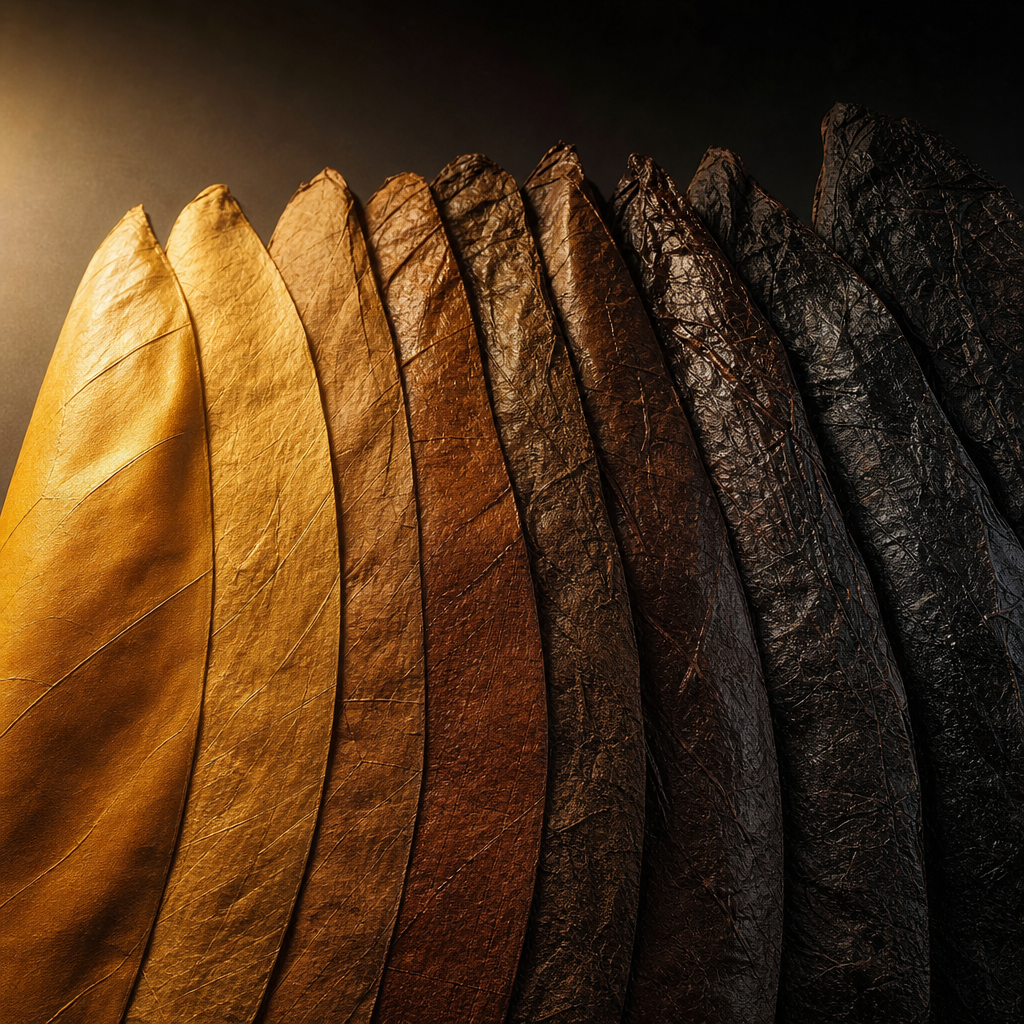
Many people start by asking, "Is Cohiba good? Is Partagás too strong?" But I suggest reversing the question: Do you usually prefer light roasted floral coffee or dark roasted cocoa bitterness? Do you like the dried fruit sweetness of sherry cask whisky or the smoky peat? These clues are more reliable than brand names. In 2019, I reviewed notes from a batch of beginners, and those who preferred lattes and creamy desserts were more likely to accept the mild woody and creamy tones of Hoyo de Monterrey and Romeo y Julieta. Those who preferred black coffee and high cocoa chocolate were more likely to appreciate the robustness of Partagás and Bolívar.
The first step in choosing a cigar is not finding the highest score, but understanding your tolerance for sweetness, bitterness, spiciness, woodiness, nuts, and leather. You can rate yourself from 1 to 5: preference for sweetness, tolerance for spiciness, acceptance of bitterness, strength limit, and time available. If you only have 45 minutes after dinner, you shouldn't start with a Churchill; if you don't usually drink strong spirits, you shouldn't choose a full-sized Robusto or Double Corona.
I recommend beginners establish a "three-stick benchmark": one mild, one medium, and one strong. For example, Montecristo No.4 as a classic medium benchmark, H. Upmann Magnum 46 as an elegant woody benchmark, and Partagás Serie D No.4 as a strength and spiciness benchmark. With a benchmark, every cigar can be placed on your coordinate, rather than just being good or bad.
Understand Brand Characteristics: Different Temperaments in the Same Region
Cuban cigars are often seen as classic textbooks, but "Cuba" is not a single flavor. Since Cohiba became a brand in 1966, it has often been described as grassy, honey, creamy, and delicate woody; Montecristo, founded in 1935, commonly features cocoa, coffee, roasted grains, and medium strength; Partagás, with a history dating back to 1845, often has black pepper, earth, leather, and a robust feel. These are not absolute rules but can serve as an initial map.
Non-Cuban cigars cannot be generalized as "stronger." Arturo Fuente Hemingway Short Story, about 4 inches and 49 ring gauge, is often used as a short-time sweet woody textbook; Padrón 1964 Anniversary Maduro is known for cocoa, coffee, brown sugar, and stable burning; Davidoff Grand Cru series tends towards hay, nuts, cream, and balance. The tobacco source, fermentation, rolling standards, and vintage strategy behind the brand will change your perception.
Brand is the entry point for choice, not the conclusion; different series within the same brand may differ more than between different brands. For example, Hoyo de Monterrey's Epicure No.2 is often seen as a representative of mild, creamy, cedar tones, but some models in the Le Hoyo series emphasize woodiness and herbs more. For Cohiba, the concentration, oiliness, and complexity of Siglo II, Robusto, and Behike 52 are not in the same position. When recording, write "brand + series + size," not just the brand name.
Model and Size: Ring Gauge and Length Determine Rhythm and Taste
Cigar size is not about being bigger, but about determining burning speed, smoke temperature, and mouth concentration. Common Robusto is about 5 inches, 50 ring gauge, with a time range of 45 to 70 minutes; Corona Gorda is about 5.6 inches, 46 ring gauge, with a more slender proportion, easily presenting clearer mid-range changes; Churchill is about 7 inches, 47 ring gauge, possibly requiring more than 90 minutes, suitable for slow observation during complete breaks. The larger the ring gauge, the higher the filler leaf ratio, which may make the taste rounder but may also mask details with thickness.
It's easiest to understand by comparing the same brand. Romeo y Julieta Wide Churchill has a 55 ring gauge, with rich smoke and obvious sweet woodiness; traditional Churchill is longer, with a thinner ring gauge, and the rhythm is longer, requiring more patience for transitions in the front, middle, and back. Montecristo No.2 is a Pirámide shape, with a pointed design that changes the entrance concentration; Montecristo No.4 as a Petit Corona, with a short time and direct profile, is very suitable for training to identify cocoa and coffee tones.
When advancing from beginner to intermediate, comparing two sizes of the same brand consecutively will help you understand cigar structure faster than jumping between brands. You can choose a month for "size practice": the first week 42 to 46 ring gauge, the second week 50 ring gauge, the third week 52 to 55 ring gauge, and the fourth week retesting your favorite size. Record the burning time, whether the first 1 cm is spicy, whether the middle becomes sweet, and whether the end becomes bitter, to see if you prefer "clarity" or "robustness."
Flavor Description Should Be Grounded: From Three-Stage to Five Indicators
Beginners often write flavors as "smooth, fragrant, strong," but this makes it difficult to replicate choices next time. I habitually break a cigar into front, middle, and end stages, then evaluate with five indicators: aroma, sweetness, spiciness, strength, and balance. The front stage usually best observes opening hay, cedar, and white pepper; the middle stage looks at whether sweetness emerges, such as honey, caramel, nuts, cocoa; the end stage observes bitterness, nicotine feel, and temperature control. This method is more useful than simply giving a score of 90.
For example, if H. Upmann Magnum 46 is well-preserved, it often presents cedar, toasted bread, nuts, and mild spices; Partagás Serie D No.4 may show black pepper, earth, coffee, and leather in the middle stage. If you only write "the former is smooth, the latter is heavy," the information is too little; if you write "Magnum 46 middle sweetness 4 points, spiciness 2 points; D4 spiciness 4 points, strength 4 points," you will know which direction to look for next time.
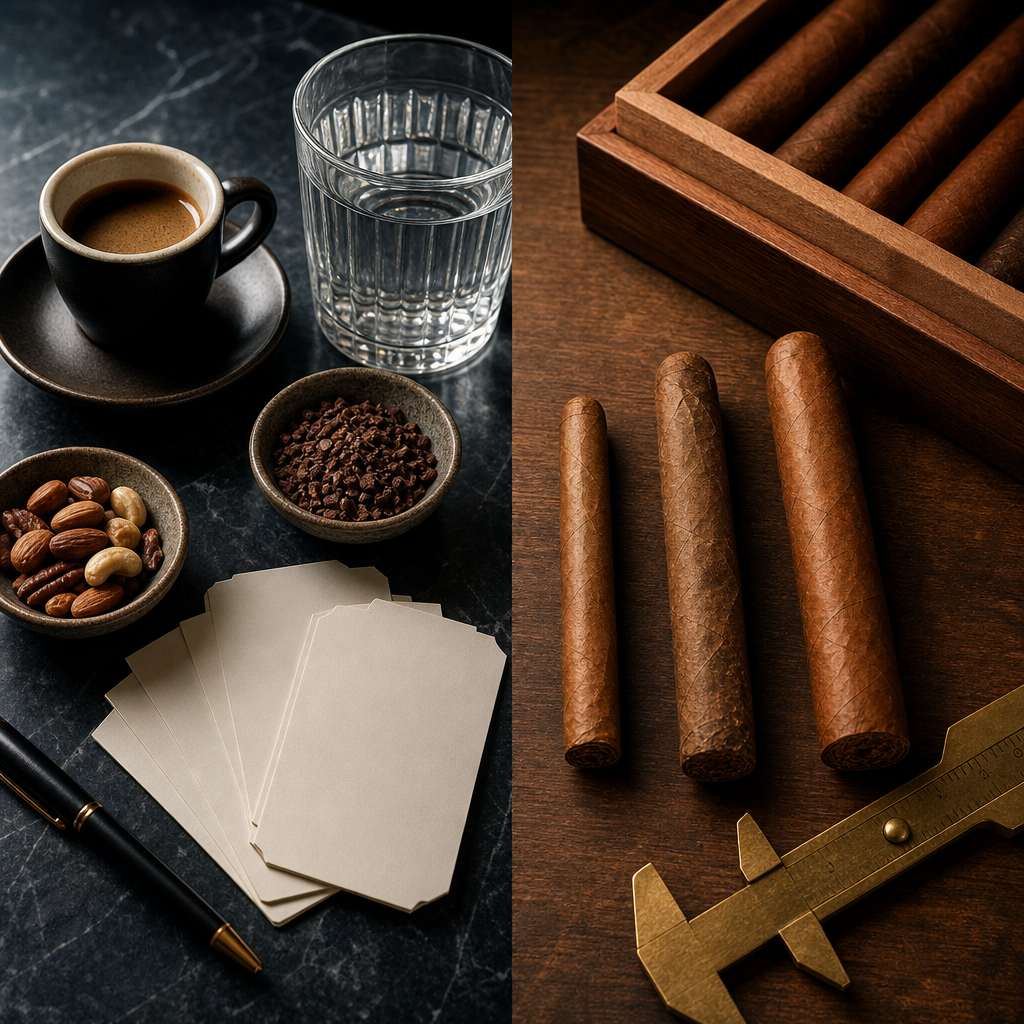
Truly useful flavor notes must help you make the next choice. I suggest writing only 6 lines each time: date, brand model, preservation humidity, paired drink, three-stage flavor, and whether you would choose the same model again. Don't start by pursuing poetic vocabulary, pursue stability first. After recording 20 sticks consecutively, you may find that you don't like "strong," but "medium strength with high sweetness"; or you may not dislike spiciness, but dislike the bitterness caused by overheating at the end.
Preservation and Appearance: Confirm the State is Healthy Before Evaluation
A cigar being bad is not necessarily because the brand or model is bad, but possibly due to incorrect preservation. I generally control relative humidity at 65% to 69%, with a temperature of about 18°C to 21°C; if humidity exceeds 72% for a long time, burning may slow, smoke may be stuffy, and draw resistance may be high; if below 62%, the wrapper may crack, smoke may be sharp, and sweetness may decrease. Many beginners think they don't like a certain brand, but it's actually just encountering too wet or too dry a state.
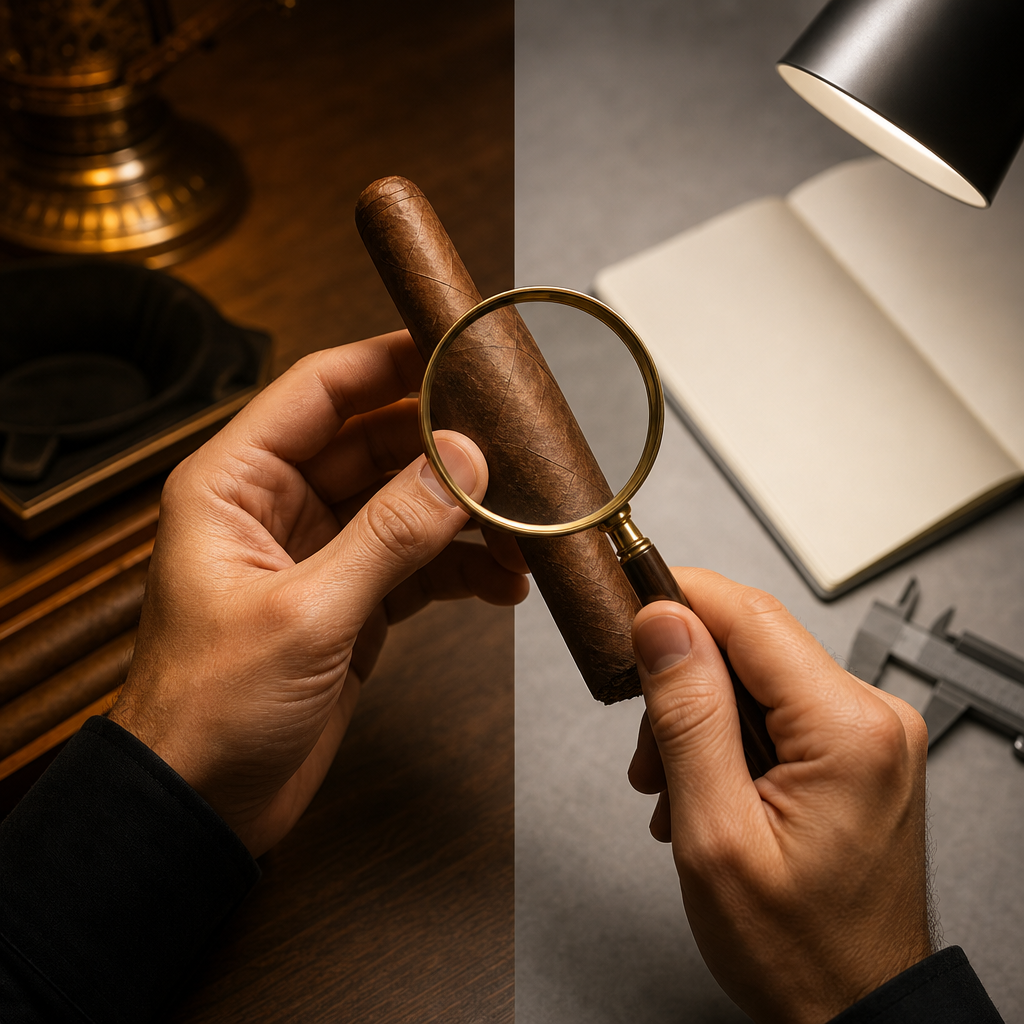
Key points for appearance inspection: whether the wrapper has large areas of damage, whether the foot is loose, whether the pressure is even, and whether there is a pungent mold smell. White small crystals are not necessarily a problem, but fluffy, odorous, diffuse spots should be cautious. Box codes can also provide vintage clues, such as Cuban box bottoms often having factory codes and month-year codes; different batches of the same model in 2020 and 2021 may perform differently, which is why veterans record box codes.
Evaluate the cigar before evaluating preservation; when the state is wrong, the score has no reference value. I also remind that collection concepts should be rational: some limited or discontinued models are indeed of interest in the market, but collection appreciation does not guarantee appreciation, still depending on source preservation and market. Clear source, stable temperature and humidity, and complete box condition are more important than hearing a popular name. If obtained through PCC authorized dealers with clear sources, at least the risk of unclear sources is reduced.
Establish Your Own Scoring Table: Scores Are Tools, Not Beliefs
International media often use a 100-point system, such as 90 points or above representing excellence, but for personal choice, I recommend using a 50-point or 20-point system because it is simple and sustainable. My personal table usually divides into appearance and construction 10 points, draw and burn 10 points, aroma complexity 10 points, balance and transition 10 points, personal preference 10 points. This can avoid "high objective quality but not loving it" being misjudged.
| Evaluation Item | Observation Focus | Common Situations Below 5 Points | Common Situations Above 8 Points |
|---|---|---|---|
| Appearance Construction | Wrapper, elasticity, filling uniformity | Cracking, too hard, loose | Oily, uniform, elastic |
| Draw and Burn | Resistance, uneven burn, ash column | Too tight, frequent extinguishing, severe uneven burn | Moderate resistance, stable burn line |
| Aroma Complexity | Woodiness, sweetness, spiciness layers | Monotonous, obvious off-flavors | Changes in front, middle, and end stages |
| Balance Transition | Coordination of strength and flavor | Spiciness overwhelms sweetness | Strength increases but remains balanced |
| Personal Preference | Whether it suits your taste | Would not choose the same model again | Willing to include in regular list |
The purpose of scoring is to let you understand your preferences, not to prove that a certain cigar is superior. For example, if you give a Bolívar Belicosos Finos 43 points and a Davidoff Grand Cru No.2 41 points, it does not mean the former is always better; it may just be that your dinner was oilier that day, making your taste more suited to a heavy style. When recording, it's best to add context: before or after meals, drinks, indoors or outdoors, and your mental state on the day.
If you have accumulated more than 30 entries, you can do simple statistics: the brand with the highest average, the most frequently liked ring gauge, and the item most likely to lose points. Some people finally find they like 46 to 50 ring gauge, 45 to 75 minutes, medium strength, and nutty sweetness; at this point, the range of choices will be greatly reduced. A stable personal scoring table is more effective than memorizing a hundred rankings.
Common Questions
Q1: Should beginners start with Cuban or non-Cuban?
You don't have to choose one. If you want to understand the classic Cuban profile, you can start with medium-sized cigars like Montecristo No.4, H. Upmann Half Corona, and Romeo y Julieta Short Churchill; if you want to experience stable construction and sweetness, you can also refer to brands like Arturo Fuente, Padrón, and Davidoff. What really matters is establishing a comparison group, not treating the region as a belief.
Q2: Does a high-rated cigar suit me?
Not necessarily. High media scores often represent overall quality, complexity, and market consensus, but your taste may lean towards mild, short-time, and obvious sweetness. A strong style with a score above 90 may be too burdensome for a beginner; instead, an 88-point, clearly structured style may be more suitable for daily learning.
Q3: How long should cigars be aged?
Different brands and batches vary greatly. Generally, if the new box has stable humidity, 3 to 6 months can often make the state more balanced; some robust models may mellow after 2 to 5 years, with spiciness possibly subsiding and sweetness more integrated. But the premise is correct preservation, otherwise, time will only amplify problems.
Q4: Why do the same model feel very different on two occasions?
It may come from batch, preservation, cutting, lighting, draw rhythm, and taste on the day. For Robusto, if the interval between each puff is less than 30 seconds, the bitterness will be obvious after the temperature rises; if the humidity is too high, the aroma will be stuffy. Eliminate operation and state first, then discuss brand differences.
Q5: Does pairing with drinks affect judgment?
Yes, and it has a significant impact. Black coffee will amplify cocoa and bittersweet; high-sugar drinks will soften spiciness; high-alcohol spirits may overpower delicate aromas. When advancing from beginner to intermediate, I suggest using room temperature water or unsweetened sparkling water as a baseline, then separately record changes with coffee, tea, and whisky pairings.
Q6: How many should I prepare as a taste reference?
Three to five is enough. You can design it as mild, medium, and strong three levels, plus one small ring gauge and one large ring gauge for comparison. The clearer the reference group, the more you can describe your preferences in your own language, and the less likely you are to be led by packaging, price, or fame.
I have always believed that the charm of cigars lies not in dividing people into knowledgeable or not, but in each quiet observation allowing you to know yourself better. Brand, vintage, score, and region are all worth studying, but ultimately it comes back to your taste, time, and mood. Choosing the right cigar is not about chasing the most expensive or the most popular, but about finding the right one in the right state and being able to articulate why you like it. —Cigar Prince Wilson Tsai
Smoking is harmful to health. Under 20 years old is not allowed to smoke. Quit smoking hotline: 0800-636363. This article is for reference by adults over 20 years old for cigar culture, preservation, and legal knowledge, not tobacco advertising, promotion, or purchase advice.