The Art of Cigar Packaging: How to Interpret SBN, SLB, and Other Packaging Forms
The Art of Cigar Packaging: How to Interpret SBN, SLB, and Other Packaging Forms
Cigar packaging is not just a cover; it is a part of the cigar's lifecycle. Many seasoned enthusiasts discuss size, vintage, factory codes, draw resistance, and burn lines, but often treat box types as mere background in their collections. However, in my view, SBN, SLB, Dress Box, 8-9-8, aluminum tubes, and ceramic jars each represent different protection logics, humidity exchange rates, wood influences, and aesthetic languages. As an editor of the "Cigar Bible," I often remind myself: understanding packaging is equivalent to understanding how a brand arranges a cigar's journey from the Havana factory, through transportation and storage, to personal humidors. This article does not cover introductory terms but instead dissects box types, flavors, preservation, and management details from an experienced perspective.
SBN: The Semi Boîte Nature Syntax
SBN is usually understood as Semi Boîte Nature, which can be temporarily referred to in Chinese as "semi-natural wood box" or "semi-natural box." Unlike the typical Dress Box, which is covered with extensive paper labels, or the SLB, which presents a more primitive cedar wood feel with a sliding lid, SBN lies in between. It is often seen in products that aim for a certain gift box feel while retaining the texture of a wooden box. For Cuban cigars, when Trinidad officially entered the international market in 1998, its high-end, restrained image with a diplomatic etiquette flavor was deeply associated with the wooden box packaging vocabulary. Later, the wood texture and brand emblem arrangements on different years' boxings of Trinidad Fundadores, Coloniales, Reyes, etc., allowed seasoned enthusiasts to recognize the brand's temperament from the packaging.
The focus of SBN is not "more luxurious" but rather its balance between protection and display: the box structure is more stable than thin paper outer boxes, allowing a certain cedar aroma when opened, but the seal is usually not as tight as a complete sliding lid box. When managing a 25-count box, SBN is suitable for placing in a stable 65% to 69% relative humidity environment, allowing moisture exchange between the inside of the box and the cabinet slowly. I do not recommend frequent opening and closing, as each opening disrupts the microclimate inside the box. When examining SBN, seasoned enthusiasts should look at the box code year, such as different batches from 2014, 2017, and 2020, as well as whether the wooden box seams and cedar lining are flat, and whether the cigar arrangement inside the box has pressure marks from transportation, which are more practical than simply believing in the vintage.
SLB: Why Slide Lid Box is Often Preferred by Veterans
SLB stands for Slide Lid Box, also known as a sliding lid wooden cabinet box. Many veterans like to call it a cabinet or box. The charm of SLB lies in its ability to harmonize cigars with wood, air, and time in the same container. There are many classic cases, such as H. Upmann Magnum 46 often seen in 25-count SLB, Bolívar Belicosos Finos also often associated with cabinet box impressions, and the SLB version of Hoyo de Monterrey Epicure No.2 has long been in focus.
Compared to Dress Box, SLB usually has less paper obstruction inside, allowing more direct contact between cigars and cedar wood, and more gentle humidity exchange inside the box. This means that the SLB version of the same model may sometimes exhibit a more rounded woody, nutty, hay, and honey feel after long-term aging.
Of course, this is not a formula, as flavor still depends on leaf vintage, rolling state, storage, and subsequent management. For example, in a 50-count cabinet box, the internal cigar stacking pressure is greater, and if the bottom cigars are not moved in a high-humidity environment for a long time, they may burn slower and have tighter draw. A 25-count cabinet box is easier to manage. My approach is to check the status of the upper and lower layers in the box every 3 to 4 months, without taking out each cigar to fiddle with, just observing the foot, wrapper oiliness, box aroma, and humidity stability. The aesthetics of SLB are also charming: the moment the sliding lid is opened, there is no excessive printing noise, but rather wood, labels, and arrangement order. This sense of restraint is why many seasoned players are willing to leave more space for cabinet boxes.
Differences Between Dress Box, SBN, SLB, and Other Packaging
Dress Box is the most common traditional paper-labeled wooden box, with brand patterns and paper seals on the outer layer. Montecristo No.2, Partagás Serie D No.4, Romeo y Julieta Churchills, Ramon Allones Specially Selected can all be seen in different periods of Dress Box appearances. The advantage of this box type is high recognizability, stable transportation protection, and complete brand visuals. The disadvantage is that it has more paper and glue materials, and the wood exchange during long-term aging is not as direct as SLB.
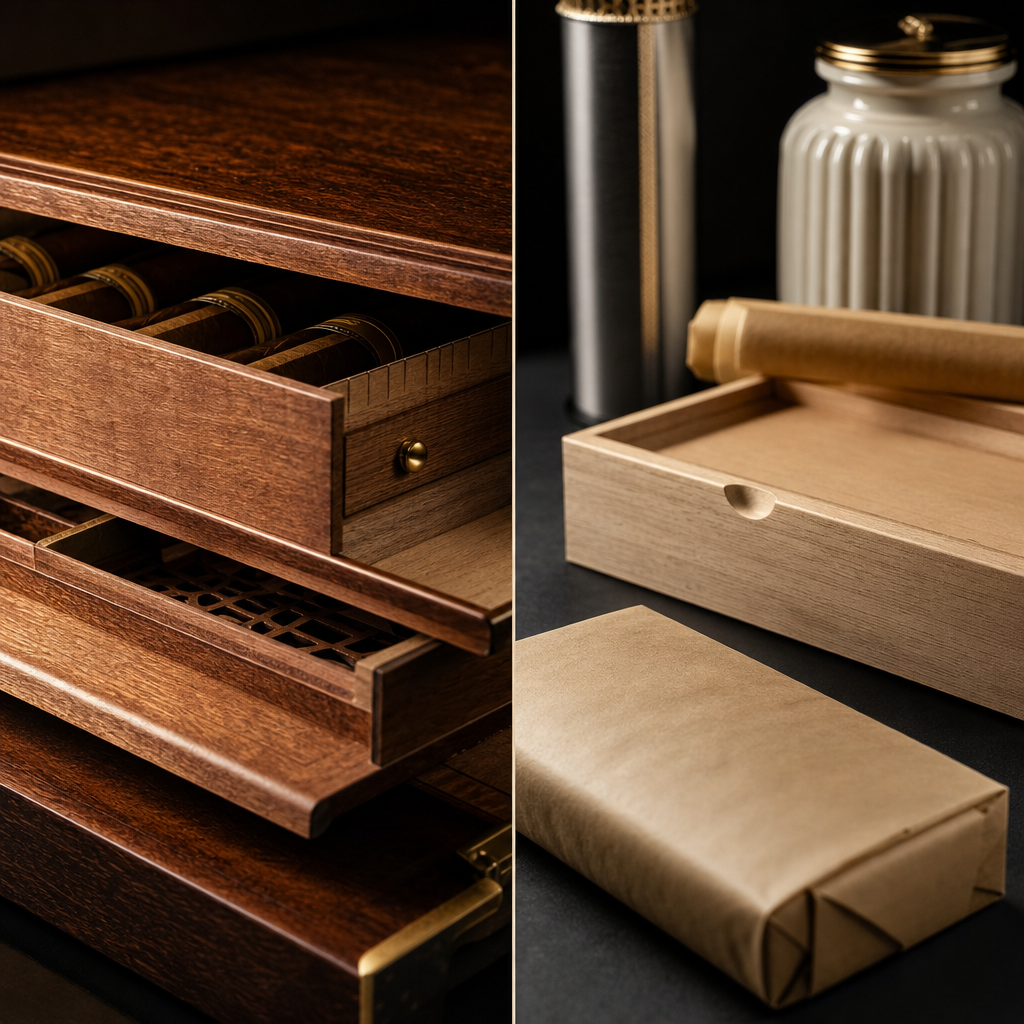
SBN strikes a balance between appearance and wooden box feel, suitable for brands that want to maintain a sense of refinement without fully going the paper box route. SLB is often used by veterans for medium to long-term observation packaging because it is closer to the "small wooden cabinet" concept. Aluminum tubes, ceramic jars, small paper box packs, and bundle ties each have different functions: aluminum tubes are good for single-stick protection, ceramic jars have a strong collection aesthetic, small paper box packs are inclined towards short-term carrying and basic protection, and bundles are often seen in some non-Cuban or regional markets to reduce packaging costs and highlight daily use attributes.
| Packaging Form | Common Capacity | Humidity Characteristics | Flavor Impact | Representative Observation Cases |
|---|---|---|---|---|
| Dress Box | 10, 25 sticks | Stable but more paper materials | Brand aroma is more neutral, woodiness is weaker | Montecristo No.2, Partagás Serie D No.4 |
| SBN | 12, 24, 25 sticks, etc. | Compromise between wooden box feel and sealing | May have delicate cedar and dried fruit notes | Trinidad, some limited or commemorative series |
| SLB | 25, 50 sticks | Gentle microclimate inside the box | More pronounced woody, nutty, hay notes | H. Upmann Magnum 46, Hoyo Epicure No.2 |
| 8-9-8 | 25 sticks | Special arrangement pressure | Roundness and appearance integrity are emphasized | Partagás 8-9-8 |
| Aluminum Tube | Single stick or boxed | Good short-term protection | Concentrated aroma inside the tube, need to pay attention to humidity | Tubos versions like RyJ, Cohiba |
| Ceramic Jar | 15, 25 sticks, etc. | High sealing, need humidity control | Strong aroma preservation, high risk of over-humidity | Limited jar, commemorative jar |
8-9-8 Arrangement: The Special Relationship of Aesthetics, Pressure, and Time
8-9-8 is not just a capacity name but a type of arrangement: 8 sticks on the top layer, 9 sticks in the middle layer, and 8 sticks on the bottom layer, totaling 25 sticks. The most representative is Partagás 8-9-8, which has been regarded by many veterans as a classic display of the brand's framework for many years. The reason is not only the size and formula but also the packaging method itself creates a sense of ritual. The 8-9-8 arrangement makes the cigars in the box present an arch-like structure, with the middle layer bearing slightly different pressure and contact surfaces. During long-term storage, if the humidity is too high, for example, consistently over 72%, the middle and lower layers may feel tighter than the upper layer, and the draw resistance may be heavier during smoking. Conversely, if the environment is consistently below 62%, the outer wrapper may become brittle, and the original elegant arrangement inside the box loses its protective meaning.
Therefore, my management of 8-9-8 is usually conservative, around 65% to 67% relative humidity, 18 to 21°C temperature range, and try to avoid large movements. From an aesthetic perspective, the outer box of 8-9-8 is often more collectible than the general Dress Box, especially with lacquer, gold stamping, inner paper lining, and cigar arrangement forming an old-fashioned Havana temperament. When discussing market prices and collection value, indeed, some years and complete box conditions will attract attention; but this does not guarantee appreciation, still depending on source preservation and market. Those who truly understand it will not only look at the beautiful outer box but also look at the box code, wrapper consistency, oil content, box aroma cleanliness, and whether the 25-stick arrangement still retains its original order.
Aluminum Tubes and Ceramic Jars: Sealed Packaging is Not a Panacea
Aluminum tubes, Tubos, are often misunderstood as "safe if left alone," but veterans should know that aluminum tubes are protective tools, not permanent humidification systems. Taking Romeo y Julieta Churchills Tubos, Cohiba Siglo series Tubos, Partagás Serie D No.4 Tubos as examples, aluminum tubes can protect the wrapper from damage and reduce humidity fluctuations during short-term movement. However, if the humidity inside the tube is high at the time of production or transportation, and the tube is never opened for a long time, the aroma inside the tube may become stuffy, and even an unclean musty smell may appear. My habit is, if aluminum tube cigars are to be stored in a humidor for a long time, I will slightly open the tube cap or check regularly to prevent it from becoming a completely isolated space.
Ceramic jars, Jar, are more interesting, especially since many commemorative jars, regional edition jars, or brand revival jars have gained attention after 2000. Ceramic jars have strong sealing and high aesthetic appeal, suitable for display. However, the stronger the sealing, the more precise humidity control is required. If a too-strong humidification pack is placed inside the jar, the humidity may remain above 70% for a long time, making the cigars heavy, burn unevenly, and the aroma may become dull. The best way to manage ceramic jars is to treat them as "semi-closed display containers": first ensure the cigar status is stable, then use a small hygrometer or regularly compare hand feel and foot aroma to judge, and do not ignore internal risks because of the beautiful appearance. Properly preserved sealed packaging can retain concentrated aroma; poorly preserved, it will also seal in the flaws.
Packaging and Flavor: Cedar, Paper Materials, Lacquer, and Air Exchange
How packaging affects flavor, the most critical are three things: material, air exchange speed, and humidity uniformity inside the box. Cedar wood can provide a mild aroma and buffer humidity, which is why many high-end cigar packages cannot do without Spanish cedar or similar wood. SLB, due to more contact between cigars and wood surfaces, often exhibits more pronounced woody, hay, nutty, and faint spice notes after long-term aging. Dress Box, due to paper materials, printing, and lining obstruction, often has a cleaner, more direct flavor, and the brand's iconic features are more easily retained. SBN lies in between, and if the wood treatment inside the box is good, it can bring a delicate woody background to the cigars, but not as deeply permeated as cabinet boxes.
Lacquered boxes are also worth noting. The outer lacquer enhances visual and protection, but if the craftsmanship is poor or the storage environment is too hot, the risk of odor increases. Especially for old boxes, it is important to smell whether there is a pungent glue smell, mold smell, or paint residue inside the box. Observing many Cuban boxings from 2010 to 2020, cigars with the same factory code and similar vintage, if one box is in a stable 65% environment for a long time and another box is in a high-temperature, high-humidity storage environment with repeated fluctuations, three years later, the smoking state may be completely different. This is the value of packaging research: it is not metaphysics but the intersection of material science, microclimate, and time management. If veterans can treat packaging as part of the flavor system, they will not only use the brand name to judge the future of a box of cigars.
Selection Advice: Judge by Purpose, Vintage, and Storage Space
When choosing a packaging form, I ask three questions: Do you plan to enjoy it in the short term or age it long-term? Is the humidification space stable? Do you value complete box aesthetics? If it is for consumption within six months to a year, Dress Box or aluminum tube versions have lower management pressure, clear appearance recognition, and are convenient for grasping the status of each stick. If it is for three years or more observation, SLB is often more worth considering, especially for brands like H. Upmann, Hoyo de Monterrey, and Bolívar that have rich layers in wood and herbal expressions. But the premise is that you have a stable enough humidor and cannot let a 25-stick or 50-stick cabinet box stay in high summer temperatures for a long time.
SBN is suitable for those who like box aesthetics and hope for a wooden box aroma, especially some limited, commemorative, or brand-positioned more refined series. SBN can make the collection more complete. If it is an aluminum tube, I suggest not treating it as a long-term no-management solution. If it is a ceramic jar, then the hygrometer, humidification pack capacity, and jar opening frequency should be included in the plan. Veterans should also look at the year and box code, such as the different market conditions and logistics conditions of 2016, 2019, and 2022. Looking at the brand and model alone is not enough to judge the status. As for collection prices, complete box labels, tax labels, seals, box codes, and reliable sources and complete preservation records will increase the value of interpretation. But it does not guarantee appreciation, still depending on source preservation and market. A truly mature choice is not to chase packaging forms but to let packaging forms serve your preservation conditions and flavor goals.
Collection Management: Box Codes, Position, Humidity, and Opening Records
Advanced management is not just putting cigars into a humidor but establishing a traceable system. I usually record the brand, model, packaging form, box code, entry date, initial humidity, appearance status, and the first smoking time. Cuban box codes gradually formed a traceable system after 1985, and after 1999, they were presented in a more easily recognizable month and year code. Veterans often use box codes to judge batches and factory backgrounds, but box codes are not quality guarantees; they are just indexes. During preservation, Dress Box can be stacked flat, but do not stack too high. SLB is best to leave air circulation space, avoiding the bottom of a 50-stick cabinet box being in a dead corner for a long time. SBN and lacquered boxes need to pay attention to whether the box body hinders humidity exchange, and if necessary, evaluate the state of the outer box and inner box separately.
In terms of humidity, I prefer Cuban cigars to be stored long-term at 65% to 68%. Non-Cuban rich types can be adjusted according to wrapper thickness and personal preference, but it is not recommended to exceed 72% for a long time. The temperature is ideally between 18 to 21°C, and when it exceeds 24°C, the risk of pests and abnormal fermentation will increase. Every time I open a box, I smell three scents: clean wood aroma, tobacco sweetness, and whether there is a moldy acid or ammonia smell. Then I check whether the foot is swollen, whether the wrapper is oily, and whether there is powdery debris in the corners of the box. Recording these details, looking back two years later, is more reliable than saying "this box seems to have improved" based on memory.
Common Questions
Which is more suitable for long-term aging, SBN or SLB?
If the storage environment is stable, SLB is usually more suitable for medium to long-term observation because the wood box and cigars are in direct contact, and the microclimate inside the box is more natural. SBN is suitable for balancing aesthetics and protection. The key is still humidity, temperature, and source status, not the box type alone deciding the result.
Does Dress Box have worse flavor than SLB?
It should not be simplified this way. The flavor of Dress Box may be more direct and clean, and it can better retain the brand's original outline. SLB often has a more rounded woody and nutty background. If comparing the same model, same vintage, and same storage conditions, the differences are meaningful.
Should aluminum tube cigars be opened for storage?
If it is just for short-term movement or short-term storage, it can be kept as is. If it is to be stored in a humidor for a long time, I will check regularly or slightly open the tube cap to allow humidity to exchange slowly. Completely sealed for years does not mean safer, especially when the humidity inside the tube is unknown, more caution is needed.
Is it suitable to put a humidification pack in a ceramic jar?
Yes, but the capacity should be careful. Ceramic jars have high sealing, and a too-strong humidification pack may lead to long-term over-humidity. I will first let the cigar status stabilize, then place a small hygrometer to observe, and avoid frequent large jar openings that cause humidity fluctuations.
Is an older box code year better?
Not necessarily. If old vintages are poorly preserved, they may be worse than new boxes. If new vintages have good sources and storage, they can show a clear framework. Box code is a clue, not an answer. Veterans should judge by year, packaging, wrapper status, aroma, and preservation records together.
Does a complete box have more collection value?
Complete box packaging, seals, box codes, tax labels, and preservation records indeed help interpret source and status and are easier to establish a collection narrative. But it does not guarantee appreciation, still depending on source preservation and market. The biggest fear in collecting is only looking at the appearance and not checking whether the internal cigars are healthy.
Conclusion
I have always believed that cigar packaging is a quiet but profound study. The compromise of SBN, the wooden breathing of SLB, the brand narrative of Dress Box, the aesthetic of 8-9-8 arrangement, and the sealed logic of aluminum tubes and ceramic jars all remind us that cigars are not objects that stop changing once they leave the factory. Truly mature veterans will not only look at the brand and vintage but also see how the box protects, limits, and shapes a cigar's sense of time.
—Cigar Prince Wilson Tsai
Smoking is harmful to health. Under 20 years old is prohibited from smoking. Quit smoking hotline: 0800-636363. This article is for reference only for adults over 20 years old as a reference for cigar culture, preservation, and regulatory knowledge, not a tobacco advertisement, promotion, or purchase suggestion.