Microclimate Management of Cigars: Advanced Techniques to Enhance Storage Quality
Microclimate Management of Cigars: Advanced Techniques to Enhance Storage Quality
As an editor of the "Cigar Bible," I am often asked by seasoned cigar enthusiasts: Why do some people store cigars with creamy, honey, and leather notes at the same 65% to 69% relative humidity, while others end up with musty, sour, and unstable burns? The answer usually lies not in a single number, but in the "microclimate."
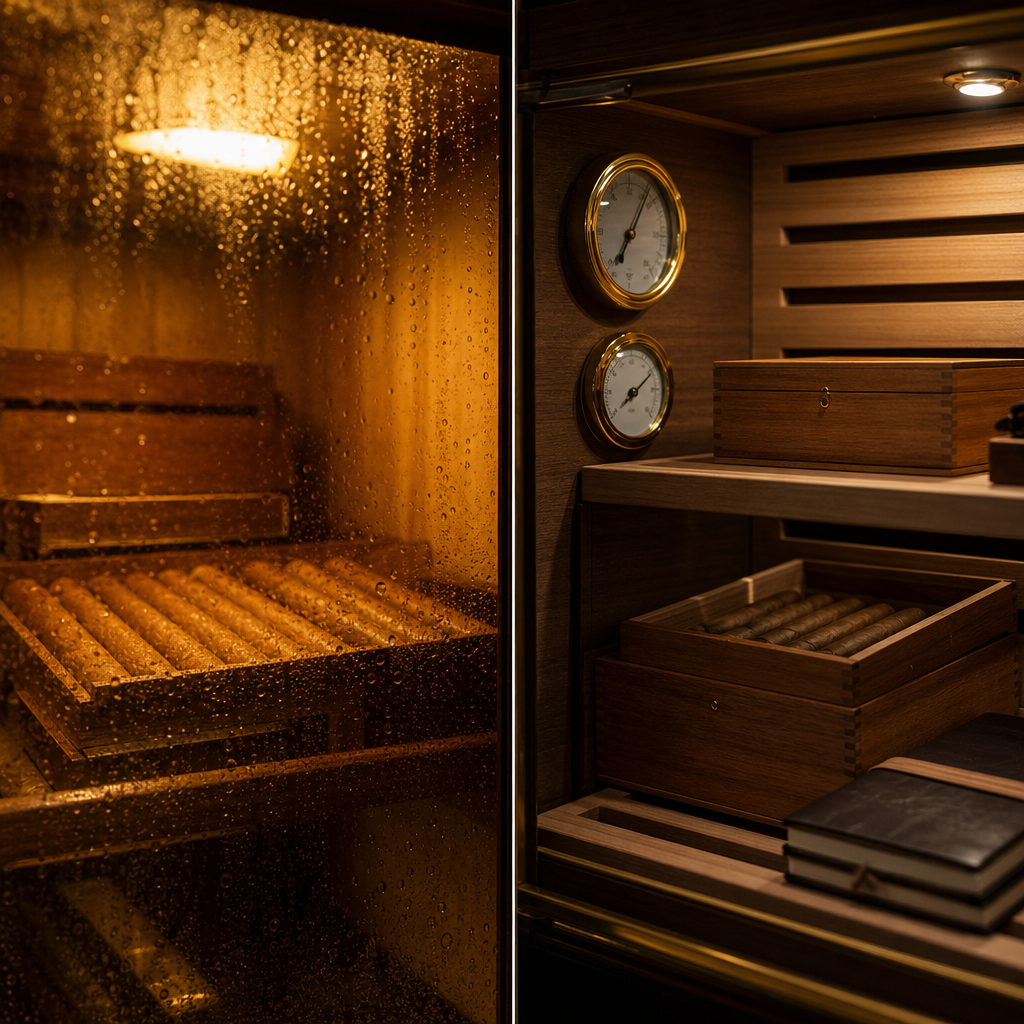
Cigar cabinets, wooden boxes, humidification packs, cedar dividers, airflow speed, and daily temperature fluctuations all create a small climate layer. Advanced enthusiasts should not only look at the current reading of the hygrometer but also manage fluctuations, directions, and recovery speeds.
Microclimate is Not a Number, But a Stable Curve
Many people consider 70% RH as the storage standard, but that is just a historical reference point for easy memory. For Cuban cigars, I often set the daily range at 65% to 68% RH, 18°C to 21°C; for thicker ring gauges above 54, such as Cohiba Siglo VI and Montecristo Línea 1935 Dumas, higher humidity can lead to dull burn lines, requiring more attention to ventilation and recovery speed.
The goal of microclimate management is not to fix humidity into a dead line but to make fluctuations smaller and slower. For example, if the humidity drops from 66% to 61%, if it happens within 3 hours, the wrapper may shrink and cause micro-cracks; if it changes slowly over 10 days, the cigar usually has time to exchange moisture, and the structural pressure is much less. Advanced enthusiasts look at the 7-day and 30-day curves, not just single points.
When handling the 2018 Partagás Serie D No.4 and the 2020 H. Upmann Magnum 46 at W Cigar Bar Gentlemen's Cigar Lounge, I record data before opening the box, on the third day after entering the cabinet, and on the 14th day. The former has a more oily wrapper and is more prone to mustiness in high humidity; the latter has a clearer structure and can retain woody and nutty notes at 65% to 66% RH. Different brands have different personalities, and microclimates should be designed in layers.
Temperature Management: The Most Underestimated Variable by Experts
The hygrometer shows relative humidity, which is influenced by temperature. The water content of air at 20°C, 67% RH is not the same as at 25°C, 67% RH; as temperature rises, air can hold more moisture, and the rate of moisture exchange inside and outside the cigar also changes. In Taiwan's summer, if the indoor temperature is 28°C during the day and the air conditioning lowers it to 22°C at night, the cabinet may experience a small tide every day.
My preferred long-term storage range is 18°C to 21°C, and the short-term display or usage area can be relaxed to around 22°C, but I do not recommend long-term proximity to 25°C. Besides dulling flavors, high temperatures also increase the risk of pests; cigar beetle eggs are more easily activated in warmer environments. Since the 1990s, many European collectors have regarded 18°C as a stable baseline, not out of superstition, but to reduce the speed of biological and chemical reactions.
Temperature is more like a metronome than humidity; if the beat is off, even beautiful humidity is just surface stability. I once saw a box of 2016 Trinidad Fundadores, with long-term humidity records falling between 66% and 68%, but the cabinet was near a west-facing wall, and the local temperature rose to 26°C in the afternoon, resulting in the upper layer being noticeably drier and spicier than the lower layer. The solution was not to add humidity but to relocate, insulate, and reduce the day-night temperature difference to within 2°C.
Humidity Strategy: Zoning by Ring Gauge, Age, and Purpose
Experts should not prepare just one type of humidity. Ring gauge, wrapper thickness, filler ratio, and age all influence the ideal storage point. Generally, slender shapes with ring gauges 38 to 42, such as Lonsdale and Lancero, are more sensitive to dryness; ring gauges above 52, like Robusto Extra or Toro, are more prone to draw resistance and slow burning due to high humidity. The core of humidity zoning is to let cigars breathe according to their structure, rather than forcing all boxes to live in the same climate.
| Type and Example | Suggested RH | Temperature | Management Focus |
|---|---|---|---|
| Thin Ring Gauge: Cohiba Lancero, Trinidad Fundadores | 66%–68% | 18–20°C | Avoid rapid moisture loss, reduce frequent box openings |
| Classic Robusto: Partagás Serie D No.4, Bolívar Royal Coronas | 65%–67% | 18–21°C | Balance burning and oiliness |
| Large Ring Gauge: Cohiba Siglo VI, H. Upmann Magnum 54 | 64%–66% | 18–21°C | Prevent over-humidity, mustiness, and uneven burning |
| Long-term Aging Box | 65%–66% | 18–20°C | Low fluctuation, minimal movement, minimal lid opening |
My approach is to divide the cabinet into "long-term box storage area" and "recent use area." The box storage area mostly uses 65% or 66% humidity packs and is preserved in original wooden boxes; the recent use area can be adjusted to 66% to 68% depending on the cigar's condition, so the wrapper is not too brittle. If a 2019 Montecristo No.2 cap easily breaks when cut, it does not necessarily mean the entire cabinet is too dry; it could be that the airflow in the use area is too strong.
Adjusting humidity should be slow. If a cigar moves from a 72% RH environment to a 65% RH, I would allow at least 21 to 30 days for transition, rather than rushing to judge the flavor. After high humidity drops, the common phenomenon in the first two weeks is that the outer layer dries first while the core remains moist, which may temporarily destabilize burning. True stabilization is when the moisture inside and outside the cigar reaches equilibrium, not when the hygrometer reaches the set point.
Details of Cedar, Original Boxes, and Cabinet Airflow
Spanish cedar is not just an aromatic decoration; it is a microclimate buffer. Cedar can absorb and release moisture, reducing short-term fluctuations, and can create a milder aromatic background inside the box. Many standard Cuban wooden boxes before 2015 have different wood thicknesses and sticker sealing methods, which affect the exchange rate compared to recent paper or lacquer boxes; experts often overlook the true humidity inside the box if they only look at the external cabinet numbers.
The advantage of original box storage is stability; the advantage of loose storage is control. Neither is absolutely superior, only different in purpose. For example, if a box of 25 Ramón Allones Specially Selected is intended to be stored for more than 3 years, I prefer to keep it in the original box and place a sensor next to the box, rather than directly stuffing a humidification pack into the box to press the cigars; if it is loose cigars that will be used in rotation soon, I use cedar trays to layer them for even air contact.
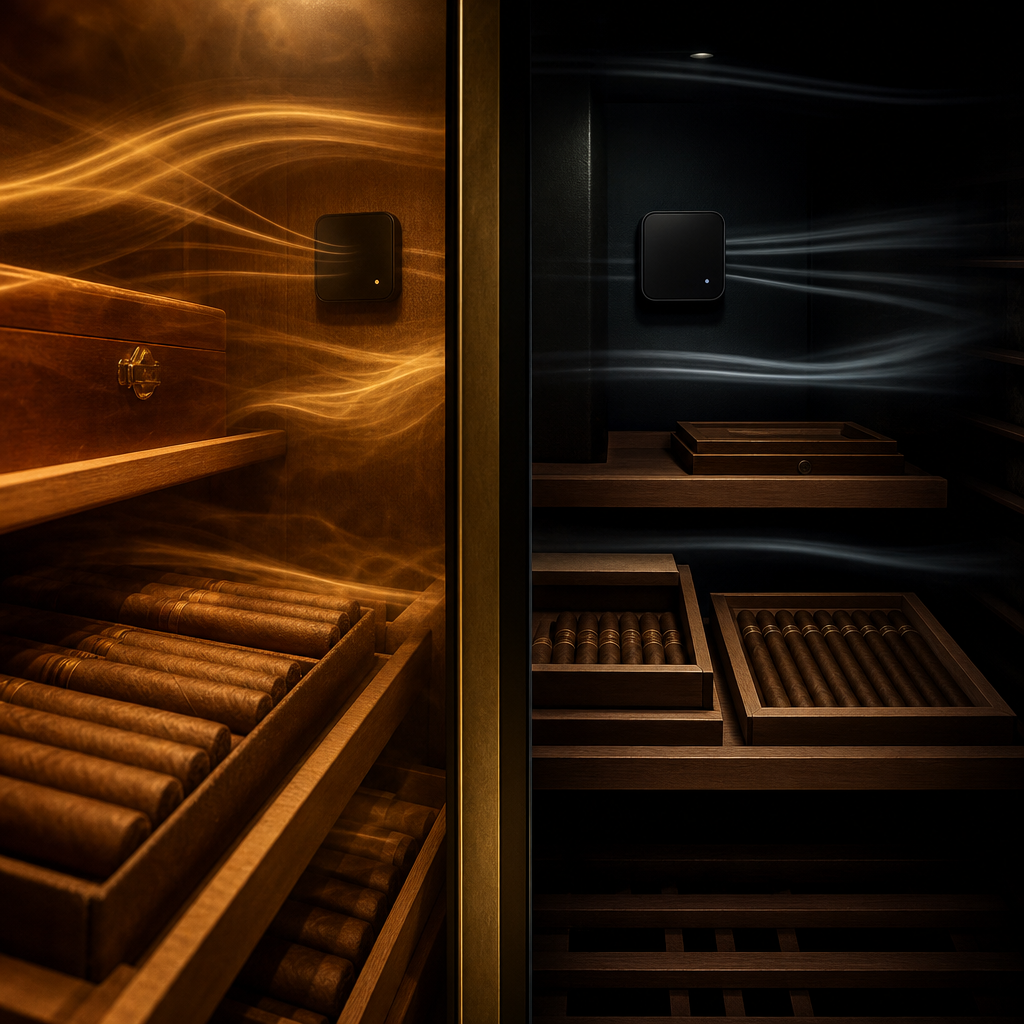
Airflow also needs moderation. If the fan in an electronic cabinet is too strong, the wrapper near the air outlet may become dry and hard; with no airflow at all, corners may become locally over-humidified. I use thin cedar sheets to guide the flow, avoiding cold air directly hitting the box surface, and change the position of boxes within the same area every 60 to 90 days. The focus is not on moving the cigars themselves but on adjusting the position of boxes within the microclimate, gradually narrowing the differences between the upper layer, lower layer, door side, and back panel.
Instrument Calibration: No Records, No Management
The most important investment for experts is not more luxurious accessories but reliable readings. Digital hygrometers on the market often have an error of ±2% to ±5% RH; if you think it is 67%, it may actually be 62% or 72%. I recommend preparing at least two sensors from different brands, placing them in the upper and lower layers of the cabinet, with another for calibration backup. Perform a salt test or use a calibration pack every 6 months; this is basic discipline.
The 75% salt test method can use saturated saltwater to establish a reference environment, but note that the sealing time should be at least 8 to 12 hours, and the sensor should not touch the liquid. If using a 32% or 75% dedicated calibration pack, stability is better. An uncalibrated hygrometer only provides emotional comfort; calibrated records are the basis for management. I have seen many cabinet problems that were actually just instrument deviations.
Records do not need to be complicated, but they should have a fixed format. My basic columns include date, time, upper cabinet RH, lower cabinet RH, temperature, whether the cabinet was opened, whether new boxes were added, and indoor air conditioning settings. After 30 consecutive days, you will see the character of your cabinet: some stabilize 2 hours after opening, some take 12 hours; some have a long-term 3% higher lower layer, some have daily fluctuations at the door. These numbers are more practical than any rumors.
Aging Rhythm: Making Flavor Changes Predictable
Cigar aging is not mysticism but a slow coordination of moisture, volatile substances, oils, and leaf structure. Take the 2017 Romeo y Julieta Churchill as an example; if stored at 18°C, 65% RH, the common phenomenon in the first two years is the slow fusion of woody, floral, and slight acidity; if long-term at 22°C, 70% RH, the flavor may round out earlier but may also lose clear structure. Experts want predictability, not speed.
Low temperature, low fluctuation will make aging slower but cleaner; high temperature, high humidity will accelerate changes, but also bring the risk of off-flavors. For boxes over 5 years old, I adopt a conservative strategy: 18°C to 20°C, 65% to 66% RH, and limit box opening to once per quarter. If you want to observe changes, it is recommended to fix the same brand and size, such as recording the burn, aroma, and aftertaste of a Hoyo de Monterrey Epicure No.2 every 12 months.
Moving cigars also affects the rhythm. After long-distance transport, I usually let the whole box rest for 30 to 60 days before making a flavor judgment; if it arrives in low winter temperatures or high summer humidity, I might extend it to 90 days. Cigars entering a new microclimate need time to rebuild balance. Rushing to conclusions often means evaluating transport stress and environmental shocks, not the cigars themselves.
Common Issues
The biggest fear in microclimate management is "looking normal" but actually being locally imbalanced. The following issues are the most common among seasoned cigar enthusiasts and are most easily improved with records and zoning.
1. Why are cigars still too wet when the cabinet shows 67% RH?
It may be that the sensor position does not represent the box's internal state, or high temperatures are accelerating moisture absorption and release. Place the sensor in an empty wooden box for 24 hours and compare it with the cabinet reading; if the box is more than 3% higher, adjust the box position and airflow.
2. Should humidification packs be placed inside or outside the box?
For long-term original boxes, I prefer to place them outside the box for slow exchange; only loose cigars or small travel boxes should have them inside. If placed inside, avoid direct contact with the wrapper, especially for oily thin wrappers like Cohiba and Trinidad, as indentations and local over-humidity can affect the condition.
3. Do I need to open the cabinet every day for ventilation?
No. Frequent cabinet opening creates fluctuations. If the cabinet is well-sealed, a brief opening for organization every 1 to 2 weeks is sufficient; if there is an odor or dampness, check the wood, sponge, and old humidification sources first, rather than relying on daily opening to solve it.
4. Are white spots on the cigar surface mold?
First, observe the form. Even thin frost that can be lightly brushed off without fuzz may be oil or mineral crystals; if it is fuzzy, blue-green, or has a moldy smell, isolate and treat it. When unsure, it is better to store separately to avoid affecting the entire cabinet.
5. How long does it take to reduce from 70% to 65%?
I recommend at least 3 to 4 weeks, and for boxes, it can be extended to 60 days. First, remove excess humidification sources, maintain 18°C to 21°C, and then observe weight, feel, and burn. Humidity adjustment is a slow process, not a correction button; the more precious the box, the more it should avoid drastic changes.
Microclimate management, in essence, is a patient craft. Cigars do not automatically improve because they are expensive, nor are they immune to imbalance because the cabinet is high-end; what is truly reliable are records, calibration, zoning, and time. I like to view each box of cigars as a work with character, giving it the right temperature, humidity, and peace, and it will naturally reward with clearer layers and more stable burning.
—Cigar Prince Wilson Tsai
Smoking is harmful to health. Smoking is prohibited for those under twenty. Quitline: 0800-636363. This article is intended for adults over twenty as a reference for cigar culture, storage, and regulations, not as tobacco advertising, promotion, or purchase advice.