Quick Answer
Smoking is harmful to health. Persons under twenty years of age shall not smoke. Smoking cessation hotline: 0800-636363. This article is provided solely for adults aged twenty and above as a reference on cigar culture, storage, and regulatory knowledge. It is not tobacco advertising, promotion, or purchasing advice.
Quick Answer
Cigar etiquette in business hospitality means first confirming the lawful space and guests' willingness, then arranging presentation, cap cutting, lighting, and the rhythm of conversation. In principle, cigars should not be used in indoor smoke-free places open to public consumption, such as restaurants, bars, nightclubs, hotels, shopping malls, and KTV venues. Exceptions require an indoor smoking room with independent air conditioning and an independent compartment, or a venue that meets the requirements for a cigar lounge. It should also be remembered that smoking in a smoke-free place is punishable by a fine of NT$2,000-10,000, and operators who fail to post no-smoking signs are punishable by a fine of NT$10,000-50,000. Proper hospitality does not turn cigars into pressure. It gives those who may participate a choice, and ensures that non-smokers are not disturbed.
Basic Definition/Background
Cigar etiquette in business hospitality is first and foremost not about tools, brands, or years, but about "propriety". Under the Tobacco Hazards Prevention Act, tobacco products are defined to include cigarettes, cut tobacco, cigars, and other tobacco products. Persons under twenty years of age shall not smoke, and no person may supply tobacco products to anyone under twenty years of age. Therefore, business cigar hospitality applies only to adults who are twenty years of age or older, who clearly wish to participate, and who are in a compliant space. If non-smokers are present at the same table, the host should prioritize their seating, dining rhythm, and freedom to leave, and must not use position, relationships, or atmosphere to force them to accept the risk of secondhand smoke.
Identifying the space is the first threshold before hosting. Indoor places open to public consumption, such as restaurants, bars, nightclubs, hotels, shopping malls, and KTV venues, are in principle entirely smoke-free. Exceptions are indoor smoking rooms with independent air conditioning and independent compartments, or venues that meet the requirements for cigar lounges. The requirements for a cigar lounge include business items that include cigar retailing, cigar-related revenue accounting for 50% or more, and facilities sufficient to block emissions or odors. Whenever smoke-free places, smoking rooms, or cigar lounges are mentioned, the following must be remembered at the same time: independent air conditioning, independent compartments, a fine of NT$2,000-10,000 for smoking in a smoke-free place, and a fine of NT$10,000-50,000 for operators who fail to post no-smoking signs. These are not bargaining chips, but the bottom line of hospitality.
Key Points
| Hospitality stage | Proper practice | Cigar taboos to avoid |
|---|---|---|
| Space confirmation | Confirm in advance whether it is a lawful space where use is permitted. If smoke-free places, smoking rooms, or cigar lounges are involved, they must meet the requirements of independent air conditioning and independent compartments, and attention must be paid to the fine of NT$2,000-10,000 for smoking in a smoke-free place and the fine of NT$10,000-50,000 for operators who fail to post no-smoking signs | Replacing regulatory confirmation with a private room, acquaintances, or temporary acquiescence |
| Guests' willingness | Ask each person whether they wish to participate, and allow them to only chat, not smoke, or leave early | Deciding for others, strongly inviting non-smokers, or interpreting refusal as disrespect |
| Presentation and lighting | The host explains the size and time required, allowing guests to choose for themselves. Only assist with cap cutting and lighting when assistance is needed | Cutting for guests without permission, rushing lighting, or directly scorching the foot with flame |
| Conversation rhythm | Clarify important issues first, then arrange the cigar segment. Robusto is commonly about 50 ring gauge and 124 mm, so time should be reserved | Frequently leaving during the meal, or tying contract discussion to smoking progress |
Business hospitality is not about displaying how much one knows, but about arranging whether the other party can feel at ease. The cigar space must be compliant before seating is discussed. The cigar size must be estimated for time before the flow is discussed. If a guest only wishes to look and does not wish to smoke, the host should treat this as a normal option. If a guest is willing to participate, the guest should also be allowed to control the pace. The host is responsible only for presentation, explanation, and attending to the ashtray, and should not let personal habits override the guest's rhythm.
[In-depth Section 1] The Rhythm of Hospitality: From Presentation and Cap Cutting to Lighting
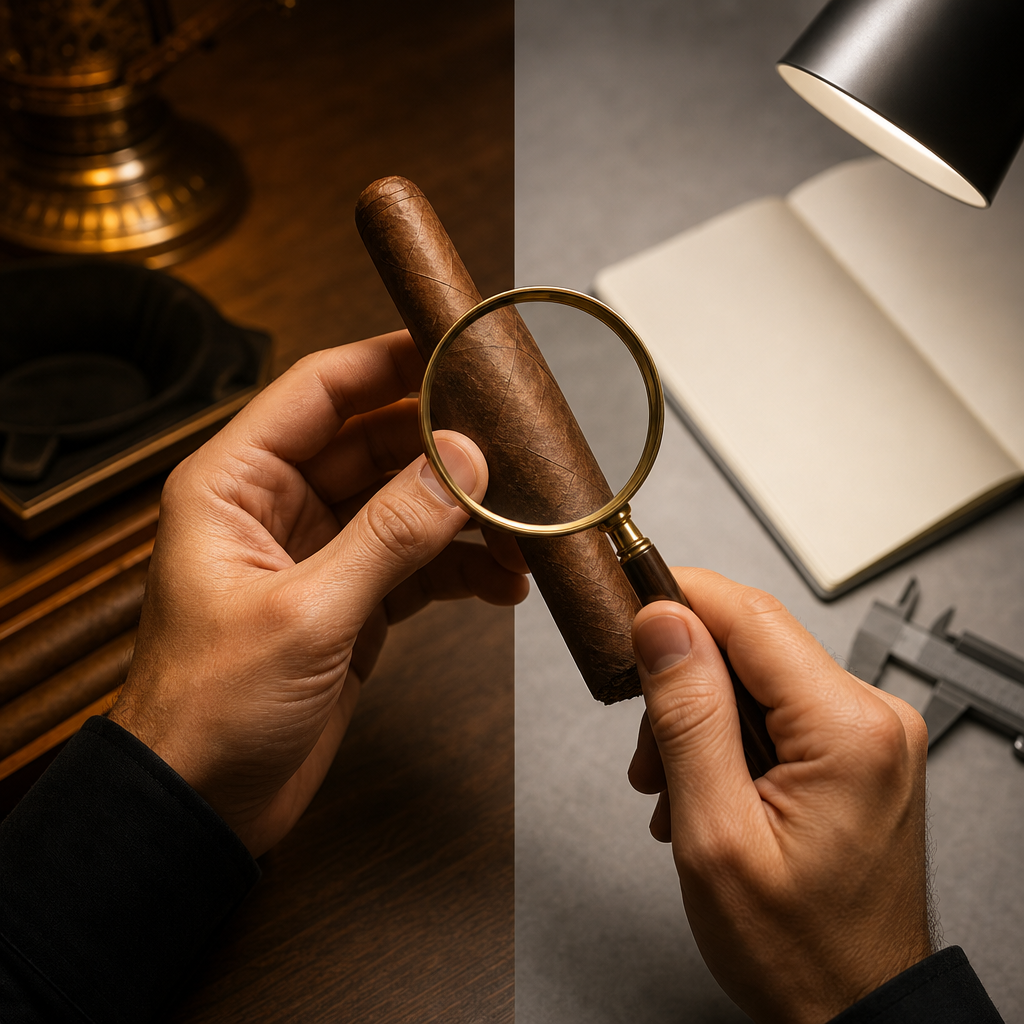
Take, for example, a reception after a four-person directors' dinner in 2026. If the organizer prepares a common Robusto format, such as 50 ring gauge and about 124 mm, it is usually more suitable for the business closing segment than a Churchill of 47 ring gauge and about 178 mm, because the time is more controllable. If someone prefers a slimmer and longer format, a Corona type of 42 ring gauge and about 129 mm can also be prepared as an option. When brands are mentioned, names such as Cohiba, Montecristo, Partagás, and H. Upmann should only serve as cultural and specification context. They should not be packaged with exaggerated language, and brands should certainly not become a reason to pressure guests.
When presenting cigars, the most proper action is to "present choices" rather than "assign an answer". The host may explain: "This one requires a shorter time, while the other takes longer. If we still need to discuss documents tonight, I suggest choosing the size that is easier to manage in time." After the explanation, the choice is handed to the guest. Before cutting the cap, first confirm whether the other party needs assistance. Experienced cigar smokers often have their own cutting methods, including using a double-blade cutter, V-cutter, or punch. If the guest asks the host for help, the principle in cutting the cap is not to damage the shoulder line. The action should be completed in one motion, without repeated trimming at the table. When lighting, first warm the foot with the flame, then allow the outer ring to heat evenly, avoiding holding the flame against the wrapper for a long time. If cedar spills are used, attention should also be paid to where ash falls and to nearby materials, so that aroma, smoke, or fire does not become a burden to others at the table. After the host lights his or her own cigar, it does not mean everyone must begin at the same time. The rhythm of business cigars is to let conversation divide naturally into segments, not to turn every puff into an etiquette examination.
[In-depth Section 2] Space Arrangement: Seating, Ventilation, and Non-Smokers
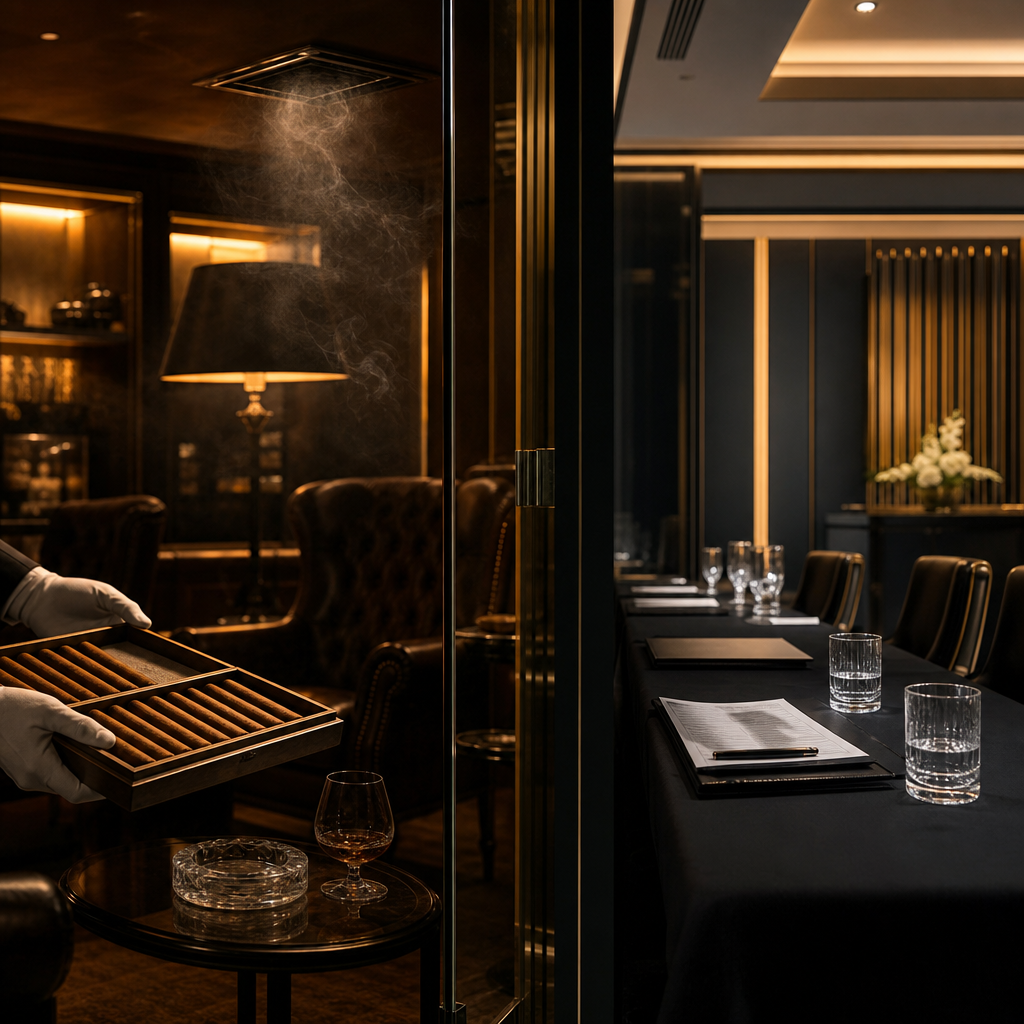
The easiest mistake in high-level business hospitality is not that the cigar is insufficiently rare, but that the space has not been designed first. If the venue involves indoor smoke-free places open to public consumption, such as restaurants, bars, nightclubs, hotels, shopping malls, and KTV venues, smoking is in principle entirely prohibited. Exceptions are indoor smoking rooms with independent air conditioning and independent compartments, or venues that meet the requirements for a cigar lounge. A cigar lounge must meet three requirements: its business items include cigar retailing, cigar-related revenue accounts for 50% or more, and its facilities are sufficient to block emissions or odors. Every time smoke-free places, smoking rooms, or cigar lounges are discussed, independent air conditioning and independent compartments should be confirmed at the same time, and it should be remembered that smoking in a smoke-free place is punishable by a fine of NT$2,000-10,000, while operators who fail to post no-smoking signs are punishable by a fine of NT$10,000-50,000.
In seating arrangements, the host must not place non-smokers downwind of smoke, nor allow the only exit to be blocked by someone who is smoking. For a six-person meeting, willing participants can be seated together on the side more appropriate for ventilation, while non-participants should sit near the door, on the outer side, and where they can move freely. If assistants, drivers, interpreters, or younger members are present, it is even more important to avoid the social pressure of "everyone is doing it, so you should too". Persons under twenty years of age shall not smoke, and no person may supply tobacco products to anyone under twenty years of age. This has nothing to do with position, nationality, or the scale of the occasion. Table arrangement also has etiquette: at least one stable ashtray for every two people, centralized management of fire sources, and distance maintained between water glasses, documents, fabric surfaces, and ashtrays. Ventilation does not mean opening the door to let odors spill out. It means controlling emissions and odors within a compliant space, so that both participants and non-participants are respected.
Practical Notes
For the schedule of business hospitality, it is recommended to divide it into three segments: "meal, documents, cigars", rather than smoking while eating the main course. In a formal dinner, the main course and key issues can generally be completed first, then 45 to 75 minutes can be used as the cigar segment. If the arrangement is a Torpedo type of 52 ring gauge and about 156 mm, the time should be even more conservative, to avoid forcing guests to interrupt because of later schedules. Cigars are not a negotiation tool. The host should not suddenly raise sensitive conditions just after the other party has lit up, nor should the host restrict the other party by saying "finish it before you leave". If the meeting involves signing, confidential documents, or alcoholic beverages, documents should be put away first, leaving only necessary water glasses and ashtrays on the table, to prevent fire, ash, or moisture from affecting the documents.
For service details, in the first round ask "Do you need assistance cutting the cap or lighting?" and do not act directly. If guests bring their own cigars, the host should respect their storage and aging habits, and should not comment on humidity, year, or source. If shared tools are used, they should be kept clean, with cigar cutters, lighters, and ashtrays placed in separate areas. Ash may fall naturally at about 2 to 3 cm. Do not show off long ash at the table, and do not tap ash toward plates, cup rims, or documents. During conversation, it is inappropriate to speak with a cigar in the mouth. Before answering a question, remove the cigar first, slow down the speaking pace, and avoid directing smoke straight toward the other party. At the end, a cigar does not need to be stubbed out like a cigarette. Simply place it in the ashtray and let it go out naturally. The host may remind guests of schedule times, but must not rush their smoking pace.
Common Mistakes
- Deciding for others whether they should participate: Even if the other party is a regular guest, ask again. Refusing to participate is not rude.
- Using cigars in a non-compliant space: Whenever smoke-free places, smoking rooms, or cigar lounges are involved, independent air conditioning and independent compartments must be confirmed, and attention must be paid to the fine of NT$2,000-10,000 for smoking in a smoke-free place and the fine of NT$10,000-50,000 for operators who fail to post no-smoking signs.
- Treating cigars as negotiation pressure: Requiring the other party to light at the same time, finish at the same time, or choose the same size are all business cigar taboos.
- Tapping ash carelessly or showing off long ash: Ash should fall into a stable ashtray, not onto tableware, tablecloths, documents, or the floor.
- Ignoring the under-twenty restriction: Persons under twenty years of age shall not smoke, and no person may supply tobacco products to anyone under twenty years of age.
- Arranging smoking during the main dining segment: The main course, soup, dessert, and cigar segment should be separated, to avoid affecting the dining experience of others at the table.
Frequently Asked Questions (FAQ: 7 or more questions, each ending with "?")
Q: Must business hospitality include cigars? Not necessarily. The core of cigar etiquette is respect, not display. If guests do not smoke, the venue is not compliant, time is insufficient, or others at the table may be affected, cigars should not be arranged. A proper host will regard "not arranging it" as an equally mature choice.
Q: How should guests be asked before the invitation whether they are willing to participate? When confirming the itinerary, ask with neutral wording, for example: "Would you like us to reserve time for cigar conversation after dinner? If that is inconvenient, we can switch to tea or a regular meeting." Do not ask as if it were a test, and do not link refusal to the quality of the relationship.
Q: Which spaces require special caution? Indoor smoke-free places open to public consumption, such as restaurants, bars, nightclubs, hotels, shopping malls, and KTV venues, are in principle entirely smoke-free. Exceptions are indoor smoking rooms with independent air conditioning and independent compartments, or venues that meet the requirements for cigar lounges. A cigar lounge must meet the requirements that its business items include cigar retailing, cigar-related revenue accounts for 50% or more, and its facilities are sufficient to block emissions or odors. It should also be remembered that smoking in a smoke-free place is punishable by a fine of NT$2,000-10,000, and operators who fail to post no-smoking signs are punishable by a fine of NT$10,000-50,000.
Q: May the host cut the cap for the guest first? Not advisable. The host should ask first whether assistance is needed. Many experienced cigar smokers have fixed tools and cutting methods, and the host's unauthorized handling may instead be rude. If the other party asks you to assist, simply handle it with clean tools and steady movements.
Q: Where should the host stand when lighting? If assisting a guest with lighting, stand where you do not block the passage and where the flame is not near clothing or documents. The fire source only needs to approach the foot. Do not hold the flame directly against the wrapper for a long time, and do not let smoke concentrate toward the guest's face.
Q: Is business conversation suitable during smoking? It is suitable for light extension and relationship-oriented topics. It is not suitable to raise core conditions, signing pressure, or sensitive disputes just as the other party has begun smoking. Formal documents, key terms, and confirmations are best completed first on a clear tabletop.
Q: How should it be arranged if someone at the table does not smoke? First give that person the freedom not to participate, then arrange a seat on the outer side, near the exit, and less affected by smoke. Do not ask the person to stay by saying "just sit for a while", and do not comment on the choice in front of the person. If the person expresses discomfort, the process should be adjusted immediately.
Q: Can an assistant or accompanying person under twenty years of age stay at the cigar hospitality venue? Persons under twenty years of age shall not smoke, and no person may supply tobacco products to anyone under twenty years of age. If any person under twenty years of age is present, the organizer should avoid making the cigar process part of that person's work, and ensure that no presentation, storage, or request to participate occurs.
Q: Can electronic cigarettes and heated tobacco be handled with the same cigar etiquette? They should not be discussed together. Electronic cigarettes, heated tobacco, designated tobacco products, and cigars are subject to different controls, and must not be mixed into cigar rules. Unapproved products may involve prohibited importation or penalties, and in business hospitality it is even more important to avoid treating different types of tobacco products as the same matter.
Sources
- Health Promotion Administration, Ministry of Health and Welfare: Announcements and educational materials related to tobacco hazards prevention.
- Customs Administration, Ministry of Finance: Regulations and declaration instructions for inbound passengers carrying tobacco and alcohol.
- Laws & Regulations Database of The Republic of China: The Tobacco Hazards Prevention Act and its enforcement rules: definitions of tobacco products, age restrictions, sales methods, smoke-free spaces, and related regulations.
- Regulatory verification date: June 18, 2026
- This article is not legal advice. Actual customs clearance and penalties are subject to the latest announcements of the competent authorities and determinations by customs.
Smoking is harmful to health. Persons under twenty years of age shall not smoke. Smoking cessation hotline: 0800-636363. This article is provided solely for adults aged twenty and above as a reference on cigar culture, storage, and regulatory knowledge. It is not tobacco advertising, promotion, or purchasing advice. --Cigar Prince Wilson Tsai