In-Depth Fluid Dynamics of the Burn Channel: Ring Gauge and Burn Rate, the Science of Draw Resistance, and Smoke Particle Physics
In-Depth Fluid Dynamics of the Burn Channel: Ring Gauge and Burn Rate, the Science of Draw Resistance, and Smoke Particle Physics
A lit cigar is a precise fluid-dynamics system -- smoke produced by combusting tobacco leaves passes through the burn channel at millisecond-scale speed, then is drawn into a gentleman's mouth for tasting. Understanding this system is not merely "knowing how to light and smoke"; it is the key to elevating appreciation from the sensory level to the level of physics.
This article focuses on the principles of burn-channel fluid dynamics, the correspondence between ring gauge and burn rate, the science of draw resistance (including correct physical units and equations), and smoke particle physics. It does not repeat practical troubleshooting (uneven-burn correction has already been included in the 25 starter articles of the W Cigar Bar Cigar Bible).
Note: The physical parameters in this article vary greatly with ring gauge, density, tobacco leaves, and external environment. They are reasonable representative values, not exact physical formulas.
The Four-Element Fluid-Dynamics System of a Cigar Burn Channel
A lit cigar consists of four dynamically interacting physical elements:
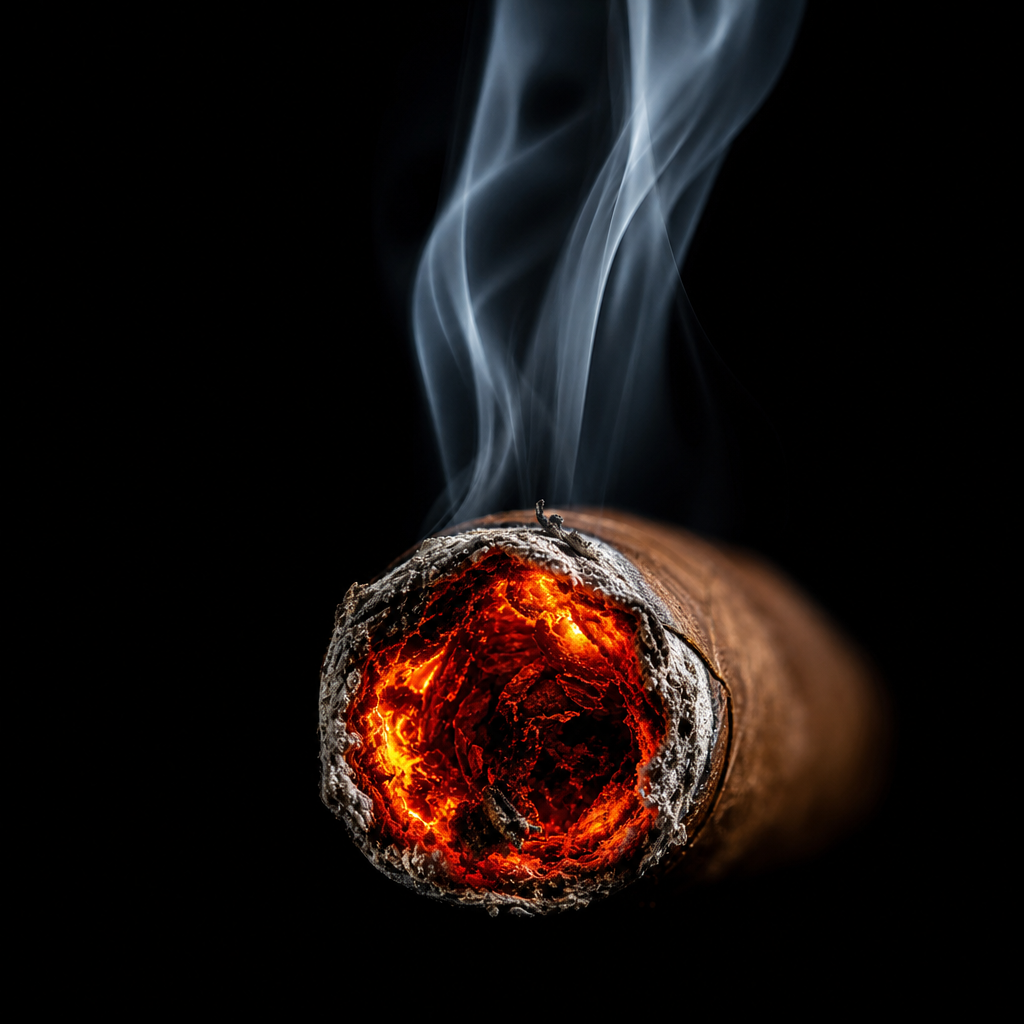
1. Burning front: The red disk where the tobacco leaves are burning, with a temperature of about 700-900°C (800-900°C at the core point, 600-700°C at the edge).
2. Draw channel: The smoke pathway from the burning front to the gentleman's mouth, with a length equal to the current unburned portion. When newly lit, the draw channel is longest (close to the full length); as it burns into the later stages, it becomes shorter and shorter.
3. Draw resistance: The physical resistance of smoke passing through the tobacco bunch, jointly determined by the bunch density (porosity of the porous medium) and ring gauge (cross-sectional area).
4. Puff force: The negative pressure generated by the gentleman's oral muscles, driving smoke through the draw channel. A typical draw generates about 1-4 kPa of negative pressure.
Any imbalance among these four elements will degrade the tasting experience -- if the draw is too loose, combustion is too fast; if too tight, smoke is difficult to draw; if the puff is too forceful, the burn overheats; if the draw channel is too long, the smoke cools excessively. The core definition of a top-tier cigar is this four-element balance.
The Physical Correspondence Between Ring Gauge and Burn Rate
Correspondence 1 -- the larger the ring gauge, the slower the burn rate: Ring gauge represents the cross-sectional area of the tobacco bunch. Cross-sectional area is proportional to the square of ring gauge (A = π(D/2)², where D is the actual diameter converted from ring gauge). Therefore, the cross-sectional area of ring gauge 56 (diameter about 22 mm) is about 1.14 times that of ring gauge 52 (diameter 20.6 mm) -- the burning front must consume 14% more tobacco leaves to advance backward by 1 mm.
Examples:
- Cohiba Behike BHK 52: ring gauge 52, length 119 mm, burn time 60-75 minutes
- Cohiba Behike BHK 56: ring gauge 56, length 165 mm, burn time 120-150 minutes
- A ring gauge difference of 4 plus a length difference of 46 mm jointly create a burn-time difference of about onefold
Correspondence 2 -- the larger the ring gauge, the more stable the burn temperature: A large-ring-gauge cigar has greater thermal mass at the burning front and higher heat capacity. It is less sensitive to disturbances from external wind and puff rhythm, and its temperature fluctuates less. This is one of the physical reasons why gentleman's club members prefer large ring gauge (52+) formats.
Correspondence 3 -- the longer the length, the more complete the smoke cooling: The distance that smoke travels from the 700-900°C burning front to the gentleman's mouth is equal to the current unburned length. The longer the length, the more complete the convective cooling as it passes through the tobacco bunch, and the closer the temperature is to the ideal tasting temperature when it reaches the mouth (about 35-50°C, the comfort zone of the tongue surface). This is the physical reason why top-tier cigars are usually longer than 140 mm.
The Science of Draw Resistance: The Dual Variables of Tobacco Bunch Density × Ring Gauge
Physical Model: Porous-Medium Flow
A cigar tobacco bunch is not a hollow tube; it is a porous medium. The physical model for air and smoke passing through the tobacco bunch should use Darcy's law or the more precise Ergun equation (which describes fluid resistance within a packed particle bed), not the Darcy-Weisbach equation for pipe flow.
The basic form of Darcy's law:
Q = (k · A / μ) · (ΔP / L)
where Q is flow rate, k is permeability, A is cross-sectional area, μ is fluid viscosity, ΔP is pressure difference, and L is flow length.
The permeability k of the tobacco bunch is determined by rolling density, the degree of tobacco leaf fragmentation, the Entubado multi-channel structure, and other factors -- this is the mathematical foundation of Torcedor craft physics.
Correct Units and Ranges for Draw Resistance
The measurement unit for draw resistance in the cigar industry is mmH₂O (millimeters of water column) or the corresponding pressure unit Pa.
- 1 mmH₂O ≈ 9.81 Pa
- Ideal draw-resistance range for top-tier cigars: about 60-150 mmH₂O (about 590-1,470 Pa, not the often misquoted 50-150 Pa)
- Too low (<60 mmH₂O / <590 Pa): overly loose tobacco bunch, burn too fast, smoke too hot
- Too high (>150 mmH₂O / >1,470 Pa): overly tight tobacco bunch, smoke difficult to draw, possible plugged cigar
Top-tier factories use draw test machine (draw-resistance testing machines) to automatically measure finished products -- Padrón, Davidoff, and the main Habanos S.A. factories (El Laguito, H. Upmann, Partagás, etc.) are all equipped with them as standard, ensuring draw resistance remains steadily within the range.
The Three Physical Effects of Draw Resistance
Effect 1 -- smoke flow velocity: The greater the resistance, the slower the flow velocity, the longer the contact time between smoke and tobacco leaves, and the more complete the extraction of esters and other flavor molecules. This is why a slightly tighter cigar is often described as having a "thicker flavor" -- physically, it is an increase in residence time.
Effect 2 -- oxygen supply to the burning front: Resistance is negatively correlated with the oxygen supply rate to the burning front. Greater resistance means less oxygen supply, slower combustion, lower temperature, and smoke that tends to be cooler and thicker; lower resistance means more oxygen supply, faster combustion, higher temperature, and smoke that tends to be hotter and thinner.
Effect 3 -- smoke particle density: The greater the resistance, the smaller the amount of gas passing through per unit time, and the higher the relative smoke particle density (the number of aerosol particles per milliliter of smoke). The "substantiality" of the tasting experience becomes stronger.
Smoke Particle Physics: A Micron-Scale Suspended Aerosol System
Particle Size
Cigar smoke is an aerosol system jointly composed of gaseous molecules and micron-scale suspended particles.
- Particle diameter range: about 0.1-1 μm, with a median value of about 0.3-0.5 μm (comparable to the 0.1-0.4 μm median value of cigarettes, but the particle distribution of cigars is slightly broader)
- This size range corresponds to the physical definition of "inhalable particles" (the PM2.5 range)
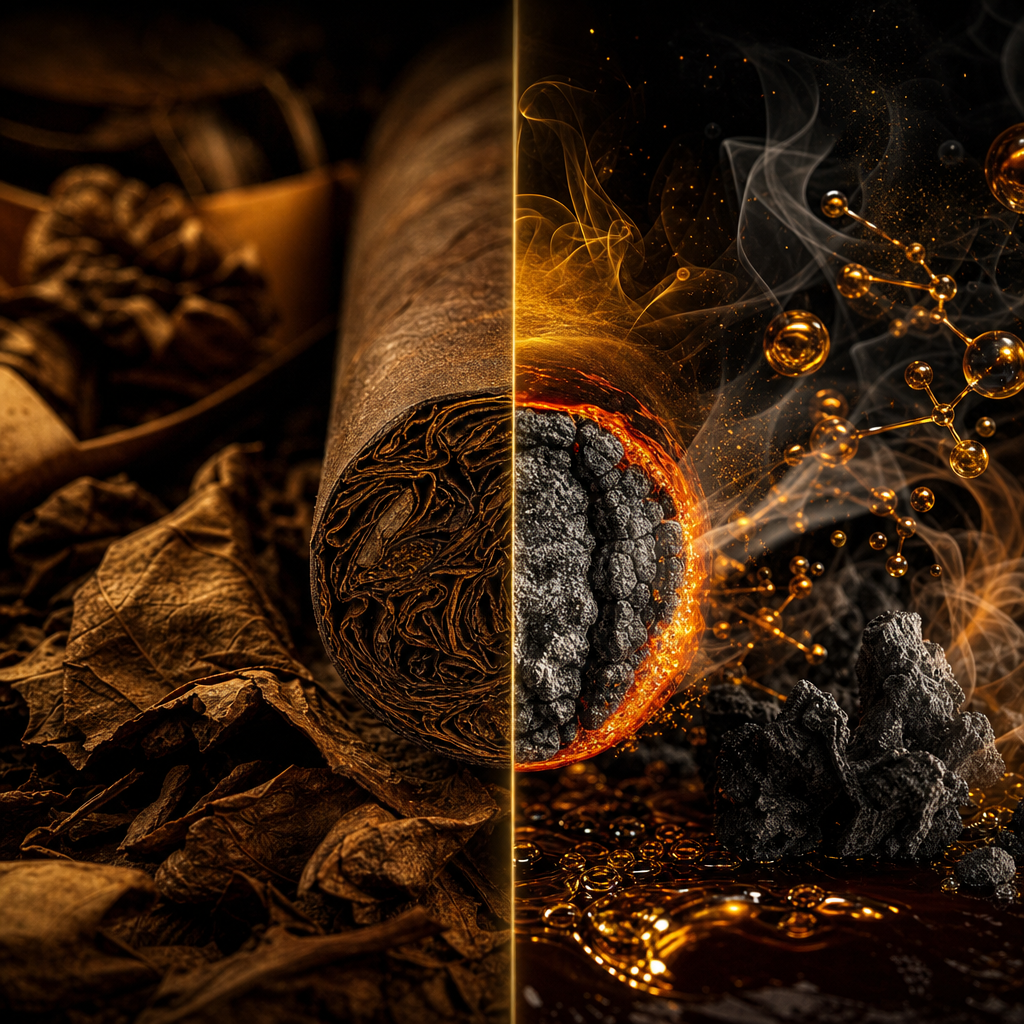
- Main components of cigar smoke particles: tar aerosol (semi-volatile organic matter) + water vapor + trace unburned tobacco leaf fragments
Why Gentlemen Do Not Draw Deeply Into the Lungs
The pH of cigar smoke is alkaline (about 8.0-8.5), while cigarette smoke is acidic (5.5-6.5). Alkaline smoke strongly irritates the lower respiratory tract, so the gentleman's instinctive response is not to inhale it into the lungs -- this is the greatest physicochemical difference between cigars and cigarettes. It is not "etiquette"; it is a method of drawing forced by chemistry. Cigars are for "oral tasting"; cigarettes are for "pulmonary absorption".
Oral Flavor Extraction From Smoke Particles
Smoke particles carry the flavor molecules of top-tier cigars, such as esters, pyrazines, and furans. In the mouth, the particles deposit on the tongue surface, palate, and buccal mucosa -- contacting the taste buds and releasing flavor. The essence of a gentleman's "tasting technique" is control over the residence time of smoke particles in the mouth:
- Slow exhale (5-10 seconds of oral residence): longer residence, more complete flavor extraction, suitable for the middle and later stages
- Quick exhale (1-3 seconds of oral residence): shorter residence, focused more on upper-layer aroma perception, suitable for becoming familiar with the flavor structure in the opening stage
- Retrohale (nasal aftertaste): a small amount of smoke is sent from the mouth into the nasopharyngeal cavity, allowing olfactory receptors to contact gaseous flavor molecules. This is the deepest level of cigar appreciation
Fluid-Dynamics Quality Control in Contemporary Cigar Factories
Three core categories of quality-control equipment in top-tier factories:
1. Draw Test Machine: Automatically measures the draw resistance of each cigar; cigars outside the range are returned for rework. Standard equipment at Padrón, Davidoff, and the main Habanos factories.
2. Weight & Density Check: Automatic weighing + density calculation; cigars with deviations exceeding 5% are returned for rework. Ensures uniform tobacco bunch density.
3. Visual Inspection: Manual inspection of wrapper sheen, visual uniformity, and cap integrity. Major factories still rely on experienced quality-control artisans; machines cannot replace them.
The craft threshold for top-tier Cuban cigars: there are fewer than 20 Cohiba Behike Rollers at the El Laguito factory, combined with strict quality control using draw test machine -- this is the craft foundation that keeps Behike draw resistance steadily in the center of the range and gives the tasting experience high consistency.
The Advanced Understanding Path for Gentleman Club Members
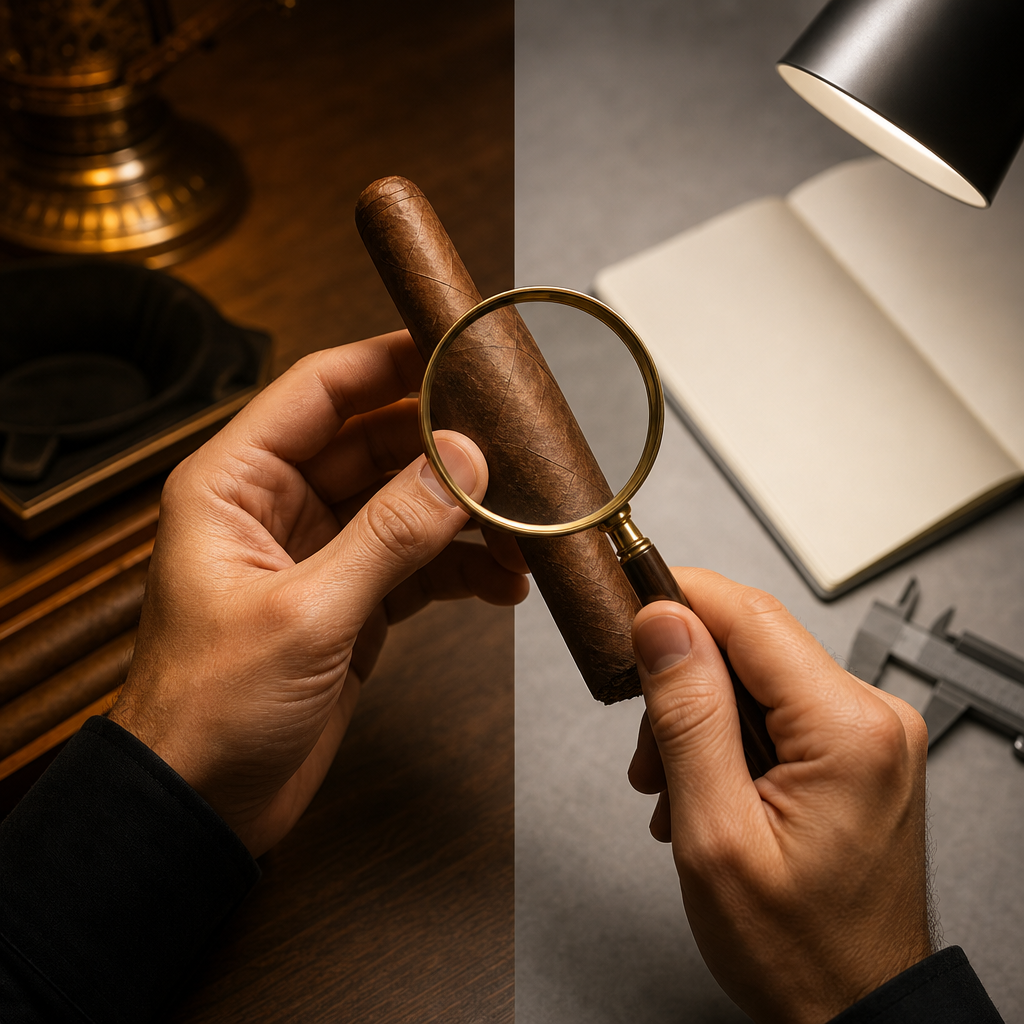
Entry level -- the physical feel of draw resistance: During blind tasting, pay attention to the force needed to draw smoke, and compare Cohiba Robustos (ring gauge 50) vs Cohiba Behike BHK 56 (ring gauge 56) -- sense the physical effect of increased cross-sectional area on draw force.
Intermediate level -- the correspondence between burn rate and ring gauge: Time and compare Behike BHK 52 (60-75 minutes) vs BHK 56 (120-150 minutes) -- experience the time quantification of the square relationship of cross-sectional area.
Deepest level -- smoke particles and oral flavor extraction: Experiment with slow exhale (10-second residence) vs quick exhale (3-second residence), and sense the flavor-extraction differences from different residence times in the same cigar. Then add Retrohale nasal aftertaste training to fully establish an intuitive appreciation of smoke particle physics.
Burn-channel fluid dynamics in one sentence: a top-tier cigar is not something casually lit; it is a precise physics system composed of a 700-900°C burning front + 60-150 mmH₂O draw resistance + 0.1-1 μm aerosol particles.
--
Source of goods: Cuban cigars from four major regular channels (PCC authorized dealers・Cuban official state-run stores・Swiss general distributor・Spanish general distributor).
LUBINSKI accessories official website: https://cigarclub.tw/
Venue information: https://share.google/d9NIeFEetij9qWKj0
This site is for adults aged 20 and above only. Smoking is harmful to health. Smoking cessation hotline: 0800-636363.
W Cigar Bar Gentleman's Cigar House, written and planned by Cigar Prince Wilson Tsai.