How to Choose Between Peat and Sherry Casks: A Personality Test for Two Major Whisky Flavor Routes, and a Comparison Chart for Cigar Strength
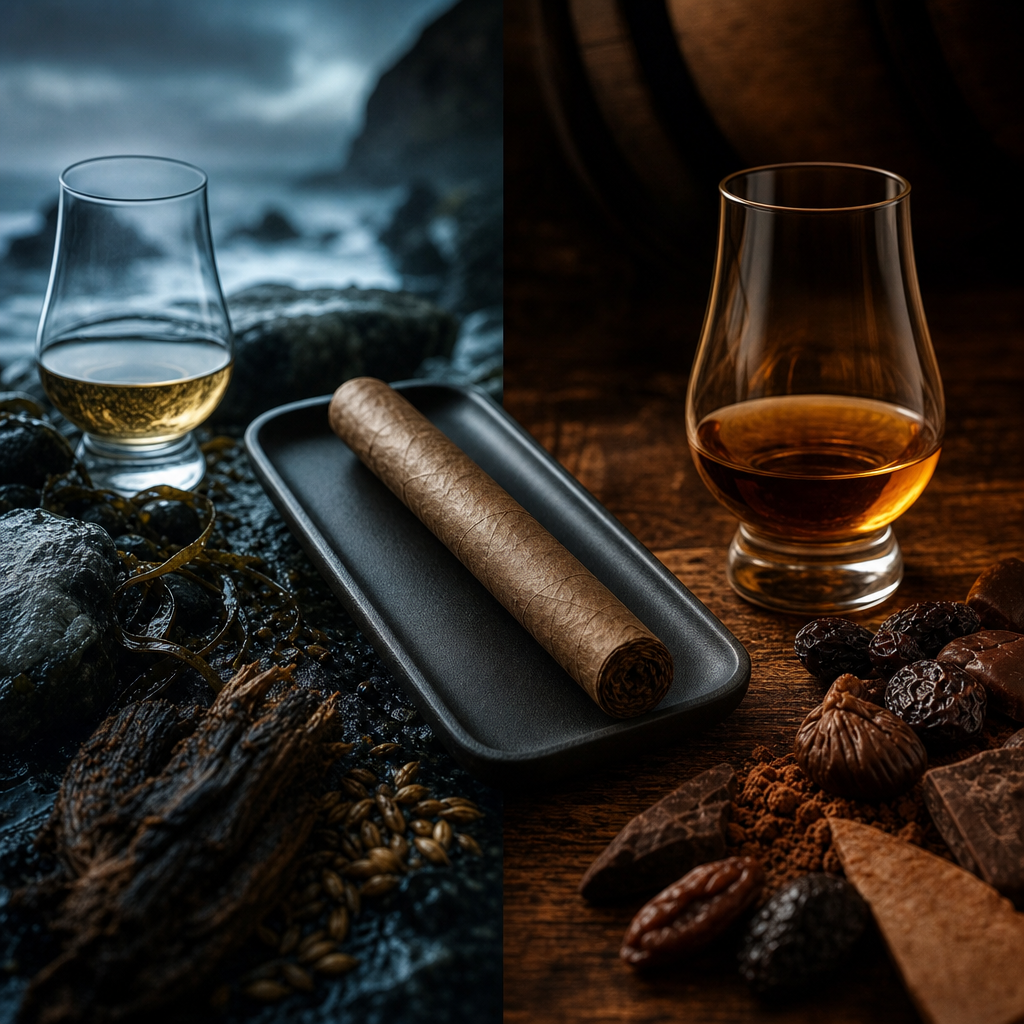
How to Choose Between Peat and Sherry Casks: A Personality Test for Two Major Whisky Flavor Routes, and a Comparison Chart for Cigar Strength
The encounter between peaty whisky and Partagás Serie D No.4 is often my first example when explaining "how to choose whisky"; the same cigar with clear strength can change like a theater with different lighting when paired with peat, sherry casks, or bourbon casks. Peat hardens the smoky profile, sherry thickens the cocoa and dried fruit, while bourbon casks bring vanilla, honey, and wood to the center line. As an editor of the "Cigar Bible," I don't talk about pairing as mysticism but rather look at craftsmanship, molecules, and flavor shifts in the mouth.
Beginners often think of peaty whisky as "very smoky" and sherry cask whisky as "noticeably sweet," but these statements are only half true. The real differences come from malt drying, cask material, oxidation environment, body thickness, and ester composition. The same applies to cigars, where strength is not simply strong or weak but a structure formed by tobacco fermentation, aging, burning temperature, oiliness, and mineral feel.
Peaty Whisky and Sherry Cask Whisky: A Comparison of Whisky Craftsmanship
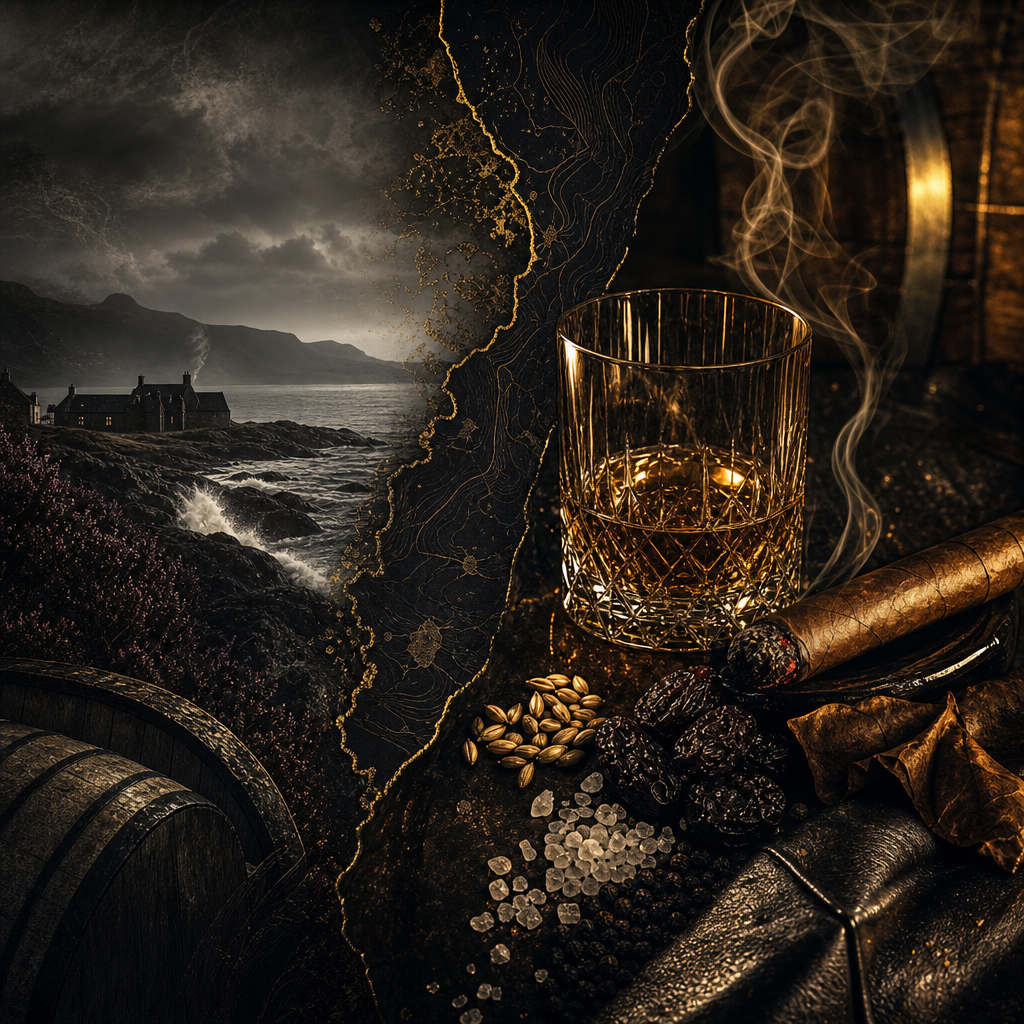
The starting point of the peat route is malt drying. Historically, some Scottish islands and coastal regions used peat as fuel, with smoke passing through germinated barley, leaving phenolic compounds. The often-discussed ppm is a concept for measuring malt phenol value, but when it enters the glass, distillation, maturation, and dilution all change the perceived intensity.
The core flavors of peaty whisky usually include phenol, cresol, guaiacol, and syringol. Phenol evokes thoughts of medicine and disinfectant cotton, cresol brings tar and charred wood, guaiacol leans towards campfire and smoked bacon, while syringol is closer to mild wood smoke. If the distillery is near the coast, saltiness, seaweed, iodine, and damp stone will push the smokiness towards a sea breeze direction.
The origin of sherry cask whisky lies in cask aging, not malt drying. Traditionally, sherry comes from the Jerez triangle in Andalusia, Spain, including Jerez de la Frontera, Sanlúcar de Barrameda, and El Puerto de Santa María. Whisky entering oak casks previously in contact with Oloroso, Pedro Ximénez, or other sherry styles will absorb dried fruit, nuts, dark chocolate, leather, and spice notes.
Peat puts smoke into malt, while sherry casks put oxidized fruit aromas and wood tannins into the maturation structure. This statement can serve as an introductory coordinate. The former is a deep imprint left by fuel and drying craftsmanship, while the latter is a late-stage complexity given by cask material, residual liquor, and oxidative maturation.
Representative Regions: Islay, Speyside, and the Flavor Map of Sherry Cask Whisky
When discussing peaty whisky, Islay is almost an unavoidable name. Laphroaig is often associated with iodine, seaweed, and medicine; Ardbeg is known for high-tension smokiness, lemon peel, and tar; Lagavulin is remembered for dark smoke, sea salt, and a thicker malt sweetness. These flavors are not the same in every batch but are enough to establish a basic outline for comparing peaty whisky.
The Highlands and island regions also have peat expressions. Highland Park from Orkney often carries heather, honey, and hay notes, not as sharp as Islay. Talisker on the Isle of Skye often layers pepper, sea breeze, smoke, and malt sweetness together. Peat is not only a heavy hit but can also be a combination of dryness, spice, floral, and mineral.
Sherry cask whisky often brings to mind Speyside. Names like Macallan, GlenDronach, Aberlour, and Glenfarclas are often used to describe the dried fruit, orange peel, walnut, dark chocolate, and spice of sherry casks. Different distilleries use European oak or American oak, and different sherry types bring differences in dry nuts or concentrated sweet fruits.
The region is not the answer itself but the first layer of filter to predict whisky flavors. Islay often gives you sea breeze and phenols, Speyside often gives you dried fruit and malt sweetness, while the Highlands and islands offer many mixed clues. When truly tasting side by side, you still have to return to the cask type, age, alcohol concentration, and distillery style on the label.
Peaty Phenol × Smoky Resonance: Partagás Serie D No.4's Strength Connection
Partagás Serie D No.4 is often seen as a cigar with clear strength and tight structure in Cuban cigars. Its expression usually includes black pepper, roasted wood, leather, coffee grounds, soil, and dark spices. If the aging state is stable, the front will have dry wood and pepper, the middle will deepen to concentrated coffee and leather, and the back will show stronger mineral and spicy tail notes.
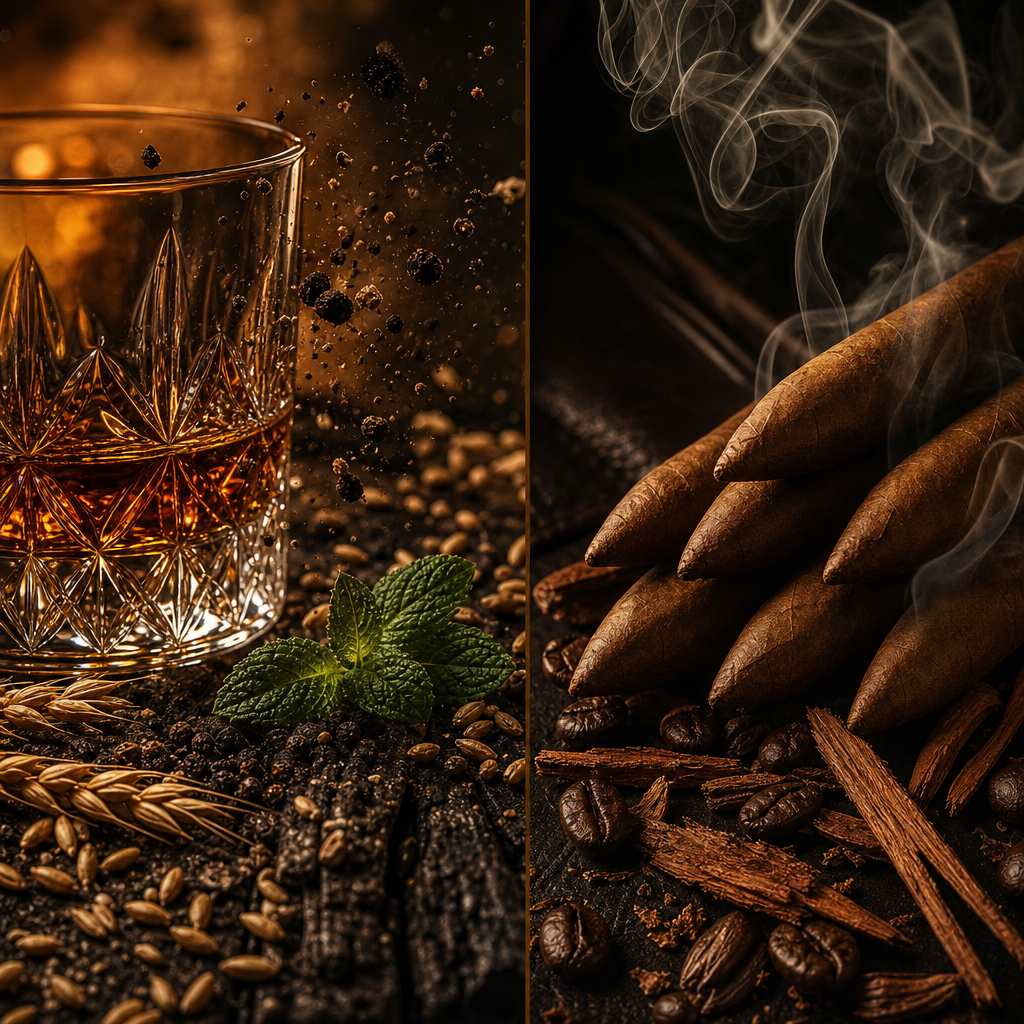
When peaty whisky meets it, the key is not as simple as "smoke plus smoke." The guaiacol and syringol in peat will form a homologous resonance with the wood smoke, roasted fibers, and tobacco char produced when the cigar burns. This resonance will make the smoky profile of Partagás Serie D No.4 more three-dimensional, turning from a single burning sensation to continuous layers of seaweed ash, charred wood, black pepper, and wet stone.
But resonance also has risks. If the whisky's cresol and iodine are too strong, they will push the leather in the cigar towards medicine and tar, narrowing the back of the mouth. At this time, I will shorten the time the liquor stays, using a small sip of whisky for two to three puffs of the cigar, letting the phenols only pull the outline without covering the tobacco sweetness.
The core of peaty phenol × tobacco smoke pairing is to retain the soil, coffee, and leather layers of the cigar after homologous resonance. If you like sea breeze, medicine, charcoal, and black pepper, this route will be clear. If you care more about cream, nuts, and soft sweetness, you don't have to start with the heaviest peat.
Sherry Dried Fruit × Cocoa Complement: Montecristo No.2's Medium-Strong Balance
Montecristo No.2's medium-strong structure makes it very suitable for demonstrating the complementary logic of sherry cask whisky. The common vocabulary for this cigar includes cocoa, coffee, creamy wood, light leather, roasted nuts, and a hint of citrus peel. Unlike Partagás Serie D No.4, which pushes forward with spice and strength, it excels in layers, arcs, and mid-section extension.
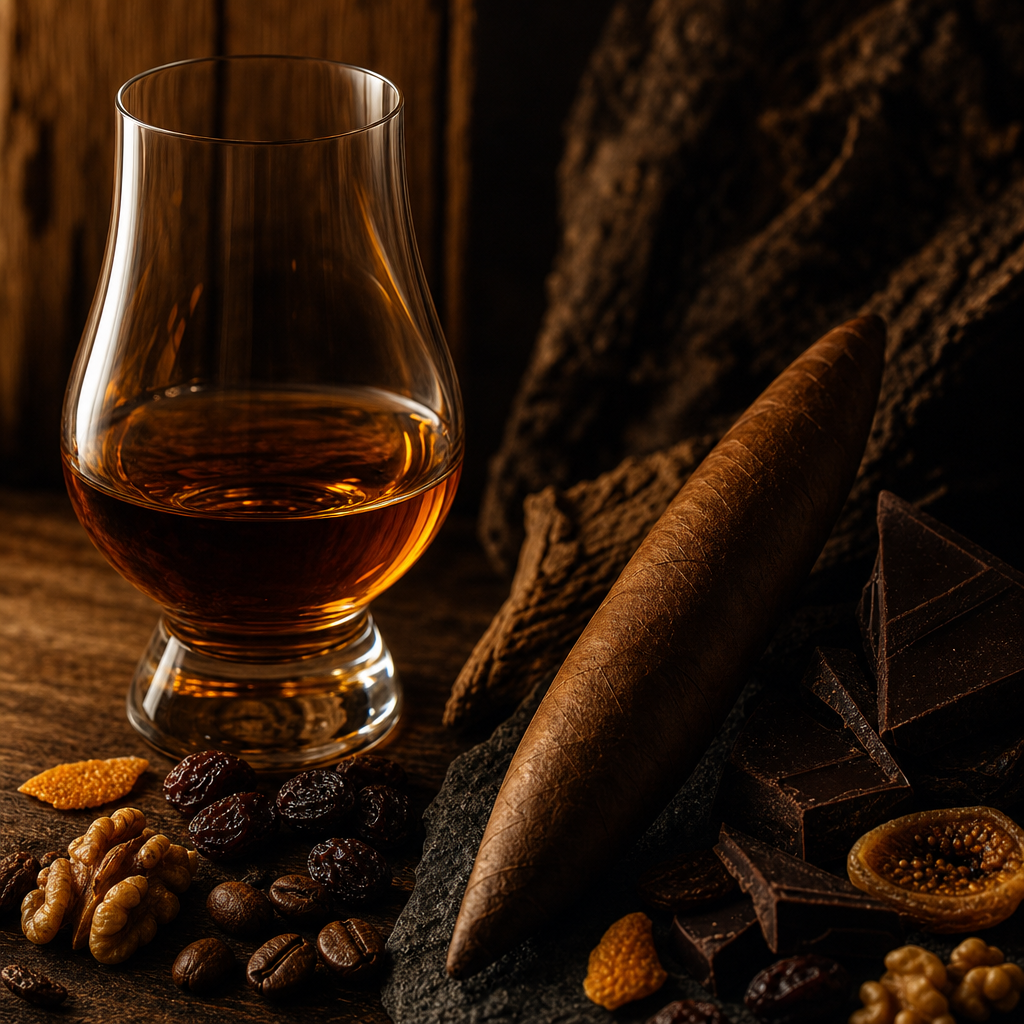
The source of dried fruit in sherry cask whisky often comes from the combined effect of oxidative maturation, cask extraction, and sherry residue. Oloroso casks easily bring walnut, hazelnut, dried orange peel, and leather, while PX casks are more likely to show raisins, prunes, candied figs, and concentrated molasses. When these molecular clues meet Montecristo No.2's cocoa and coffee, they form a "sherry dried fruit × cocoa complement": dried fruit increases the imagination of sweetness, cocoa provides a bitter backbone, and nuts connect the two.
Chemically, this is not a direct increase in sugar but a cross-compensation of olfactory and taste. Furfural in whisky gives hints of almond, roasted, and caramelization, wood tannins bring a dry framework, and esters bring fruit aroma. Pyrazines in cigar smoke make cocoa, coffee, and roasted nuts more pronounced, so the mouth integrates "dried fruit sweetness" and "cocoa bitterness" into a thicker mid-section.
The focus of sherry cask whisky with Montecristo No.2 is to use dried fruit and nuts to complement cocoa, not to cover the cigar with sweetness. If the liquor is too thick and the PX feel too heavy, Montecristo's delicate wood will be flattened. Choosing Oloroso or a more restrained sherry cask version can instead present a better balance for medium-strong cigars.
Bourbon Cask Middle Route: Hoyo de Monterrey Epicure No.2 and Introductory Coordinates
Between peat and sherry, I often regard bourbon casks as the middle route of whisky flavors. American white oak casks bring vanillin, lactones with coconut feel, honey, buttery corn, light caramel, and roasted wood. These elements are highly recognizable, low in aggressiveness, and suitable for those who already have basic tasting skills and want to establish a system to calibrate their taste.
Hoyo de Monterrey Epicure No.2's medium strength can just accommodate this middle-line style. It commonly features cream, cedar wood, light honey, herbs, almonds, and soft floral, with relatively round smoke texture. When paired with single malt from bourbon casks or blended malt mainly from bourbon casks, vanilla and coconut will amplify the creamy wood of the cigar, and honey will make the herbal edges smoother.
This route is very important for beginners because it can prevent being led by the styles at both ends from the start. When peat is too prominent, all cigars may be read as smoky; when sherry is too thick, all cigars may be read as dried fruit cocoa. Bourbon casks act as a neutral background, allowing you to first recognize the wood, cream, herbs, and nuts of the cigar itself, then compare the shifts caused by other cask types.
The bourbon cask middle route is not a compromise but a baseline for establishing how to choose whisky and interpret cigar strength. First calibrate with a medium-strength cigar like Hoyo de Monterrey Epicure No.2, then extend to peat or sherry, and the learning curve will be clearer. You will know whether you love the smoke itself, the thickness of dried fruit, or the balance of wood and vanilla.
Experiment of Flavor Shift with the Same Cigar and Different Whiskies
I often use the same cigar with three different whiskies to let readers understand that whisky comparison is not a contest of adjectives. Taking Partagás Serie D No.4 as an example, pairing with bourbon casks will see black pepper slightly round out, coffee and wood become sweeter, and leather supported by vanilla. Switching to sherry casks, concentrated coffee will lean towards dark chocolate, with raisins, walnuts, and orange peel appearing beside leather.
Switching to peaty whisky, the shift will be more intense. The soil feel of Partagás will be pulled towards wet mud, seaweed ash, and charred wood, with black pepper expanding from the tip of the tongue to the back of the nose. If the peaty body carries lemon peel or saltiness, the mineral line at the back of the cigar will brighten; if the peat leans towards medicine and tar, the tail will become darker and drier.
The same method can also be used on Montecristo No.2. When paired with bourbon casks, its creamy cocoa and cedar will be clearer; with sherry casks, cocoa becomes dark chocolate, coffee becomes mocha, and nut feel more complete; with peat, the original soft wood will be covered by smoky shadows, suitable for readers who want to see its other side, but not necessarily the most balanced reading.
The value of using the same cigar with different whiskies lies in seeing the specific positions where flavors are amplified, shifted, or obscured. Don't just remember simplified formulas like "peat pairs with strong, sherry pairs with medium-strong." A better way is to record which molecules push the front, middle, and back sections, so you know where to adjust next time.
How to Choose Whisky: Peat, Sherry Casks, and Cigar Strength Comparison Chart
If you're asking how to choose whisky, don't start with brand names but with preference words. If you like sea breeze, medicine, campfire, and black pepper, look for peaty whisky; if you like raisins, prunes, dark chocolate, and walnuts, look for sherry cask whisky. If you like vanilla, honey, coconut, and light caramel, stand on the bourbon cask middle route first.
The decision tree can be simple. The first question asks if you can accept obvious smokiness and medicine feel; if yes, then see if the cigar strength can accommodate it. The second question asks if you like dried fruit and dark chocolate; if yes, then see if the cigar has cocoa, coffee, or nut undertones. If both are still uncertain, the bourbon cask will be a better baseline, especially suitable for pairing with medium-strength cigars.
| Whisky Route | Main Flavor | Corresponding Cigar | Pairing Logic |
|---|---|---|---|
| Peaty Whisky | Smoke, Medicine, Sea Breeze, Charred Wood | Partagás Serie D No.4 (Strong) | Peaty Phenol × Tobacco Smoke Homologous Resonance |
| Sherry Cask Whisky | Dried Fruit, Dark Chocolate, Nuts, Leather | Montecristo No.2 (Medium-Strong) | Sherry Dried Fruit × Cocoa Bitterness Complement |
| Bourbon Cask Middle Route | Vanilla, Honey, Coconut, Roasted Wood | Hoyo de Monterrey Epicure No.2 (Medium) | Vanilla Wood × Creamy Cedar Establish Baseline |
Truly effective whisky flavor selection is to use cigar strength to accommodate the dominant molecules of the liquor, not just look at the liquor name. Strong cigars can withstand peaty phenols, medium-strong cigars can complement sherry cask dried fruit, and medium cigars are suitable for letting bourbon casks calibrate the taste. This chart is not a fixed rule but helps you avoid letting one end of the flavor overwhelm the whole scene from the start.
Frequently Asked Questions
The best learning order for the three routes of peat, sherry casks, and bourbon casks is to start in the middle, then go to both ends.
Does peaty whisky have to be paired with strong cigars?
Not necessarily, but strong cigars are more likely to accommodate the phenolic and smoky pressure of peat. If the cigar is too delicate, medicine, tar, and seaweed ash may overshadow floral and creamy wood. Partagás Serie D No.4 is suitable because it has a black pepper, leather, and coffee backbone.
Will sherry cask whisky make cigars sweeter?
It won't actually change the sugar content of the cigar but uses olfactory signals of dried fruit, caramelization, and oxidative nuts to make it feel sweeter. Montecristo No.2's cocoa, coffee, and nuts can catch these signals, so it appears thicker. If the sherry cask is too heavy, delicate wood may also be obscured.
Why is the bourbon cask middle route suitable for beginners?
The vanilla, coconut, honey, and roasted wood of bourbon casks are highly recognizable, making it easier to establish flavor coordinates. When paired with Hoyo de Monterrey Epicure No.2, the cream, cedar, and herbs of the cigar won't be overly skewed. Once you know the baseline taste, comparing peat and sherry casks becomes more accurate.
What is a hybrid route, and will peat plus sherry be too complex?
A hybrid route refers to peaty raw liquor re-entering sherry casks or combining peaty body with sherry cask maturation ratios. It will simultaneously present smoke, sea breeze, dried fruit, dark chocolate, and nuts, with denser layers. When pairing, pay special attention to cigar strength; otherwise, peat and sherry will compete for dominance.
What should be recorded when changing whiskies with the same cigar?
It's recommended to record the front, middle, and back sections, noting wood, sweetness, spice, smoke, bitterness, and tail length. Don't just write good or bad, as the focus of pairing is flavor shift. You will gradually see which type of whisky makes the cigar brighter, thicker, drier, or narrower.
Will adding water to whisky affect cigar pairing?
Adding a small amount of water may open up esters and wood aromas, or reduce alcohol stimulation, making the details of the cigar easier to read. After adding water to peaty whisky, the sea breeze and medicine feel may become more pronounced; after adding water to sherry casks, dried fruit and nuts may become clearer. The key is to make small adjustments each time to know where the changes come from.
Peat and sherry casks are not about taste hierarchy but two craftsmanship personalities. Peat pushes phenols, sea breeze, and smoke to the foreground, sherry casks lay dried fruit, dark chocolate, and nuts in the mid-section; bourbon casks make vanilla wood the calibration line. Next time you face a whisky flavor choice, first ask your preference, then see if the cigar strength can accommodate it, and the answer will be clearer than you think.
Further Reading|Complete Map of Whisky Regions: From Scotland's Five Major Regions to Asia's New Forces, and a Comprehensive Overview of Pairing with Cigars|Complete Analysis of Cask Strength Whisky: The Art of Cask Aging and Adding Water, and the Ultimate Showdown with Cohiba Behike 52|The Refreshing Formula of Highball Whisky Soda: Bubbles and Malt for Summer Nights, Paired with Por Larrañaga Petit Corona
—Cigar Prince Wilson Tsai
Smoking is harmful to health. Under 20 years old is not allowed to smoke. Quit smoking hotline: 0800-636363. This article is for reference only for adults over 20 years old as cigar culture, storage, and regulation knowledge, not a tobacco advertisement, promotion, or purchase suggestion.
No drunk driving. Excessive drinking is harmful to health. Under 18 years old is prohibited from drinking. This article is also not an alcohol advertisement, promotion, or purchase suggestion, please drink responsibly.