Complete Comparison of Cigar vs Wine Cellaring Investment: Mellowing, Aging, and the Investment Logic of Two Top-Tier Gentlemanly Pastimes
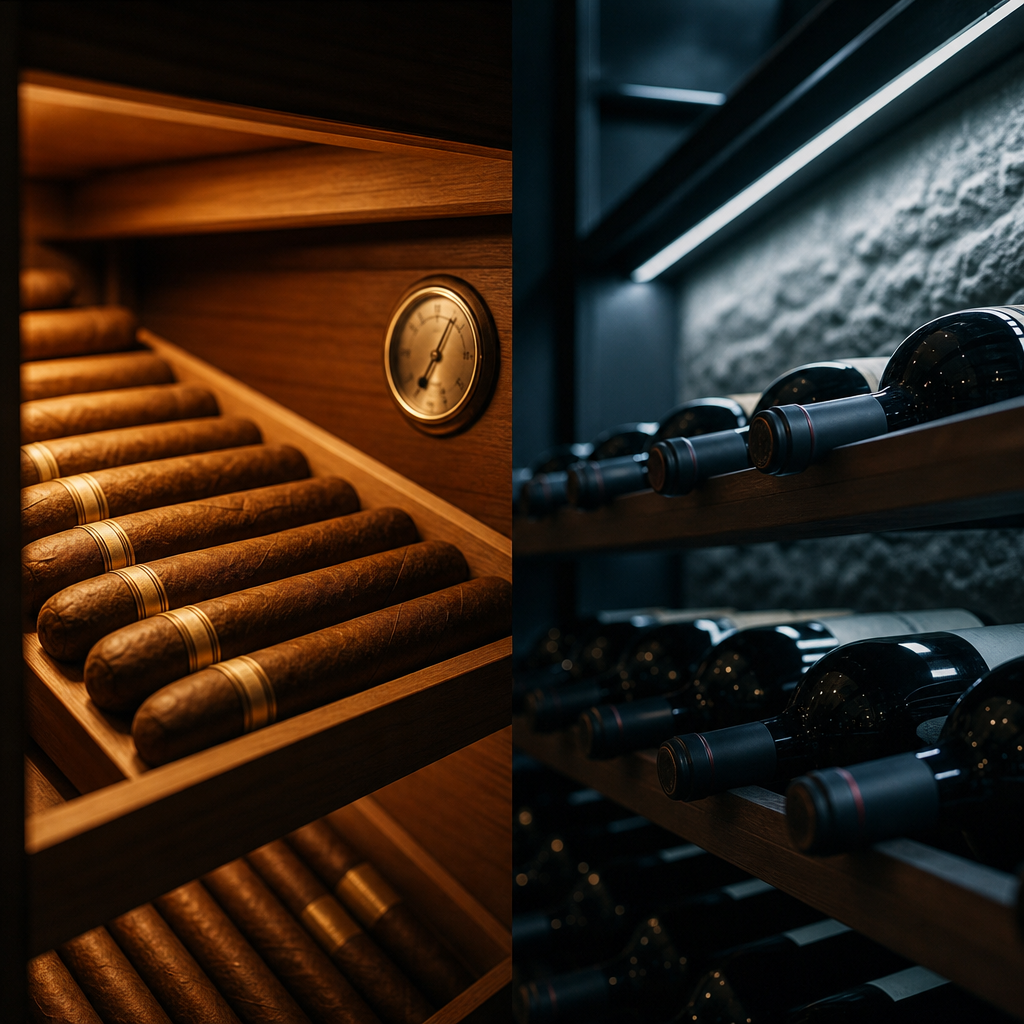
Complete Comparison of Cigar vs Wine Cellaring Investment: Mellowing, Aging, and the Investment Logic of Two Top-Tier Gentlemanly Pastimes
Top-tier cigars and top-tier wines have been twin products within 200 years of gentleman's club culture - sharing similar gentleman consumer groups, price distributions, auction markets, and historical premium logic. But in their actual investment structures, the two have fundamental differences: cigars follow a "mellowing" path, while wines follow an "aging/maturation" path. These two terms have a clear distinction in the industry and are not synonyms.
This article focuses on comparing the investment structures of these two asset classes, providing gentleman's club members with a complete decision-making framework.
Neutral note: All market data in this article are industry reference values. Transaction results vary greatly among auction houses. Past performance does not represent future performance. This does not constitute investment advice.
Mellowing vs Aging/Maturation: The Essential Difference Between Two Terms
Cigar "mellowing" (aging): The slow transformation of oils, sugars, and ester molecules inside tobacco leaves, the reduction of spiciness, the increase of layering, and the change in flavor from sharp to rounded. The ideal environment is 70% humidity / 16-20°C / protected from light with ventilation. The industry consensus is that 5-15 years is the optimal mellowing range for most top-tier Cuban cigars; over 30 years enters deep mellowing; over 50 years enters the final stage of historical mellowing. Mellowing is not infinitely linear - cigars over 80 years old will begin to lose aroma and enter the decline stage known in the industry as the "dormant phase."
Wine "aging" or "maturation": The integration of tannins, acidity, alcohol, and ester molecules. The aging window varies greatly depending on grape variety, vintage, and winemaking technique - Bordeaux First Growths 20-50 years, top-tier Burgundy (Romanée-Conti, Domaine Leroy) 15-40 years, Champagne vintage 10-30 years. Environmental requirements are stricter: 12-14°C / 70-75% / absolute protection from light / vibration avoidance.
Three key differences:
- Cigar mellowing is "internal molecular evolution," while wine aging is "molecular interaction + micro-oxidation"; the two scientific mechanisms are different
- The cigar mellowing window is longer (5-80 years), while the wine aging window is shorter (mainly 10-50 years)
- After cigars reach the final stage of mellowing, quality can remain stable for many years (a historical mellowing plateau), while wine will clearly decline if aged too long (over-matured red wine loses all acidity and tannins disintegrate)
Investment Structure Comparison: Liquidity, Storage Costs, Risks, and Historical Premiums
Liquidity
The wine auction market is more mature - Christie's, Sotheby's, Acker Merrall & Condit, and other major auction companies hold multiple dedicated sales every year. Top-tier red wines (Lafite 1982, Romanée-Conti 1990, Pétrus 1989) have high liquidity, with "transactions completed within 24 hours of auction." The cigar auction market is smaller. Top-tier series (Pre-Embargo H. Upmann, 1955 Partagás Lusitanias, early batches of Behike) may take "3-12 months to find the right buyer," and liquidity is clearly lower than that of top-tier red wine.
Storage Costs
Cigar storage is cheaper than wine storage: a one-time investment in a humidor plus annual maintenance costs is about one-third to one-half of those for a wine cellar. However, the long-term cost of a professional humidor (such as the 33 VIP cigar lockers at W Cigar Bar Da'an flagship store, maintained by dedicated personnel 24 hours a day) approaches that of a top-tier wine cellar. Wine cellars require stricter environments and face the risk of bottle oxidation, resulting in higher storage costs.
Risk Structure
Three major cigar risks: cigar beetle (Lasioderma serricorne) hatching, white deposits (the identification debate between Plume-like deposits and true mold, see plume-mold-microscience-deep), and changes in political embargo policy (2026/5/1 EO 14404 is the strictest in the contemporary period).
Three major wine risks: cork failure (cork taint, TCA compound contamination), in-bottle oxidation, and counterfeit branded wine (the proportion of counterfeit top-tier Bordeaux has risen significantly in recent years, similar to the counterfeit cigar supply chain).
Historical Premiums
The historical premium of top-tier red wine is more obvious: 1982 Lafite rose from USD 100 per bottle at release to an industry-estimated USD 5,000-15,000 per bottle in 2026, an increase of about 50-150 times.
The historical premium of top-tier cigars is more moderate: 1958 H. Upmann Sir Winston rose from about USD 5 per cigar at release to USD 800-1,500 per cigar in 2026, an increase of about 160-300 times. However, because cigars have a consumable attribute (once smoked, they are gone), the industry consensus is that the actual net investment return is "slightly lower than the headline figure."
Past performance does not represent future performance.
Differences in Customer Groups Between the Two Asset Classes
The gentleman's club member groups for top-tier cigars and top-tier wines overlap highly but are not completely the same.
Wine collecting circle: More internationalized, with a more even distribution of customers (Europe, North America, and Asia-Pacific each accounting for about 1/3).
Cigar collecting circle: Affected by the U.S. embargo, the North American customer group is relatively smaller, while Europe (Switzerland, the United Kingdom, Spain) and Asia-Pacific (Japan, Hong Kong, Taiwan, Singapore, China) account for a larger proportion.
Asia-Pacific gentleman's club members have the highest proportion of simultaneous investment in both categories - among top gentlemen in Taiwan, Hong Kong, Singapore, and Tokyo, the parallel configuration of "wine cellar + humidor" is standard. The gentleman's club members of W Cigar Bar Da'an flagship store are a representative group for this configuration, known in the industry as the "dual-asset allocation of Asia-Pacific gentlemen."
The Gentleman's Dual-Asset Investment Philosophy
Principle 1 - Do not buy for investment; buy for enjoyment: Gentlemen who do not intend to smoke / do not intend to drink are the people in the industry who should least enter these two markets.
Principle 2 - Long-term holding: Cigars for more than 10-20 years, wines for more than 15-30 years. Short-term speculation is the strategy with the highest failure rate in the industry.
Principle 3 - Four major official channels: Whether cigars or wines, purchase only through official distributors or top-tier auction companies, and avoid private channels and the gray market - this is the only way to reduce counterfeit risk and preserve historical premiums.
Advanced Path From Red Wine Into Cigar Collecting
Entry level: Cohiba Robustos or Romeo y Julieta No.4 - to experience the foundation of cigar mellowing.
Mid-level: Behike BHK 54 + a Bordeaux Second Growth of the same level (Pichon Lalande, Léoville Las Cases) for comparative appreciation - to feel the difference in chemical language between the two categories at the "mid-to-high-end" level.
Deepest level: Pre-Embargo H. Upmann Sir Winston paired with 1982 Lafite - the most complete flagship dual-asset moment and appreciation experience for contemporary gentlemen.
Conclusion
Cigars and wines are not competitors; they are twin products of 200 years of gentleman's club culture - one has the temporal thickness of mellowing, the other has the chemical depth of aging. A gentleman needs to study both together to be complete.
Investment involves risk. Past performance does not represent future performance. This article is only an asset comparison analysis widely discussed in the industry and does not constitute investment advice. For specific market conditions, please refer to public information from top-tier auction companies such as Christie's, Sotheby's, Bonhams, and Acker Merrall & Condit.
--
Procurement sources: Cuban cigars from the four major official channels (PCC authorized dealers, Cuban official state-run stores, Swiss general agent, Spanish general agent).
LUBINSKI accessories official website: https://cigarclub.tw/
Venue information: https://share.google/d9NIeFEetij9qWKj0
This site is for adults aged 20 and above only. Smoking is harmful to health. Smoking cessation hotline: 0800-636363.
W Cigar Bar Gentleman's Cigar Lounge, written and planned by Cigar Prince Wilson Tsai.