Techniques for Choosing Cigars: A Comprehensive Consideration from Name to Flavor
Choosing a cigar is never just about the ring gauge, length, or brand reputation. Once you get started, you'll find that a Robusto from Cuba, Nicaragua, or the Dominican Republic can have completely different rhythms; similarly, a "Churchill" may present entirely different levels due to series, vintage, and storage conditions.
As the editor of "Cigar Bible," I often remind friends: first learn to understand the name, then consider flavor, origin, personal taste, and occasion on the same map. In this article, I will use actual brands, vintages, and selection logic to help you establish a more stable judgment method.
First Clue from the Name: Size, Series, and Family Character
Many people only remember the brand when looking at a cigar name, ignoring the model behind it. Take Montecristo No.4 as an example, with a length of about 129mm and a ring gauge of 42, it is a classic representative of the Cuban Petit Corona; Partagás Serie D No.4 is about 124mm with a ring gauge of 50, although the length is close, the smoke volume, burning speed, and presence in the mouth are stronger. The name is not a decoration; it often reveals half of the size, series positioning, and historical style.
Looking at Romeo y Julieta Churchill, the name Churchill is not just a shape, but also a hint of long-term, linear development; Hoyo de Monterrey Epicure No.2 reveals a more rounded, relaxed, and suitable for fine-tasting positioning from "Epicure." After 2010, many brands launched short and fat sizes, such as H. Upmann Half Corona and Trinidad Vigía, reflecting modern people's shortened time but still wanting to retain concentration and complexity.
Beginners can read the name with three questions: Is it a regular, limited, or commemorative series? Is its vitola slender, standard, or large ring gauge? Is it entry-level, core, or high-end in the brand family? For example, since its launch in 2002, Cohiba Siglo VI has often been regarded as a thicker, more modern representative of the Línea 1492 series, while Siglo II is more agile. Understanding the name allows you to estimate time, strength, and flavor direction before lighting up.
Establishing Language with a Flavor Wheel: Don't Just Say "Smooth" or "Strong"
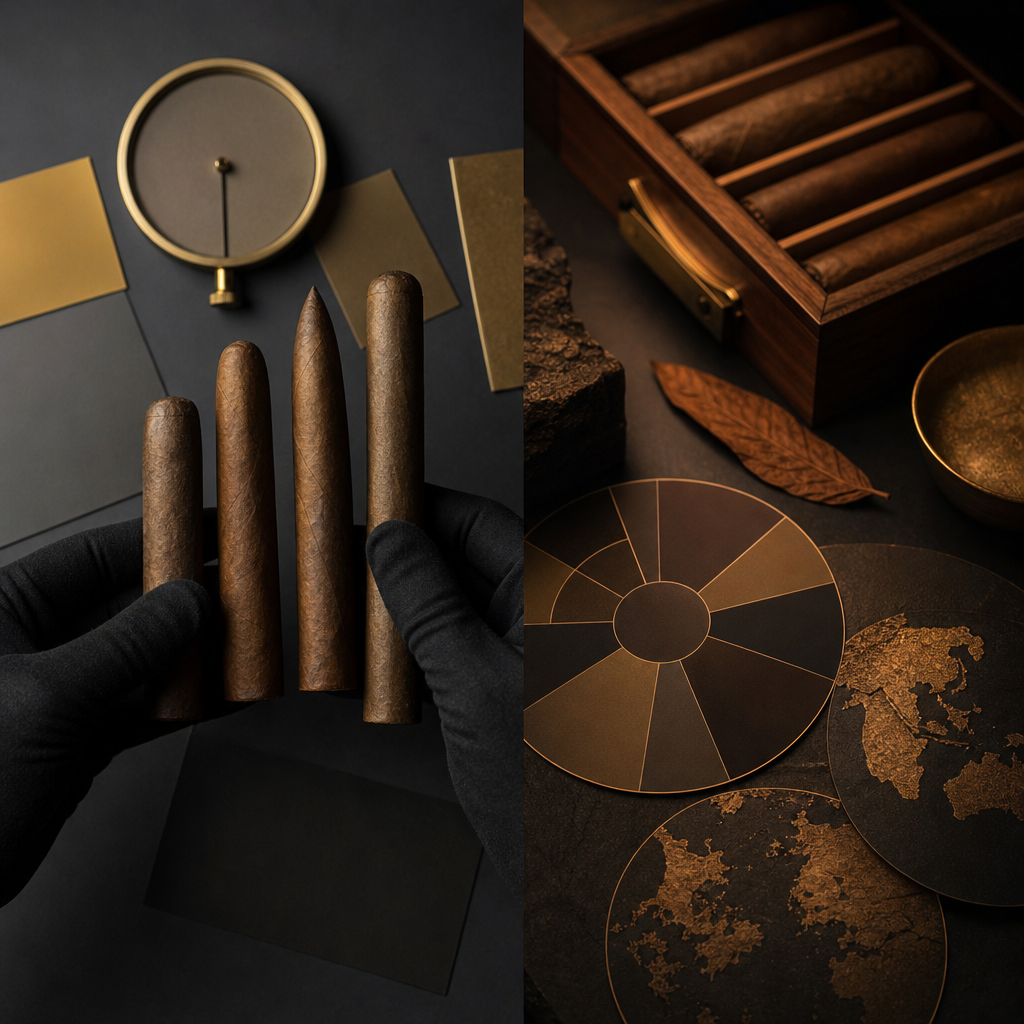
Beginners often use "smooth, fragrant, strong" to describe cigars, but these three words are too broad and cannot help you choose more accurately next time. It is recommended to break down the flavor into several aspects: woody, nutty, creamy, leathery, coffee, cocoa, pepper, spice, floral, and mineral. For example, H. Upmann Magnum 46 often has nutty, light woody, and mild spicy notes; Partagás Serie P No.2 tends to have leather, black pepper, and deeper soil notes.
Flavor should also be viewed separately from "strength" and "richness." Strength is the nicotine and body sensation, while richness is the density of aroma; Davidoff Signature No.2 may not be strong, but its aroma is clean and delicate, not thin. Padron 1964 Anniversary Maduro often has cocoa, coffee, brown sugar, and a thick texture, with a noticeable increase in richness. Being able to break down flavors prevents you from mistaking all strong cigars as high-end.
I suggest keeping a personal record, writing 5 columns for each cigar: brand model, year or box code, burning time, flavors in the first three segments, and whether you would choose it again. For example, with a 2021 box of Hoyo Epicure No.2, if you record creamy woody notes in the front, honey nut in the middle, and herbal bitterness in the back, you can determine next time that you prefer a "medium strength, sweet and woody balance" route.
Origin Background: The Same Size, Soil and Craft Change Personality
Cuban cigars are often talked about in terms of regions like Vuelta Abajo and Pinar del Río because soil, humidity, and long-term formula traditions form unique herbal, mineral, woody, and oily notes. Montecristo, Partagás, Cohiba, and H. Upmann each have brand languages, not just label differences. Even if they are both Corona Gorda, the structure and aroma brightness of H. Upmann Magnum 46 and Punch Punch will differ.
Non-Cuban regions require more attention to country and leaf blend. Nicaragua often uses a combination of Estelí, Jalapa, and Condega leaves, with Estelí providing strength and pepper, Jalapa adding sweetness and aroma, and Condega offering balance. My Father Le Bijou 1922 often presents obvious spice and thickness; Oliva Serie V Melanio is known for cocoa, coffee, sweet wood, and a more mature structure. Origin is not a ranking of superiority, but a style coordinate.
The Dominican Republic often has more elegant aroma lines, such as Arturo Fuente Hemingway Short Story, where you can still feel sweet, woody, and gentle spice in a short size; Davidoff Winston Churchill series uses leaves from different regions to create more modern layers. When choosing, don't just ask which country is better, but ask: Do you want herbal minerals, spicy thickness, or clean elegance today? Understanding style through origin is more reliable than judging status through origin.
Size and Time: Bigger Ring Gauge Isn't Always Better
Size changes the burning rhythm and affects smoke temperature and flavor development. Robusto is usually about 124mm with a ring gauge of 50, suitable for 45 to 70 minutes; Toro is about 152mm with a ring gauge of 50 to 54, possibly requiring 70 to 100 minutes; Lancero is about 190mm with a ring gauge of 38, with delicate smoke but more challenging to make and control fire. Choose size based on time and focus, not appearance momentum.
Here is a beginner's selection table I often use to help you match time, style, and situation:
| Size Type | Common Specs | Approximate Time | Suitable Style | Representative Example |
|---|---|---|---|---|
| Petit Corona | 125-130mm / RG 40-42 | 35-50 minutes | Clear, Direct | Montecristo No.4 |
| Robusto | 120-130mm / RG 50 | 45-70 minutes | Balanced, Easy to Master | Partagás Serie D No.4 |
| Churchill | 175-180mm / RG 47 | 90-120 minutes | Slow Development | Romeo y Julieta Churchill |
| Pirámide | 150-160mm / RG 52 | 70-100 minutes | Focused, Sense of Change | Montecristo No.2 |
Large ring gauges like 56, 58 bring more filler leaf proportion, with large smoke volume and full flavor, but not necessarily more complexity; thin ring gauges like 38, 40 better highlight the precision of the wrapper and blend, but are also more prone to overheating. If you only have 40 minutes, forcing a Churchill will make the latter part rushed; if you have a full two hours after dinner, a short size may leave you wanting more. The right size is one that allows you to complete it leisurely from start to finish.
Establishing a Cigar Selection Route Based on Personal Taste, Not Chasing Lists
Many beginners choose cigars based on rankings, ending up with styles that others like but are too heavy for themselves. You should first mark your taste preferences: do you like coffee cocoa, nutty cream, woody leather, or floral herbs? Then see what strength you can accept. If you usually drink light-roast pour-over coffee, you may find it easier to appreciate the delicacy of Hoyo, Davidoff Signature, and H. Upmann; if you prefer espresso or peaty whisky, Padron, My Father, and Partagás may resonate more.
I divide the selection route into three groups: the first group is gentle and delicate, such as Davidoff Signature No.2 and Hoyo Epicure No.2; the second group is moderately balanced, such as H. Upmann Magnum 46 and Romeo y Julieta Short Churchill; the third group is thick and spicy, such as Partagás Serie D No.4, My Father Le Bijou 1922, and Padron 1964 Maduro. First find your taste range, then explore deeper into the brand, and the success rate will be much higher.
You can also reverse-engineer using drink preferences. People who like oolong tea often accept woody, floral, and aftertaste; those who like bourbon whisky may prefer vanilla, caramel, oak, and sweet aroma; black coffee lovers are usually not averse to cocoa, roasted, and slight bitterness. After recording 10 cigars, you'll find that you don't "like brand names," but rather a certain burning rhythm, aroma density, and length of aftertaste.
Year, Storage, and Source: A Good Name Also Needs a Good State
The same cigar can have significant differences due to year and storage conditions. For Cuban box codes, different batches in 2018, 2019, 2020, and 2021 often have differences in humidity, tightness, and flavor openness; non-Cuban brands can also vary due to batch, packaging date, and transportation conditions. Cigars are not just about labels; you also need to look at the wrapper's oiliness, elasticity, foot aroma, and whether there are cracks or mold spots. A poorly stored famous brand often loses to a well-preserved mid-range option.
Storage temperature and humidity can use 18 to 21°C and relative humidity of 65% to 69% as a stable range; if the environment is too humid, burning will be stuffy, bitterness will increase, and draw resistance may also increase; too dry can lead to overheating, spiciness, and wrapper cracking. Aging is not a myth; usually, 6 months to 2 years can make some cigars more integrated, but not all types are suitable for long-term storage. Collection appreciation does not guarantee appreciation; it still depends on source preservation and market.
Source is equally crucial. When I came into contact with the PCC authorized dealer system, what I valued most was traceability, stable transportation, and storage conditions, not how beautiful the story was. When choosing, you can check three things: whether the box label and seal are reasonable, whether the wrapper color is naturally consistent within a box, and whether the humidity is stable. If the price and market difference are too large, you need to be more cautious, because the biggest fear with cigars is not buying something rare enough, but buying something with unclear source and storage.
Common Questions
The most important thing in choosing cigars is to look at brand, size, flavor, time, and storage together, not just judge by reputation.
Should beginners choose Cuban or non-Cuban first?
Both are fine. Cubans often have herbal, woody, mineral, and gentle changes; Nicaragua, Dominican Republic, and Honduras often have clearer spice, sweetness, and structure. It is recommended to choose 3 medium-strength types from each for comparison records.
Does a larger ring gauge mean higher quality?
No. A large ring gauge has a large smoke volume and full flavor, but a thin ring gauge can better show the precision of the blend. If well-made, Lancero, Corona, and Petit Corona can be very delicate.
Why does the same brand taste different this time and last time?
It may be related to year, batch, humidity, transportation, lighting method, and your dietary state. Eating spicy food, drinking high-alcohol beverages, or staying up late can all change taste judgment.
How to avoid choosing too strong cigars?
First, avoid those labeled full body, maduro, and from high-strength blends, starting from mild to medium or medium. Davidoff Signature, Hoyo Epicure, and some H. Upmann models are more suitable as advanced starting points.
How long should cigars be stored before they are good?
There is no fixed answer. Stable cigars can be left for 2 to 4 weeks to balance humidity; if you want to observe aging changes, you can record every 6 months, but don't expect every cigar to get better.
Is it reliable to choose cigars based on ratings?
Ratings can be referenced but should not replace personal taste. Ratings reflect the judgment of a certain time, batch, and reviewer; your preferences, time, and storage conditions are the keys to whether you can enjoy it.
Choosing cigars is like choosing a piece of music: the brand is the composer, the size is the beat, the origin is the instrument, storage is the pitch, and your taste is the final listening experience. My experience is that those who truly understand selection are not in a hurry to chase rarity but know what rhythm, strength, and aftertaste they want today. When you can express what you like and dislike in your own words, cigars truly become a part of taste.
—Cigar Prince Wilson Tsai
Smoking is harmful to health. Under 20 years old is not allowed to smoke. Quitline: 0800-636363. This article is for reference only for adults over 20 years old as knowledge of cigar culture, preservation, and regulations, not tobacco advertising, promotion, or purchase advice.