Cigar Aging Techniques: How to Precisely Grasp the Best Flavor
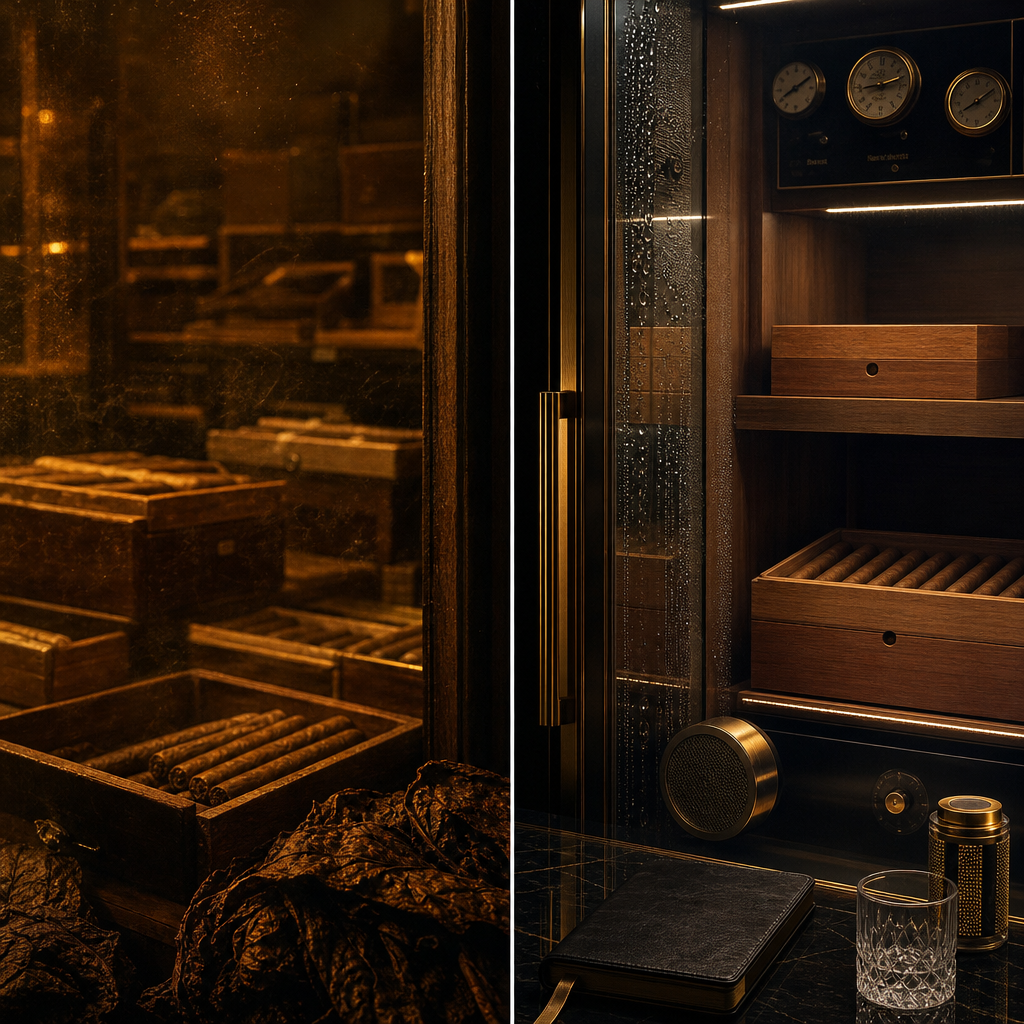
The aging of cigars is not just about placing the box in a cabinet; it's more like a slow flavor calibration. Once beginners have mastered cutting, lighting, and tasting, the next step is learning how to let the cigar reach a more rounded position in the right environment and rhythm.
As the editor of the "Cigar Bible," I often view aging as "managing variables": temperature, humidity, air, time, box condition, and regional style, each of which can change the way aromas are revealed. Mastering this allows you to truly retain the layers of a good cigar.
The Essence of Aging: Letting Irritation Retreat, Bringing Aroma to the Forefront
The core of cigar aging is not simply getting older, but gradually balancing the moisture, oils, ammonia, and tannins in the tobacco leaves. A freshly acquired cigar may sometimes have sharp herbal, spicy, or pungent aromas; after 3 months, 6 months, or even 3 years, these edges will slowly soften, and sweet, woody, nutty, and creamy notes become more recognizable. The goal of aging is not to chase the number of years but to make the flavor transition from rough to complete.
Take the Cuban Partagás Serie D No.4 as an example. If a 2018 box code is stored stably, in the first year, leather and black pepper are often stronger; by around 2022, more rounded notes of toasted bread, cocoa, and dried fruit often emerge. Conversely, some refreshing cigars, if left too long, may lose their original beautiful floral and grassy sweetness, which may not necessarily be better.
I divide aging into three stages: 0 to 6 months is the stabilization period to correct humidity after transport; 6 months to 3 years is the flavor integration period, suitable for observing changes; over 3 years is when long-term aging judgment begins. Beginners should not blindly believe in ten-year-old boxes at first; learning to recognize changes from 6 months to 2 years is more practical.
Temperature and Humidity: Replace Superstition with Stability
The most common question about cigar storage is "what temperature and humidity should it be?" My standard is simple: a temperature of 18 to 21°C and humidity of 65% to 69% RH is a relatively safe range for most Cuban and non-Cuban cigars. In Taiwan, if the indoor temperature often exceeds 26°C in summer, flavors can easily become stuffy, and the risk of pest infestation increases, so controlling temperature is more important than blindly adding humidity.
Humidity is not the higher, the better; stability is the underlying logic of aging. If humidity is consistently above 72%, cigars can burn unevenly, draw tight, and present damp wood and sour stuffiness; below 62%, the wrapper may crack, and the aroma may thin. If using an electronic temperature-controlled cabinet, I recommend setting it to 19°C, 66% RH, and observing for 14 days before making minor adjustments, rather than chasing numbers daily.
In practice, I place two calibrated hygrometers from different brands in the cabinet, such as a Boveda Butler or Xikar digital hygrometer, and use a salt test or 75% calibration pack to confirm discrepancies. If the two differ by more than 3%, use the calibrated data. Many "aging failures" are not cigar issues but misjudgments caused by hygrometer errors.
After Receiving a New Box: Rest First, Then Talk About Aging
A box of cigars that has undergone international transport, storage, and temperature changes usually does not have uniform internal humidity immediately. Especially with 25-count wooden boxes, such as H. Upmann Magnum 46 or Ramón Allones Specially Selected, the moisture state in the center and periphery of the box may differ. I usually give a new box at least 30 to 60 days of stabilization, not rushing to judge its true performance.
The first thing with a new box is not to smoke it but to let it quietly return to a stable state. The method is simple: after checking the outer box for no mold spots or wormholes, place it in an environment of 65% to 67% RH; try to open the cabinet as little as possible in the first two weeks to let the wooden box, cigars, and air balance each other. If the box comes from a more humid area, it can be placed at 64% to 65% RH first to avoid lingering dampness.
When handling Cuban boxes from PCC authorized dealers, I particularly record the date received, box code, initial aroma, and appearance. For example, if a 2020 Montecristo No.2 has a strong ammonia smell upon arrival, I would mark "evaluate again after 90 days." Three months later, if white pepper decreases and coffee and cocoa increase, it indicates the aging direction is correct.
Box Aging, Naked Aging, and Rotation: Different Methods for Different Goals
The advantage of whole-box storage is microenvironment stability; the wooden box can slowly adjust humidity and retain the common style of the same batch of cigars. Single cigar storage is convenient for observation and classification, but if the humidor is frequently opened and closed, humidity fluctuations will be more pronounced. For beginners, if it's the same box of 10 or 25 cigars, I recommend starting with original box storage and then separating a small number of singles for observation based on space and goals.
For long-term aging, whole-box stability is usually higher than frequently rotated single cigar collections. But rotation is not entirely forbidden; it just needs to be rhythmic. Adjusting the position slightly every 3 to 6 months is sufficient, avoiding weekly handling, smelling, and photographing. The oils on the cigar surface and the wrapper are delicate; excessive contact increases the risk of cracking and humidity fluctuations.
| Storage Method | Suitable Goal | Recommended Humidity | Notes |
|---|---|---|---|
| Whole Wooden Box | Aging over 2 years | 65%~67% | Open box less, record box code |
| Single Cigar Humidor | Short to medium-term observation | 66%~69% | Avoid heavy mixing of flavors |
| Glass Tube Cigars | Preserve aroma | 64%~66% | Briefly air every 6 months |
| Cedar Divider | Brand management | 65%~68% | Cedar aroma should not be too strong |
If you collect different styles, rich types like Liga Privada No.9 and Padrón 1964 Anniversary can be stored in the same area; elegant types like Hoyo de Monterrey Epicure No.2 and Por Larrañaga Petit Coronas should be stored separately to avoid aroma overlap. The clearer the classification, the more accurate the future judgment of aging effects.
Time Management: Which Cigars are Suitable for Long Aging, Which Should Be Enjoyed Early
Not every cigar is suitable for long-term aging. Generally, cigars with solid structure, medium to high concentration, rich in oils, and larger size have more potential for long aging; while light, floral, small-sized cigars often perform best within 1 to 3 years. For example, if a Cohiba Siglo VI is stored properly, it often exhibits honey, hay, cream, and a hint of mineral notes after 5 to 8 years.
Judging aging potential requires looking at structure, not just brand reputation. For instance, a 2016 Bolivar Belicosos Finos may initially have heavy earth, leather, and spicy notes; by 2021, if humidity is stable, it often becomes rounder, with clear layers of caramel, roasted wood, and black coffee. In contrast, small-sized short-time cigars may not retain enough aroma tension if aged for 10 years.
My practical timeline for beginners: Robusto types can be observed within 1 to 3 years; Churchill, Double Corona can be observed for 3 to 7 years; high-concentration non-Cuban cigars show significant changes within 1 to 5 years. If involving collection value, remember: collection appreciation does not guarantee appreciation, still depends on source preservation and market. Flavor should always come before label price.
Flavor Recording: Use Notes to Find Your Best Window
Without records, aging can easily become storytelling based on impressions. I recommend writing down 6 items each time you taste: date, temperature and humidity, box code or year, burning condition, flavors from the first third to the end, overall score. The score doesn't need to be complex, 80 to 95 is sufficient; the focus is on comparing the same cigar every 6 to 12 months.
The best flavor is not the year someone else tells you, but the window you find through records. For example, if you record a Trinidad Vigía in 2023 and feel herbal and white pepper are high; in 2024, you find cream, almond, and honey have increased, and the end bitterness has decreased. You can then determine it has entered a suitable range for you, without having to wait for the so-called "older."
My simple record format is as follows:
- Appearance: wrapper gloss, elasticity, any cracks.
- Cold smell: wood, floral, cocoa, grain, or ammonia.
- Burning: number of slant burns, ash stability, draw resistance.
- Flavor: write 3 main flavors for each of the first, middle, and end sections.
- Conclusion: suitable for enjoyment now, or let rest for another 6 to 12 months.
When you accumulate records for over 20 cigars, you'll start to see your preferences: some like the tension of fresh spice, others prefer the rounded sweetness after 5 years. The maturity of aging techniques is not about following authority but being able to clearly state "why I like this time point."
Common Questions
Are the white spots on the cigar surface mold?
Not necessarily. If the white spots look like fine powder, can be brushed off easily, and have no mold smell, they may be oil crystals; if they appear hairy, green-gray, and penetrate the foot, they need to be isolated. The key to judgment is texture, smell, and spread speed. If in doubt, do not mix with other cigars.
Can cigars be stored in a refrigerator?
Not recommended for regular household refrigerators. The temperature is too low, humidity fluctuates greatly, and food odors can easily be absorbed by cigars. If temperature control is needed, use a dedicated environment that can maintain 18 to 21°C, 65% to 69% RH, and monitor with a calibrated hygrometer.
How long is aging just right?
There is no fixed answer. Robustos often perform well in 1 to 3 years, large sizes can be observed for 3 to 7 years. Just right is not the year, but the moment when irritation decreases, aroma becomes clearer, and burning is more stable. It's recommended to record every six months.
Can overly moist cigars be quickly dried?
Do not use a hairdryer, sunlight, or direct dehumidifier. If too moist, place in a 62% to 65% RH environment and let it stabilize slowly over 1 to 3 weeks. Rapid drying will cause the wrapper to shrink, uneven moisture inside and out, making burning more problematic.
Can different brands be placed in the same humidor?
Yes, but they should be categorized. Rich, spicy cigars should not be long-term adjacent to floral, creamy delicate cigars. Use cedar dividers and label dates. For precise flavor pursuit, brand, region, and concentration zoning is more ideal.
Aging cigars is actually practicing patience: not rushing to prove you understand, but willing to let time, records, and taste speak together. I like to treat each box of cigars as a journey, some suitable for the brightness of youth, some waiting for time to wear down the edges. True good flavor often comes from stability, restraint, and careful observation. —Cigar Prince Wilson Tsai
Smoking is harmful to health. Under 20 years old is not allowed to smoke. Quit smoking hotline: 0800-636363. This article is for reference by adults over 20 years old as knowledge of cigar culture, preservation, and regulations, not as tobacco advertising, promotion, or purchase advice.