Exquisite Cigar Accessories: Essential Tools to Enhance Taste
Exquisite Cigar Accessories: Essential Tools to Enhance Taste
Cigar accessories are not mere show-off items; they are crucial in elevating a cigar from "enjoyable" to "stable, clean, and ceremonial." Beginners often focus on brand, year, and size, neglecting cut, fire source, humidity, and support methods—small details that often determine the smoothness of the first 10 minutes.
As the editor of "Cigar Bible," I've seen too many good cigars ruined by dull blades, overheated flames, or incorrect humidity. In this article, I want to discuss cutters, lighters, storage boxes, humidity tools, and travel accessories from a practical perspective, helping you master etiquette and flavor.
Cutter: The First Cut Determines the Cigar's Breath
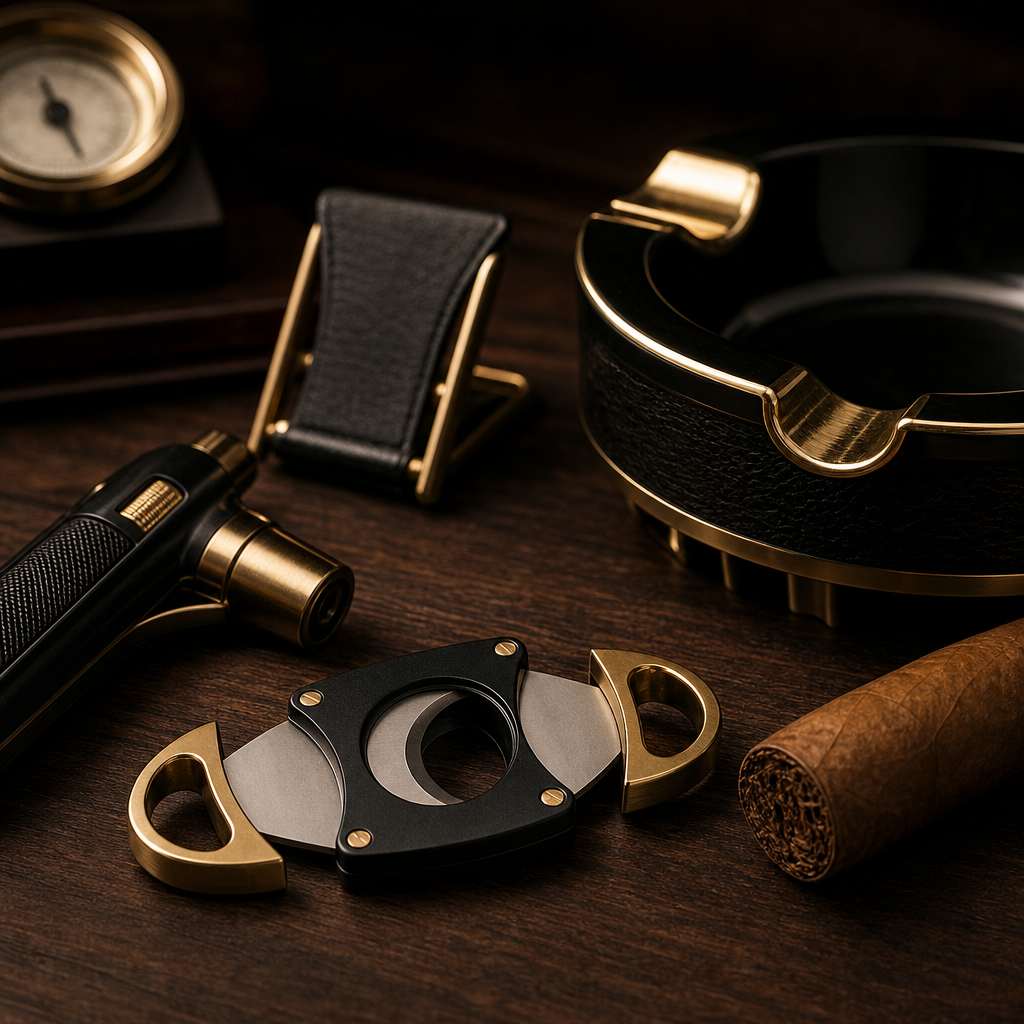
The basic task of a cigar cutter is to allow air to pass smoothly through the cigar core without damaging the cap. Common tools include double-blade straight cuts, V Cuts, punches, and cigar scissors. For the commonly seen 52 to 56 ring gauge Robusto and Toro sizes after 2020, double-blade straight cuts are the most versatile; for larger ring gauges above 60, ensure the blade opening is wide enough to avoid cracking the wrapper.
A cutter is not just about sharpness; it must be "sharp, symmetrical, and controllable." I often recommend beginners start with stable products like the Xikar Xi series or Colibri V-Cut, not out of brand superstition, but because their blade alignment, tactile feedback, and maintenance convenience reduce novice error rates.
The cutting position usually falls about 1 to 2 millimeters above the cap curve, with the principle being "open the channel, not cut off the structure." Cutting too deep may cause the wrapper to loosen in the middle; cutting too shallow may obstruct airflow, raising the temperature. For robustos like Partagás Serie D No.4, a small cut can make the initial wood and pepper notes feel tight.
Maintenance is also necessary after use. Cigar oil and tiny leaf residues will remain on the blade, so it's recommended to clean the blade with a dry cloth or a small amount of alcohol every 20 to 30 cigars, and store it completely dry. Do not mix the cutter with keys or coins; a chipped blade will result in frustration rather than ceremony.
Lighters and Matches: The Fire Source Must Be Stable, and the Temperature Must Be Controlled
When lighting a cigar, the purity and controllability of the fire source are more important than the size of the flame. It's generally not recommended to use scented candles or cheap oil lighters, as odors can adhere to the foot of the cigar. Common cigar fire sources include long wooden matches, cedar spills, single-flame torches, double-flame, or triple-flame torches; torches are the most convenient but also the most likely to scorch the foot due to high temperatures.
A good light is not about burning the cigar quickly but about evenly heating the foot and letting it awaken naturally. For example, the classic S.T. Dupont Ligne 2 is known for its stable flame and ceremonial sound, suitable for indoor slow-paced settings; while windproof torches like Colibri Daytona and S.T. Dupont Megajet are more suitable for terraces or outdoor environments. Choosing different fire sources for different scenarios is the judgment of a mature user.
My approach is to keep the outer edge of the flame about 1 to 2 centimeters from the foot, slowly rotating for 20 to 30 seconds to create an even red spot on the edge, then gently puff to confirm the burn line. Do not insert the flame directly into the center of the foot, as this can cause the center to overheat, leading to bitterness, burnt taste, and uneven burning.
Don't overlook the gas either. It's recommended to use high-purity butane, with products marked 5X or 7X filtered usually having fewer impurities, reducing the chance of nozzle blockage. Before each refill, release the residual gas, and let it sit for 3 to 5 minutes before lighting; this small step can stabilize the flame height and extend the lighter's life.
Ashtrays, Cigar Rests, and Placement Etiquette: Give the Cigar a Place, and Give the Gesture Some Decorum
An ashtray seems to merely hold ash, but it actually involves burn stability, table order, and etiquette. Cigar ash is longer and heavier, unsuitable for small cigarette slots. An ideal cigar ashtray should have enough depth, wide slots for support, and a stable base, allowing both parejo and figurado to lie naturally without crushing the wrapper or letting the foot touch the ash pile.
Knowing how to put down a cigar shows more etiquette than holding it all the time. In formal occasions, I do not recommend placing the cigar directly on the rim of a glass, plate, or tablecloth; it's unsanitary and can leave odors and ash marks. For outdoor or travel, a metal folding cigar rest weighing less than 50 grams can avoid many awkward situations.
The length of the ash also has its knowledge. If a Cuban cigar is well-rolled, maintaining 2 to 3 centimeters of ash before gently placing it on the edge of the ashtray is sufficient, without frequent tapping. Constantly flicking the ash can cause the burning end to vibrate, leading to cracks or uneven burning. For long cigars like Cohiba Siglo VI, stable ash can help maintain the temperature in the front section.
In terms of cleaning, ceramic, glass, and crystal ashtrays are easier to maintain; metal materials need attention to scratches and oxidation. If not cleaned after use the previous night, the alkaline smell of residual ash will be very noticeable the next day. My habit is to rinse with warm water and wipe with a soft cloth, avoiding strong-scented cleaners to prevent affecting the space's aroma next time.
Storage Boxes and Humidification Cabinets: Stability Is More Important Than Luxury
The core of cigar storage is temperature and humidity. Most handmade cigars are suitable for maintaining a relative humidity of 65% to 70% and a temperature of about 18 to 21°C; in Taiwan's hot and humid summer, if the room exceeds 26°C for a long time without stable control, it can easily lead to over-humidity, swelling, mold spots, or tobacco beetle risks.
The value of humidification equipment lies not in how expensive it looks but in whether it can maintain a stable curve over the long term. Desktop cigar boxes are suitable for storing 20 to 100 cigars, while electronic humidification cabinets are suitable for 150 or more or cross-brand collections. Brands like Adorini, Elie Bleu, Boveda, and Cigar Oasis have different positions, and you should estimate the actual storage volume within a year before choosing.
New cigar boxes need to be seasoned before use. If the Spanish cedar lining is too dry, it will absorb the moisture from the cigars; you can use a 69% Boveda or distilled water humidification device to let the empty box operate for 7 to 14 days until the humidity stabilizes for 48 consecutive hours before placing cigars inside. Do not use tap water, as minerals and impurities may leave odors or watermarks.
When it comes to collection value, rare edition box sets, discontinued models, or specific years may indeed attract market attention, such as some limited editions from 2014 gaining discussion in the secondary market; but collecting appreciation does not guarantee appreciation, as it still depends on source preservation and market. For me, doing a good job of preservation first, then talking about stories and years, is the responsible order.
Hygrometers, Calibration, and Humidification Packs: Numbers Must Be Reliable, and Judgment Must Be Based on Them
Many beginners buy a cigar box and completely trust the included analog hygrometer, which is a common misconception. Traditional analog hygrometers react slowly, and transportation vibrations may cause deviations of 5% to 10%. If you think the box is at 68% but it's actually 75%, it's not surprising if the cigar foot softens and the draw tightens after two months.
A hygrometer is not a decoration; it's your dashboard for judging preservation status. I recommend at least preparing a calibratable electronic hygrometer, such as the Caliber IV, Govee, or Inkbird types, with a resolution of 1% being sufficient. Perform a salt test or use a 75% calibration pack every 6 months, confirm the error, and label it with the date.
The humidification method should also match the capacity. A 65% or 69% Boveda is convenient for a 20-stick travel box; if you only place one pack in a 100-stick or larger wooden box, the humidity distribution will be uneven. You can place it in layers according to the space and rotate positions every 2 to 4 weeks. When the humidification pack becomes hard and significantly lighter, it's time to replace it; don't wait until it's completely flat.
Practical judgment cannot rely solely on numbers; you must also feel and smell. Over-humidified cigars often have a spongy feel, sticky cuts, and smoldering burns; overly dry cigars have brittle wrappers, a crisp sound, and sharp flavors. If you encounter a dry cigar, don't rush to remedy it with high humidity; slowly restore it with 62% to 65% over 2 to 4 weeks to avoid cracking the wrapper due to rapid moisture changes.
Travel Cases, Leather Cases, and Portable Tools: Maintain Elegance When Going Out
When carrying cigars outside, the biggest fears are crushing, overheating, and odor contamination. Hard-shell travel cases are more suitable for long-distance travel than soft leather cases, especially 3-stick or 5-stick ABS, aluminum, or carbon fiber cases that can withstand backpack pressure. If you're only bringing 1 to 2 sticks for a dinner, a leather case is lighter, but make sure the inner diameter can accommodate 54 or 56 ring gauges.
The standard for outdoor accessories is to protect the cigar and maintain the order of the occasion. I usually bring a reliable lighter, a small cutter, a folding cigar rest, and a 65% small humidification pack. These items don't take up space but can avoid the embarrassment of finding fire, borrowing a cutter, or placing the cigar incorrectly.
When traveling, also pay attention to airline regulations. Whether lighters can be checked or carried on varies by region and airline; torch lighters are more sensitive at many airport security checks. For international trips, I separate the cutter, empty lighter, and cigars, and check the 2024 airline safety regulations in advance.
The number of cigars carried should also be moderate. Bringing 2 to 3 sticks for a day out is usually sufficient, avoiding leaving them in a hot car for more than an hour. If the car's interior temperature exceeds 40°C in summer, even for half a day, it can cause the cigars to oil, swell, or mix flavors. No matter how good the accessories are, they cannot compensate for uncontrolled environments.
Accessory Purchase Budget Table: Buy Right First, Then Buy Beautiful
The world of accessories can easily lead to confusion, with everything from a few hundred-dollar plastic cutters to tens of thousands of dollars for lacquered lighters. My view is that in the entry stage, focus on buying functionality first, pursue feel and material at the intermediate stage, and consider craftsmanship, limited editions, and collection matching at the high stage. Don't put all your budget on appearance at the beginning and neglect preservation equipment.
The first batch of accessories should prioritize solving three things: clean cutting, even lighting, and stable storage. Below is a rough estimate in New Taiwan Dollars; actual amounts will vary by year, exchange rate, brand agency, and material, but it can serve as a reference for beginners establishing an accessory set in 2025.
| Accessory Type | Entry Budget | Intermediate Budget | Selection Focus |
|---|---|---|---|
| Double-Blade Cutter | 500–1,500 | 2,000–5,000 | Blade alignment, capable of cutting above 54 ring gauge |
| V Cut | 1,200–2,500 | 3,000–6,000 | Stable cut depth, no cap cracking |
| Torch Lighter | 800–2,000 | 3,000–8,000 | Stable flame, easy refueling, windproof |
| Desktop Cigar Box | 2,000–6,000 | 8,000–30,000 | Sealing, Spanish cedar, capacity |
| Electronic Hygrometer | 400–1,500 | 2,000–4,000 | Calibratable, fast response, low error |
| Travel Case | 800–2,500 | 3,000–8,000 | Pressure-resistant, moisture-proof, suitable capacity |
For example, if you enjoy about 60 cigars a year, instead of buying three stylish cutters, allocate for a reliable double-blade cutter, a 50-stick cigar box, two electronic hygrometers, and enough humidification packs. If you later prefer Churchill, Double Corona, or other long sizes, upgrading to a larger capacity box or humidification cabinet will be more rational than blindly expanding from the start.
Frequently Asked Questions
The essence of accessories is to serve cigars and occasions; any tool that makes the process more stable, cleaner, and more appropriate has value. Here are some of the most common questions I get from beginner friends.
Should a beginner choose a straight cut or V Cut for their first cutter?
I recommend starting with a double-blade straight cut, as it has the widest range of applications, handling everything from petit corona to robusto. V Cut concentrates flavor and has a more linear taste, but if the cut groove is too deep, some small ring gauge cigars may have too strong airflow.
Will a torch lighter make cigars bitter?
The tool itself is not the problem; distance and time are key. Keep the flame from directly touching the foot, maintain a 1 to 2-centimeter distance, and slowly heat with the outer flame to reduce the risk of bitterness and overheating.
Does a cigar box have to be placed in an air-conditioned room?
In Taiwan, air-conditioned rooms are easier to control temperature, but stability is the key. If the indoor temperature is consistently above 26°C, consider an electronic humidification cabinet or temperature control equipment to avoid pest and over-humidity issues caused by high temperatures.
Can humidification packs be reused by adding water?
Not recommended. The internal formula of the humidification pack is a two-way humidity control system, and adding water arbitrarily will change the concentration and effectiveness. When it becomes noticeably hard and loses elasticity, replace it directly; the cost is much lower than ruining a box of cigars.
Does an expensive ashtray really make a difference?
The difference lies in stability, slot width, material, and cleaning convenience, not necessarily in price. As long as it can stably support, not let the cigar touch the ash pile, and leave no residual odor after cleaning, it's a qualified cigar ashtray.
Can I go out with just cigars and no tools?
You can, but the risk is higher. Cutters, fire sources, and placement tools may not always be available on-site, and quality is hard to control. If you value etiquette and rhythm, a small tool kit will make the whole process much more composed.
For me, the charm of cigar accessories lies not in piling up prices but in having clear reasons for every pick-up, cut, light, and placement. When tools make actions quiet and precise, flavors naturally have more space to be seen. True taste is about getting the details just right, not overshadowing the main event, nor treating the cigar in hand carelessly.
—Cigar Prince Wilson Tsai
Smoking is harmful to health. Under 20 years old is not allowed to smoke. Quitline: 0800-636363. This article is for reference by adults over 20 years old for cigar culture, preservation, and legal knowledge, not a tobacco advertisement, promotion, or purchase suggestion.