Introduction to Blended Whisky: The Art of Balance in an Accessible Style, Paired with a Half-Hour Ritual of H. Upmann Half Corona

Introduction to Blended Whisky: The Art of Balance in an Accessible Style, Paired with a Half-Hour Ritual of H. Upmann Half Corona
Pairing blended whisky with H. Upmann Half Corona is, in my opinion, the most comprehensible intersection between whisky beginners and Cuban short cigars. As an editor of the "Cigar Bible," I often say that beginners don't need overwhelming complexity, but rather a half-hour where they can clearly feel how "sweetness, wood, cream, and smoke" come together. This H. Upmann Half Corona (Cuba, Half Corona, 44 × 90mm) is known for its grain sweetness, creaminess, light woodiness, and elegant cigar body, making it perfect for showcasing the balanced design of Blended Whisky.
This article does not portray blended whisky as a single brand story, nor does it mystify cigars. I will first clarify the drink itself: how malt whisky, grain whisky, the master blender, cask aging, and the art of blending come together to form a daily whisky. Then, I'll place it within the thirty-minute burn curve of the H. Upmann Half Corona, examining how the grain whisky's sweet base × grain-tuned smoke, the smoothness of blending × the low burden of short cigars, and soda bubbles × creamy sweetness unfold one by one.
Introduction to Blended Whisky: Why 90% of the World Drinks Blended Whisky
When discussing blended whisky, it's important to dispel a common misconception: it is not a subsidiary of single malt. In the mid-to-late 19th century, continuous distillation allowed for the stable production of grain whisky, and Scottish merchants began combining original spirits from different distilleries, cask types, and aging years into a consistent style. This technology allowed whisky to move beyond the realm of heavy peat, heavy oils, or heavy oak, reaching a broader dining table and bar.
Today, 90% of whisky sales are often categorized as blended, not because people don't understand, but because blended whisky solves the problems of "stability" and "readability." Single cask or single malt often have distinct personalities, while blended whisky aims to keep aromas, sweetness, alcohol stimulation, oak tannins, and finish length within a predictable range. For first-timers, this predictability is not boring; rather, it allows the palate to gradually establish a flavor map.
The design philosophy of blended whisky is usually balance, smoothness, and drinkability. Balance means that sweetness, aroma, woodiness, spice, and alcohol do not overpower each other; smoothness means that the sharp edges are softened through cask aging, blending, and dilution; drinkability means that one can slowly understand it with small sips, without needing to memorize a whole set of terminology first. The core of blended whisky is not to lower the difficulty, but to organize complexity into an order that even beginners can recognize.
Malt Whisky and Grain Whisky: The Framework of Blending Art
The body of Blended Whisky is usually composed of two main parts: malt whisky and grain whisky. Malt whisky is often made from malted barley, undergoing mashing, fermentation, pot still distillation, and then aging in oak casks, often providing fruit, malt biscuit, honey, nut, smoke, or sea breeze characteristics. Grain whisky may use corn, wheat, or other grains, often produced using continuous distillation, with a lighter body and cleaner sweetness, like vanilla, cream, cereal, and light caramel.
If beginners remember only one thing, they can think of malt whisky as "expression" and grain whisky as "background." Malt whisky brings highs and lows, giving a drink a clear nose and finish; grain whisky smooths out sharpness, allowing vanilla sweetness, grain sweetness, and alcohol to form a softer entry. This is why blended whisky is often seen as a daily whisky: it doesn't rely on a single flavor to create a memory point, but on multiple elements to maintain continuity.
Cask type also intervenes in this framework. Bourbon casks often bring vanilla, coconut, cream, honey, and light woodiness; sherry casks may bring raisins, nuts, cocoa, and spices; refill casks make the wood finer, retaining more of the grain's original character. When malt whisky is responsible for the outline and grain whisky for the sweet base, the art of blending begins to have a syntax that can be paired with cigars.
Master Blender: How the Chief Blender Turns Differences into Stability
The role of the master blender is not as simple as mixing a few casks together. They must remember the spirit of each distillery, the maturation speed of each cask type, and the changes that different vintage spirits will present after air exposure. The challenge is that when some casks have particularly strong personalities and others are quieter, they must still maintain the brand's existing aroma profile in the final blend.
In practice, the master blender will establish sensory data for each batch of original spirits through extensive nosing, which means smelling and small-scale tasting. Young grain whisky may provide a bright sweet base, more mature malt whisky adds baking and nutty notes, and a small amount of smoky original spirit acts like a spice, not to dominate, but to add depth to the finish. This is a matter of proportion: too little has no presence, too much will unbalance the whole.
For beginners, understanding the master blender is best done by thinking of them as an orchestra conductor. The violin doesn't always have to be the brightest, nor does the double bass need to be heard in every note, but without any layer, the overall thickness becomes thin. The stability of blended whisky is the result of the master blender compressing countless differences into a clear flavor line.
Accessible Style Does Not Mean Compromise: The Design Philosophy of Smoothness, Balance, and Drinkability
The term "accessible style" is easily misunderstood, as if being smooth means simple content. In fact, the hardest part of blended whisky is making it seem effortless while retaining layers. The entry vanilla, honey, cereal, light fruit aroma, oak, and slight spice must each stand in the right place, not overly sweet, nor relying on alcohol heat to create presence.
Smoothness does not mean lack of character. A good blended whisky will have the alcohol enveloped by the sweet base and woodiness, with the entry first being grain sweetness and vanilla, followed by oak, spice, and a slightly dry finish. This structure pairs well with the elegant body of short cigars, as it won't flatten the delicate grain smoke of the cigar's front section, nor will it turn the creaminess into heavy grease.
The true test of accessible style is the density of detail, not volume. If the body is too thin, it will be quickly covered by cigar smoke; if the oak is too hard, it will make the light woodiness of the H. Upmann Half Corona astringent. Smoothness, balance, and readability are the most useful qualities of blended whisky when facing short cigars, not concessions.
H. Upmann Half Corona: Grain Sweetness and Creamy Lines in Half an Hour
H. Upmann is one of the Cuban cigar brands suitable for discussing "delicacy," and the Half Corona size compresses the time to about thirty minutes. The 44 × 90mm specification means it doesn't require a long prelude, quickly entering the theme of grain sweetness, creaminess, and light woodiness after lighting. The elegant cigar body also makes it easier for beginners to distinguish the texture of the smoke, without being surrounded by intense spiciness or heavy earthiness from the start.
Its front section often has roasted cereal, malt biscuit, buttery toast edges, and light cedar. The middle section has a more pronounced creaminess, with the smoke becoming slightly round, like wrapping dry grain sweetness in a layer of fat; the back section sees a rise in light woodiness and slight roasting, but usually doesn't turn to intense bitterness. This curve is important because if the blended whisky goes in the direction of vanilla, grain, and honey, it can find corresponding points in each section.
| H. Upmann Half Corona Stage | Main Cigar Flavor | Blended Whisky Correspondence | Intersection Result |
|---|---|---|---|
| Front Section | Grain Sweetness, Light Cedar | Grain Whisky Sweet Base | Cereal Feel Amplified, Entry Clearer |
| Middle Section | Cream, Toast | Vanilla, Honey, Bourbon Cask Sweetness | Creaminess Rounder, Smoke Softer |
| Back Section | Light Woodiness, Slight Roasting | Oak, Spice, Nuts | Finish Cleaner, Avoiding Overly Sweet |
| With Water | Finer Smoke | Fruit Aroma and Vanilla Released | Aroma Opens Up, Alcohol Sensation Decreases |
| With Soda | Lighter Creamy Sweetness | Bubbles and Carbonation | Mouth Refreshed, Next Sip Clearer |
This table is not about who overpowers whom, but how the two translate each other. The grain sweetness of H. Upmann Half Corona is not candy sweetness, but the sweetness of roasted starches; the grain base of blended whisky is not just sugary water, but sweetness with vanilla and cereal after maturation. This pairing is suitable for beginners because both start with "grain," giving the palate a common language.
Flavor Chemistry Alignment: Grain Sweet Base, Creamy Smoke, and Bubble Cleansing
Let's break down the hints into token×token. The first group is "grain whisky sweet base × grain-tuned smoke with the same literal frequency": the vanillin, lactones, and slight caramelization in grain whisky will remind one of cornflakes, malt biscuits, and buttery pastry; H. Upmann Half Corona's smoke has roasted grains, hay, and light cedar. When the two meet, the tongue first feels the sweet base, and the retronasal sense then catches the smoke, making "grain" not just an adjective, but a continuous olfactory path.
The second group is "smoothness of blending × low burden of short cigars." The burning time of short cigars is about thirty minutes, the flavor doesn't drag on, and it doesn't require a heavy body to support two hours; the smooth entry of blended whisky prevents the delicate creaminess of the first section from being torn apart by alcohol heat. The chemical perception here can be understood as the vanilla sweetness brought out by alcohol evaporation, complementing the phenolic compounds and roasting molecules in the smoke, making the sweetness and smokiness inseparable in the nasal cavity.
The third group is "soda bubbles making the creamy sweetness lighter." The bubbles bring carbonation stimulation, pushing away the creamy feel and smoke residue on the mouth surface, allowing the grain sweetness of the next H. Upmann to reappear; at the same time, soda lowers the alcohol concentration, making vanilla and light fruit aromas easier for beginners to capture. If drinking neat at room temperature is like reading a complete sentence, adding soda is like adding punctuation, allowing sweetness, wood, and smoke to appear in segments. The key chemical logic of this pairing is that the common grain sweetness establishes the same frequency, while bubbles and dilution are responsible for organizing mouth residue.
Half-Hour Ritual: The Rhythm from Room Temperature, Adding Water to Highball
I recommend understanding the same blended whisky in three small portion ways, rather than rushing to decide which is best. The first sip is neat at room temperature, just hold it in your mouth for two to three seconds, observing the order of vanilla, grain sweetness, oak, and alcohol sensation. Then light the H. Upmann Half Corona, let the front section grain smoke come out first, and then return to the glass; at this point, you'll find the whisky's sweet base becomes like malt biscuits.
The second stage can involve adding a small amount of room temperature water. Water will open up some ester aromas, making fruit, honey, and vanilla looser, while reducing the alcohol sensation on the tongue tip. When paired with the creamy feel of the Half Corona's middle section, the blended whisky after adding water will appear finer, not piling the creamy feel too thick. For whisky beginners, adding water is not diluting taste, but placing aroma layers in a more observable position.
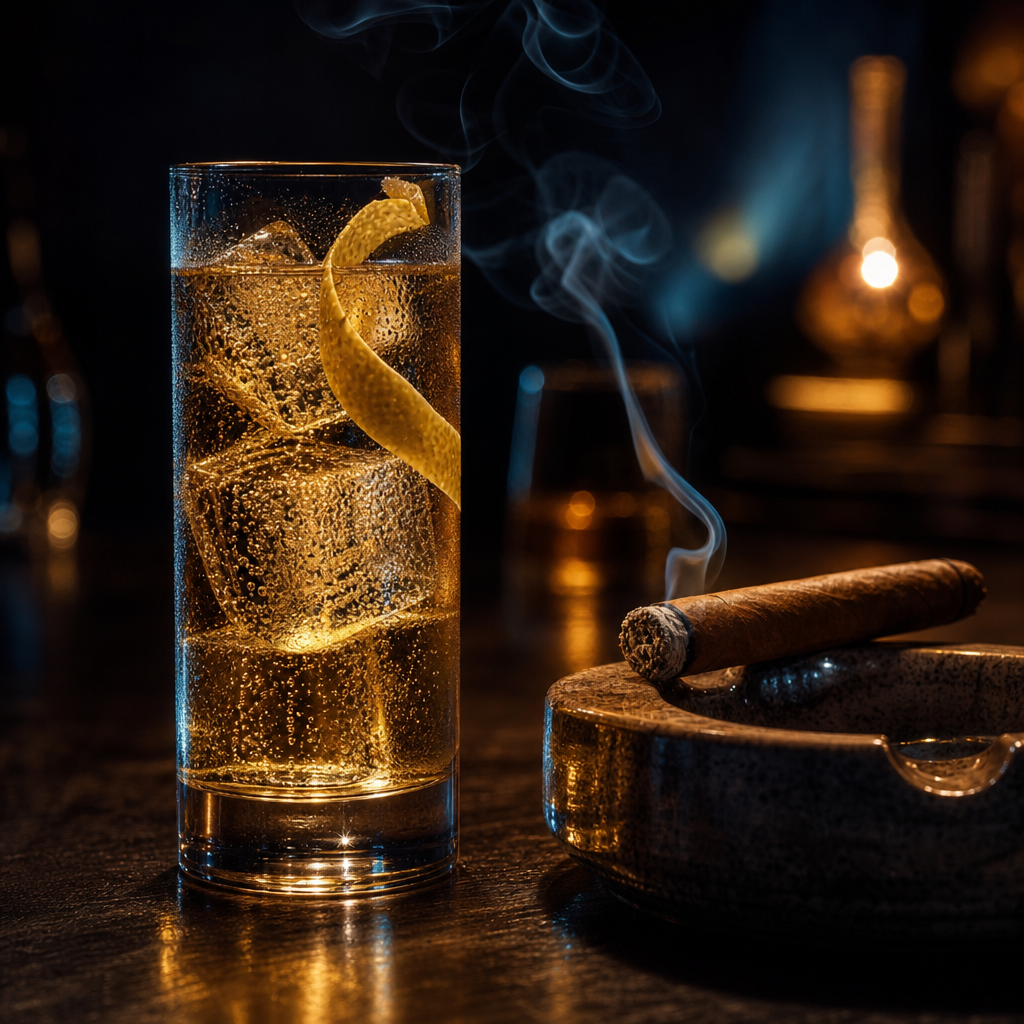
If choosing Highball for the third stage, which means adding ice and soda, pay attention to the sense of proportion and rhythm, rather than pursuing quantity. Ice lowers the temperature, causing the sweetness to contract, while bubbles remove smoke residue from the tongue surface; at this point, the light woodiness of H. Upmann becomes clearer, and the creamy sweetness no longer sticks to the mouth. By the back section, as the cigar woodiness slightly rises, the clarity of Highball can separate the bitter and sweet, keeping the finish clean.
Pairing Daily Whisky with Short Cigars: Three Common Mistakes Beginners Should Avoid
The first mistake is treating "the stronger, the better to pair" as a principle. H. Upmann Half Corona is an elegant cigar body, and heavy peat, high alcohol, or strong oak tannins can easily cause its grain sweetness and creaminess to lose detail. The reason blended whisky works here is that it doesn't rush to show muscle, but uses a smooth sweet base to accommodate the smoke.
The second mistake is adding ice to the brim from the start, causing the aroma to completely shrink. Ice can make the body more refreshing, but when the temperature is too low, vanilla, honey, malt, and light fruit aromas become indistinct, and beginners only feel cold and carbonation. A better approach is to first smell at room temperature, then add water, and finally try adding ice or soda, letting the tongue know what difference each change brings.
The third mistake is treating a half-hour short cigar as a sidekick that can be ignored at will. Although it is short in time, the changes in the front, middle, and back sections are very clear; if you only drink or only watch the smoke, you'll miss the most delicate intersection points of the two. The focus of pairing daily whisky with short cigars is not the form, but re-confirming the position of sweetness, woodiness, and smoke residue every five to ten minutes.
Frequently Asked Questions
Is blended whisky suitable for whisky beginners?
Yes, because its design focus is usually balance, smoothness, and readability. Beginners can start with vanilla, grain sweetness, light woodiness, and honey, without having to deal with heavy peat or strong tannins right away. Blended whisky allows beginners to first establish a flavor map, then gradually move towards more characterful whiskies.
Is Blended Whisky simpler than single malt?
Not necessarily. Single malt emphasizes the personality of a single distillery, while Blended Whisky tests the proportion and stability between multiple original spirits. Its complexity is hidden in the structure, not in declaring its presence with strong aromas in every sip.
Why can H. Upmann Half Corona pair with daily whisky?
Because its grain sweetness, creaminess, and light woodiness do not conflict with the vanilla, honey, and grain base of blended whisky. The approximately thirty-minute time also makes the pairing rhythm clear, making it easy to observe from the front section sweetness to the back section woodiness.
Will adding soda make whisky tasteless?
If the soda proportion is too high, the aroma will indeed fade; but a moderate amount of bubbles can organize the mouth, making the creamy sweetness and smoke residue lighter. For this pairing, the meaning of adding soda is to refresh the palate, not to turn the whisky into another drink.
Do I need to choose a particularly characterful blended whisky?
You don't need to start with a version with very sharp character. A blended whisky with vanilla, grain sweetness, honey, and light oak as the main axis can better correspond to the elegant lines of H. Upmann Half Corona. Once familiar with this benchmark, comparing smoky or sherry cask-heavy styles will be clearer.
How should this pairing be arranged in order?
First smell the whisky, then take a small sip neat, then let the H. Upmann Half Corona enter the front section grain sweetness. In the middle section, you can add a little water to observe the aroma opening up, and in the back section, if you want to make the mouth cleaner, use the method of adding ice and soda. The whole process should take about thirty minutes, without making the steps complicated.
As an editor of the "Cigar Bible," I see the value of this pairing not in its grandeur, but in its clarity. Blended whisky organizes malt, grain, cask aging, and blending art into a gentle framework; H. Upmann Half Corona responds with grain sweetness, creaminess, and light woodiness. Half an hour is enough to slowly read through a segment of flavor dialogue.
Further Reading|Complete Map of Whisky Regions: From Scotland's Five Major Regions to Asia's New Forces, A Comprehensive Overview of Flavors Paired with Cigars|Subtropical Maturation of Kavalan Whisky: Yilan Snow Mountain Water Source and Rapid Cask Aging, Paired with the Elegant Long Cigar of Trinidad Fundadores|Complete Analysis of Cask Strength Whisky: The Art of Cask Aging and Adding Water, Paired with the Top Match of Cohiba Behike 52
—Cigar Prince Wilson Tsai
Smoking is harmful to health. Smoking is prohibited for those under twenty. Quitline: 0800-636363. This article is for reference only for adults over the age of twenty regarding cigar culture, preservation, and regulations, and is not a tobacco advertisement, promotion, or purchase suggestion.
No drinking and driving. Excessive drinking is harmful to health. Drinking is prohibited for those under eighteen. This article is also not an alcohol advertisement, promotion, or purchase suggestion, please drink responsibly.