Groucho Marx and the Performance Art of the Cigar: A Line-Recovery Prop, an Improvisational Weapon, and a Comedy Genius's Cigar Philosophy
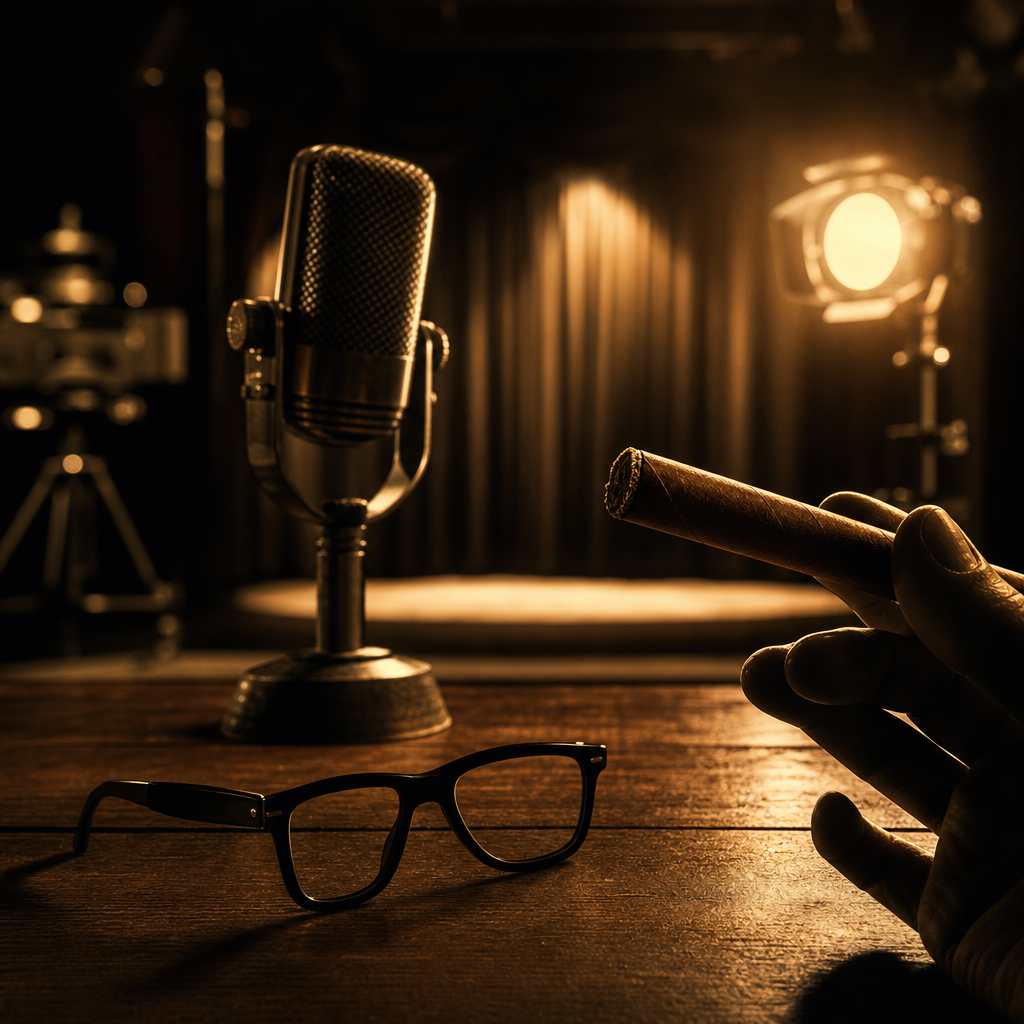
Groucho Marx and the Performance Art of the Cigar: A Line-Recovery Prop, an Improvisational Weapon, and a Comedy Genius's Cigar Philosophy
Julius Henry "Groucho" Marx was born on October 2, 1890, in a rented apartment above a butcher shop on East 78th Street in Manhattan, New York. He was the third of the five Marx Brothers, and from his teenage years he earned a living on the Vaudeville stage with his brothers. His stage persona gradually took shape: an exaggerated stooped walk, a thick black greasepaint mustache (later replaced by a real one), square spectacles, and a cigar forever held between his fingers or at the corner of his mouth.
The story of that cigar is far more complex than a simple prop.
The Prop Philosophy of Vaudeville: The Cigar as a Controller of Time
Groucho explained it most clearly himself:
"If you forget your lines, all you have to do is stick the cigar in your mouth and puff away until you remember."
This line reveals the cigar's core function in comedy: it is a container for a pause. On stage, comic timing is critical: a punchline must arrive at exactly the right moment, and being one second early or late can weaken the effect. The cigar provided a natural buffer: pick it up, put it in the mouth, take a puff, ponder for a moment. The action takes about 1.5 to 2 seconds, just enough for the brain to shift from panic back to composure.
Even more important was its visual language. Groucho used the cigar to "point" at the person he was speaking to, giving his sarcasm a sharper target. After an explosive one-liner, he would leisurely adjust the cigar, creating a sense of comic breathing space. These were instincts honed through thousands of Vaudeville performances.
His Cigar Taste: Dunhill 410 and Belinda as Reserve
Groucho was not the kind of heavy consumer who smoked ten cigars a day. He had a clear principle of self-discipline: never smoke a cigar before noon.
His routine was roughly this: a lighter-aroma cigar after lunch, and a stronger, richer cigar after dinner. His favorite was the Dunhill 410. In that era, Alfred Dunhill still produced its own hand-rolled cigars, and its quality was highly respected by the trade. His humidor also held larger Belinda cigars (possibly Churchill size), reserved for special occasions.
On film sets, the cigar in his hand was almost never lit. He did not want the entire crew inhaling smoke in an enclosed studio. More importantly: the language of a prop is visual; it does not need to burn to have power.
"You Bet Your Life": The Cigar Goes on National Television
In 1947, Groucho Marx began hosting "You Bet Your Life" on radio. In 1950, it moved to television and ran for 11 years (1950-1961), transforming him from "the wittiest of the Marx Brothers" into a television star known across America.
The program was a guest quiz show, but Groucho's ad-lib responses and acerbic commentary were its soul. In this setting, which demanded instant wit, the cigar played an indispensable role: after a guest said something, Groucho would turn the cigar and assume a pensive pose, prompting the audience to anticipate his comeback. Then the one-liner would land, and its effect would be multiplied.
This was a professional comedian's supreme use of the "pause." The cigar was the shape of that pause.
The "22 Children" Line: The Most Famous Groucho Cigar Quote Was Never Actually Said
The most widely circulated Groucho quote in cigar history goes like this:
A female guest said she had given birth to 22 children because she "loved her husband very much." Groucho supposedly replied: "I love my cigar too, but I take it out of my mouth once in a while."
The line is so brilliant that it has been quoted repeatedly for decades in cigar articles and comedy anthologies around the world. The problem is: no surviving recording or video of "You Bet Your Life" confirms that he ever said it.
Researchers reviewed a large number of program recordings. In a 1950 radio episode, there was indeed a couple who claimed to have had 20 children, but the recording contains no similar line at all. In 1972, when Groucho was interviewed by Roger Ebert for Esquire, he explicitly stated that he had never said it.
Yet the line continues to circulate to this day. That, in turn, is the most interesting Groucho phenomenon: a line he never said was accepted by later generations as true because it sounded "too much like him." His persona was more powerful than any line he actually spoke.
A Dunhill in Vatican Square, and Kipling's Poem About Women
Among the true Groucho cigar anecdotes, one took place in Vatican Square. Holding a precious Dunhill, he accidentally dropped it into a puddle in the square. A Catholic priest bent down, picked it up, and handed it back to him with a smile, saying: "Congratulations, Groucho, you just said the secret word!" It was an imitation of the famous moment in "You Bet Your Life" when saying the secret word won a cash prize. The priest was clearly a devoted viewer.
His third wife, Eden Hartford, once complained about that "stinking old cigar." Groucho responded by quoting Rudyard Kipling's 1886 poem "The Betrothed":
"A woman is only a woman, but a good Cigar is a Smoke."
"A woman is only a woman, but a good cigar is a smoke." With the poet's words as the closing note, a family argument ended elegantly.
Conclusion: Restraint and Composure Are the True Gentlemanly Cigar Philosophy
Groucho Marx passed away on August 19, 1977, at the age of 86. He crossed four media eras: Vaudeville, film, radio, and television. The cigar was always by his side, but he understood restraint: no smoking before noon, no lighting up in the studio, a light one after lunch, and a heavier one after dinner.
He did not use the cigar to display status. He used it to calibrate time, making every pause meaningful and every moment worthwhile.
For members of W Cigar Bar Gentlemen's Club, this may be the most practical cigar lesson: you do not need to smoke ten cigars a day to count as an appreciator. Knowing how to slow down and choose the right moment is true taste.
--
Sources: Cuban cigars from four official channels (PCC authorized dealers, official Cuban state-run stores, Swiss general distributor, Spanish general distributor).
LUBINSKI Accessories official website: https://cigarclub.tw/
Reservation for appreciation: https://share.google/d9NIeFEetij9qWKj0
This site is for adults aged 20 and above only. Smoking is harmful to health. Smoking cessation hotline: 0800-636363.
W Cigar Bar Gentlemen's Cigar Lounge, written and planned by Cigar Prince Wilson Tsai.