Cuaba Complete Brand Depth: The Perfect Revival of the Only All-Figurado Cuban Cigar Brand in 1996
Cuaba Complete Brand Depth: The Perfect Revival of the Only All-Figurado Cuban Cigar Brand in 1996
On November 19, 1996, in the lobby of Claridge's Hotel in London, Habanos S.A. president Francisco Linares announced something unprecedented: after a full 28 years, Cuba would launch its first new commercial cigar brand. Even more dramatically, this brand -- Cuaba -- would use the Perfecto figurado (tapered at both ends), a format that had almost disappeared in the post-revolutionary era, as its only format, handmade by the last group of Cuban Torcedor masters still able to make figurados. This was not merely the birth of a new brand, but the restoration of an ancient craft.
Cuaba: A Taino Indian Name
The name Cuaba comes from the Taino people -- the Indigenous inhabitants who had lived in Cuba for generations before Columbus landed there in 1492. In the Taino language, Cuaba refers to a highly flammable shrub. Once dried, the branches of this plant ignite very easily, and the Taino used them in religious rituals to light tobacco. Columbus recorded in his nautical journal that, when he arrived in Cuba, he saw Indigenous people "holding burning sticks and inhaling those aromatic leaves" -- those sticks were Cuaba.
In other words, the name Cuaba connects cigars and tobacco to their most original starting point: not the commercialized cultivation brought by Spanish colonizers, but the sacred ritual relationship between Indigenous people and the land thousands of years ago. Habanos chose this name as a declaration -- what this all-figurado brand represents is a return to the purest form and philosophy of the cigar.
1996 London Claridge's: Francisco Linares' Cultural Declaration
Habanos in 1996 was under pressure to seek a breakthrough. The Cuban cigar quality crisis of 1989-1996 had only just ended, and the market's confidence in Havana cigars was slowly being rebuilt. At this critical moment, Linares decided to redefine Havana's craft image with a bold brand statement.
At the Cuaba launch, Torcedor master Carlos Izquierdo González led 14 colleagues in a live demonstration of rolling Perfectos -- this traditional format, tapered at both ends and widest in the middle, had almost disappeared from the Cuban cigar market after the 1950s. Craftsmen truly capable of making this format were already extremely rare in Cuba in 1996, and González was one of its last guardians.
In 1996, González's 15-person team produced only 40,000 to 50,000 Cuaba cigars. Because the molds had not yet been completed at the time, this earliest batch of Cuaba was shaped entirely by hand, and each cigar differed slightly in length and ring gauge. One year later, when the official molds were put into use, that earliest "moldless version" immediately became a collector's treasure.
Carlos Izquierdo González: The Last Master of Figurado Cigars
To understand why Cuaba is special, one must understand González's position. The technique of rolling straight-sided Parejo cigars is relatively standardized -- every Torcedor must learn it, but the technique is more broadly applicable. Rolling a Perfecto, however, requires the craftsman to control at the same time the tapering proportions at both ends, the position of the maximum ring gauge in the middle belly, and the consistency of density from head to foot. It is one of the most difficult formats.
The application of the Entubado method (rolling each filler leaf individually into a small tube before combining them) is especially crucial in a Perfecto -- only Entubado can ensure that the tapered ends do not create draw resistance because of uneven density. González was not merely a Torcedor; he was one of the few craft inheritors who truly understood the physical logic behind the geometry of the Perfecto. The core philosophy of the Cuaba brand is precisely this: as long as there is sufficient skill, the Perfecto figurado is the "optimal solution" in cigar combustion physics -- the even tapering allows combustion to progress from the wider section toward both ends, theoretically controlling the temperature and concentration of each puff better than a straight-sided cigar.
An All-Perfecto Philosophy Across the Entire Line: The Complete Format Genealogy from Divinos to Salomón
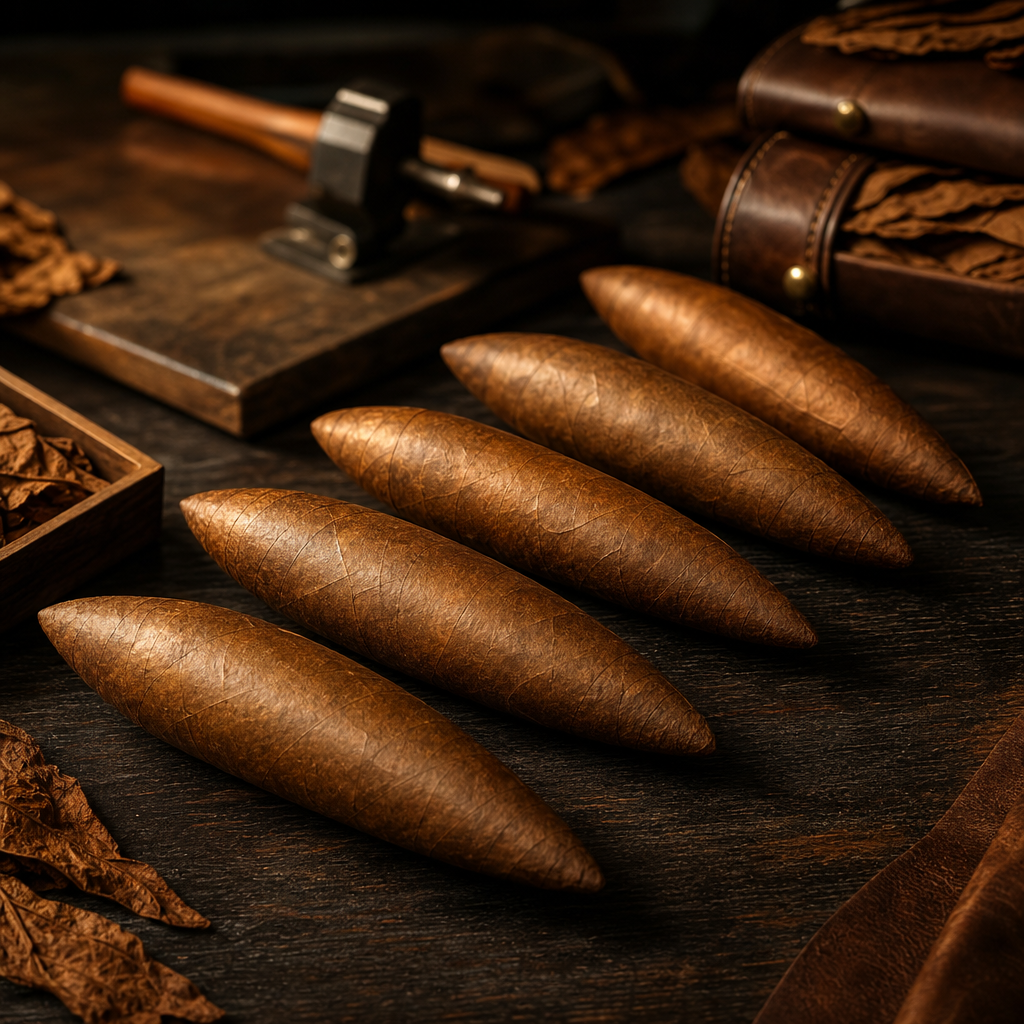
When Cuaba was launched in 1996, it introduced four formats, all Perfecto figurados:
| Item | Length | Ring Gauge | Galera vitola |
|---|---|---|---|
| Divinos | 101mm | 43 | Petit Bouquet |
| Tradicionales | 120mm | 42 | Favoritos |
| Generosos | 133mm | 42 | Favorita |
| Exclusivos | 145mm | 46 | Exquisitos |
Starting in 2003, Habanos gradually added three larger formats: Distinguido (a long-bodied, wide-bellied Perfecto), Diadema (Perfecto grande, close to Gran Corona size), and Salomón -- the top-level double-tapered figurado and one of the formats with the highest craft complexity.
The addition of Distinguido allowed Cuaba to reach more experienced appreciators with ample time; Salomón became the brand's flagship boutique item, with limited quantities per box and often circulating in small 10-count boxes. The fact that the entire brand has no straight-sided Parejo at all is Cuaba's unique positioning among Havana brands.
Cuaba's Flavor Philosophy: The Herbal Lightness of Vuelta Abajo
All Cuaba formats use 100% long-filler tobacco from Vuelta Abajo and the San Juan y Martínez region, paired with Cuban-origin Natural or Colorado-shade wrappers. Compared with the rich complexity of Cohiba or Bolívar, Cuaba's flavor positioning leans toward herbal notes, cedar, and light pepper as the opening main themes; the middle belly (the widest point) is where the flavor is fullest, reflecting the distinctive combustion and temperature-rise curve brought by Perfecto geometry; in the final section, as the diameter contracts, the temperature rises slightly, bringing out a light nutty and leather finish.
Cuaba is positioned at Medium to Medium-Full in strength, suitable for intermediate and above appreciators. For those accustomed to straight-sided cigars, the rhythm of each draw on a Cuaba requires appropriate adjustment -- in the middle section at the widest point, the draw pace should be slowed so that each puff can develop fully; at the tapered ends, the rhythm can be slightly accelerated to maintain combustion temperature. This experience of "adjusting the tasting rhythm according to the shape" is precisely the core message the Cuaba brand seeks to convey: a good figurado cigar is not merely different in shape; it asks the appreciator to establish a more active interactive relationship with it.
Conclusion: A Perfect Statement After 28 Years of Silence
Since Cuaba's debut, its all-figurado brand positioning has remained distinctive. It does not have the royal aura of Cohiba, the historical weight of Partagás, or the worldwide recognition of Montecristo No.2 -- but it occupies a position in the world of Havana cigars that no one else can replace: the brand that takes "returning to the roots of the Perfecto" as its entire mission.
For members of the W Cigar Bar gentlemen's club, Cuaba Salomón is an appreciation experience that must be scheduled once a year and requires sufficient time and a quiet space; Cuaba Distinguido is a deep figurado journey that can be enjoyed alone at dusk. A cigar tapered at both ends is like a true gentleman -- able to advance and retreat with ease in every setting, with its very shape serving as an aesthetic statement.
--
Source of supply: Cuban cigars from the four major official channels (PCC authorized dealers, Cuban official state-run stores, Swiss general distributor, Spanish general distributor).
LUBINSKI accessories official website: https://cigarclub.tw/
Reserve an appreciation session: https://share.google/d9NIeFEetij9qWKj0
This site is for adults aged 20 and above only. Smoking is harmful to health. Smoking cessation hotline: 0800-636363.
W Cigar Bar Gentlemen's Cigar Lounge, written and planned by Wilson Tsai, the Cigar Prince.