Quick Answer
Smoking is harmful to health. Persons under twenty years of age must not smoke. Smoking cessation hotline: 0800-636363. This article is provided only for adults aged twenty and above as a reference on cigar culture, storage, and regulatory knowledge. It is not tobacco advertising, promotion, or purchasing advice.
Quick Answer
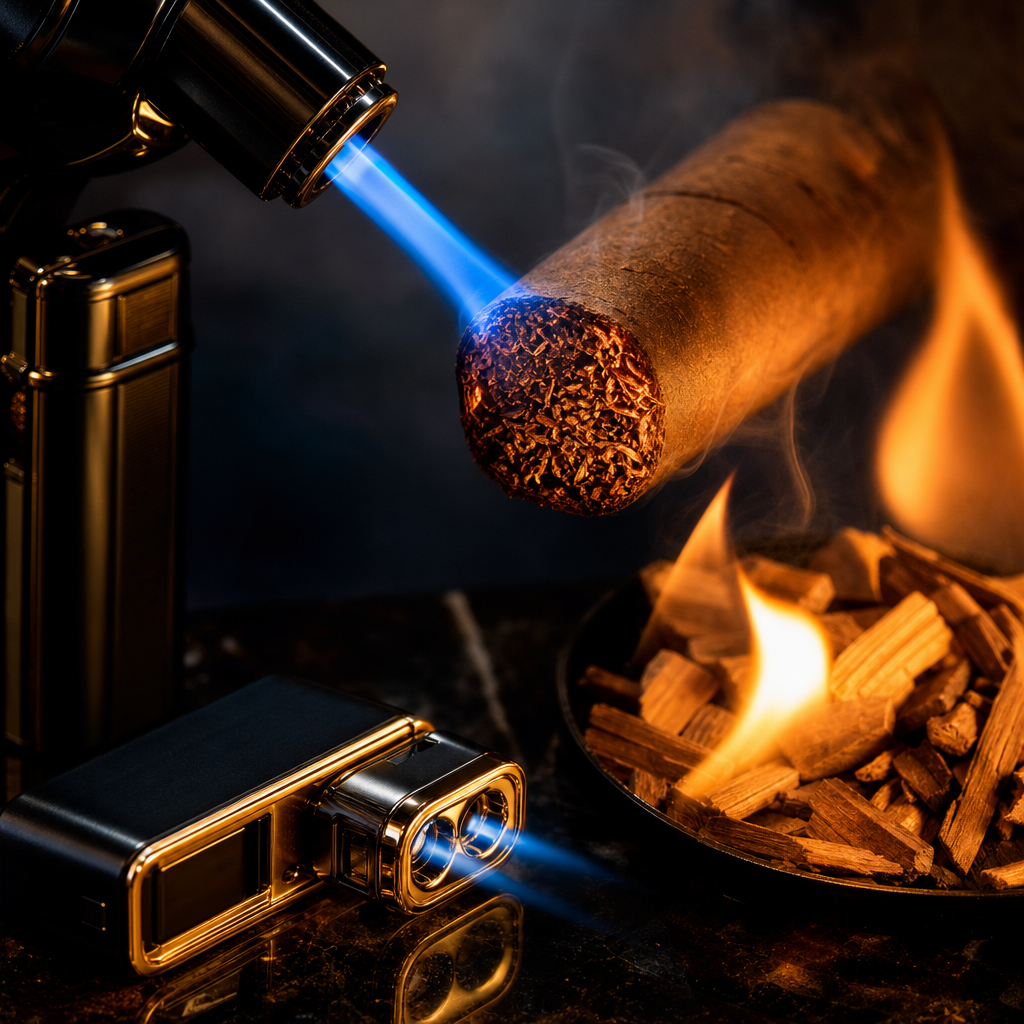
For beginners choosing a cigar lighter, the safest choice is an adjustable-flame single-flame or dual-flame torch lighter. Ring gauge 50 and below usually work best with a single flame; 50 to 56 can use a dual flame; only above 56 should a four-flame lighter be considered. The blue flame of a torch lighter is concentrated, with a temperature of about 1,200°C to 1,400°C. It lights quickly, but the distance must be kept wider. Cedar spills have a gentler flame and are suitable for slowly toasting the cigar foot, but they are clearly affected by wind. The principle is not that the bigger the flame, the better, but to let the outer ring and center of the foot heat up together and turn evenly brown, avoiding direct contact between the flame and the tobacco leaves, which can cause charring and bitter, harsh off-notes.
Basic Definition/Background
The goal of lighting a cigar is not merely to make the foot "catch fire", but to let the filler, binder, and wrapper at the foot ignite steadily on the same plane. A typical cigar consists of the outer wrapper, the inner binder, and the filler. The foot is the end surface where all three are exposed together. If the outer ring overheats first, the wrapper can easily curl or char. If the center is not fully lit, canoeing, tunneling, or frequent extinguishing may occur later. This is also why the flame pattern of a cigar lighter is more important than simple flame power.
Common lighting tools can be divided into torch lighters and cedar spills. Torch lighters use butane fuel, which mixes with air through the nozzle to form a blue, high-temperature flame. A single flame is one narrow jet; a dual flame has two jets side by side; a four-flame lighter covers the cigar foot with a wider area. Cedar spills are thin strips that are lit first, then used to indirectly toast the cigar with a natural tongue of flame. The flame temperature and shape are less concentrated, but aroma interference is lower, and they can also help beginners slow down and observe color changes at the foot.
Cigar size is often expressed by ring gauge. 1 ring gauge equals 1/64 inch. Ring gauge 42 is about 16.7 mm, 50 is about 19.8 mm, and 60 is about 23.8 mm. The thicker the cigar, the larger the foot area, requiring a wider or more patient heating method. The thinner the cigar, the more likely an overly wide flame is to toast the edge of the wrapper. Storage and aging affect moisture condition, but during lighting, the result should still be controlled through distance, rotation speed, and flame angle.
Key Points
| Tool Type | Flame Characteristics and Approximate Temperature | Suitable Ring Gauges and Situations |
|---|---|---|
| Single-flame torch lighter | Narrow, concentrated flame jet; blue flame about 1,200°C to 1,400°C | Ring gauge 38 to 50, suitable for beginners practicing point control |
| Dual-flame torch lighter | Wider coverage, still with clear hot spots | Ring gauge 46 to 56, common Robusto, Toro sizes |
| Four-flame torch lighter | Large flame area, fast heating, lower margin for error | Ring gauge 56 and above, requires greater distance and continuous rotation |
| Cedar spill | Gentle tongue of flame, highly affected by wind, fluctuating from several hundred degrees to under one thousand degrees | Use indoors without wind, when slowly toasting the foot is desired |
The key is not to bring the cigar close to the fire, but to treat the flame as a heat source. A single flame is suitable for precise touch-ups; a dual flame balances speed and control; a four-flame lighter is meaningful mainly for large ring gauges or light outdoor breezes. Cedar spills are suitable for "preheating" and "finishing", especially allowing the outer ring of the foot to turn evenly brown first, then completing ignition at the center in a shorter time. If only one tool can be prepared, beginners will find an adjustable, stable-jet, pure butane dual-flame torch lighter the easiest to handle.
〔Deep Dive 1〕Single Flame, Dual Flame, Four Flame: The More Flame Jets, the More Distance Is Needed
The difference among single-flame, dual-flame, and four-flame torch lighters lies essentially in "heat distribution". A single-flame lighter has only one nozzle, with a small flame tip. It is suitable for Corona and Petit Corona cigars of ring gauge 38 to 46, and also for correcting uneven local burn. Looking at common specifications, Montecristo No.4 is about 129 mm with ring gauge 42. If a four-flame lighter is used, the flame area is often larger than the foot diameter, and a beginner can easily char the outer ring by getting slightly too close. A single flame, by contrast, can slowly heat around the outer ring.
A dual flame is the most common compromise for beginners. A Robusto is commonly around 124 mm with ring gauge 50. For example, with a 50-ring-gauge format such as Partagás Serie D No.4, a dual flame can be held about 2 to 3 cm below the foot. Rotate the cigar with your fingers every 2 to 3 seconds, letting the outer ring first become an even gray-brown, then light the center. A Toro is commonly 6 inches with ring gauge 52, and can also usually be handled with a dual flame, without rushing to switch to a four-flame lighter.
A four-flame lighter is suitable for large formats of ring gauge 56, 60, and above, such as a Gordo commonly measuring 6 inches with ring gauge 60. Its advantage is broad coverage and short time; its drawback is strong thermal shock. If the flame tip directly touches the foot, the wrapper edge may turn black within 1 second. S.T. Dupont was founded in 1872, Colibri introduced lighter-related products in 1928, and Xikar became known to many users for cigar accessories in the 1990s. Regardless of brand, the specifications should be judged by nozzle count, flame adjustment, and fuel purity, not only by appearance.
〔Deep Dive 2〕Cedar Spills: The Principle and Limits of Slow-Flame Toasting
Cedar spills are often called cedar spill. The material is usually thin strips taken from woods in the Spanish cedar category, and similar woods are also commonly used as cigar box linings. The method is to first light one end of the strip. After the open flame stabilizes and black smoke decreases, use the side of the tongue of flame to toast the cigar foot. Unlike a torch lighter, a cedar spill does not project a concentrated, high-temperature blue flame. Instead, it uses the gentler, wavering tongue of flame produced by burning wood. Because the heat source is dispersed, it is less likely to scorch one point instantly, but it also requires more time and a steadier technique.
In an indoor, windless environment, cedar spills can be used for two-stage lighting. The first stage is "toasting the foot": hold the cigar at about a 45-degree angle, keep the foot about 2 to 4 cm from the tongue of flame, rotate slowly for 10 to 20 seconds, and observe whether the outer ring turns evenly dark brown. The second stage is "ignition": bring the tongue of flame closer to the center, while still avoiding prolonged contact between open flame and tobacco leaves. If the foot diameter is larger, such as ring gauge 54 and above, the outer ring can be preheated with a cedar spill first, then the center can be touched up with a single or dual flame. This is easier to control than aggressively burning with a four-flame lighter from the start.
The limitations of cedar spills are also clear: when the outdoor wind speed is slightly higher, the tongue of flame drifts, making the heat landing point hard to judge; if the strip is too thin, the burn time is short, and beginners may press the flame too close due to time pressure; if the strip contains more moisture, it may produce more smoke and an unstable tongue of flame. It is not a mysterious tool, but a slow, visualized heat source. For someone encountering cigars for the first time, the greatest help of a cedar spill is that it forces observation of the foot color and burn surface, rather than rushing to draw a flame onto the foot.
Practical Notes
Actual lighting can be divided into four steps. First, confirm that the head end of the cigar has been properly cut and that the draw channel at the smoking end is normal. If the cap is not opened properly and lighting is rushed, the burn condition can later be misjudged because of draw resistance. Second, hold the cigar in your hand, and do not keep it in your mouth while drawing hard over the flame. The blue flame tip of a torch lighter is very hot. It is recommended to keep the cigar foot about 2 to 3 cm away from the flame tip, toasting with hot air rather than letting the flame touch the tobacco leaves. A cedar spill may be brought slightly closer, but the foot should still be heated with the side edge of the tongue of flame.
Third, toast the outer ring first before lighting the center. For a ring gauge 50 Robusto, first let the perimeter of the foot turn evenly brown, then move the flame toward the center. For a ring gauge 42 Corona, one rotation around the outer ring with a single flame is usually enough. For a ring gauge 60 Gordo, if using a four-flame lighter, the distance should be farther and rotation should be more frequent to avoid carbonizing one side first. Fourth, after lighting, observe the burn surface rather than immediately taking repeated large draws. You may gently blow on the foot or check whether the ash ring is even. If one side is not glowing, use a single flame to add heat from below the unburned area.
Fuel also affects tool performance. For torch lighters, pure butane is recommended, and the lighter should be purged, filled, and allowed to rest before ignition according to the instructions. At higher altitudes or lower temperatures, the torch flame may become shorter or unstable. This is not a cigar problem, but a change in fuel pressure and vaporization efficiency. Cedar spills should be kept dry and uniform in thickness. After lighting, wait until the flame stabilizes before bringing it near the cigar. No tool should be used in pursuit of speed. For beginners, spending 40 to 90 seconds lighting one cigar is a common rhythm.
Common Mistakes
-
The flame is too close The blue flame tip of a torch lighter should not touch the foot. If the outer ring of the wrapper turns black and curls, the usual cause is insufficient distance or staying in one place too long.
-
Using a four-flame lighter for a thin ring gauge Cigars of ring gauge 38 to 44 have small feet. A four-flame lighter covers too much area, easily charring the outer ring first while the center remains unstable.
-
Lighting only the center without toasting the outer ring A glowing center does not mean the entire foot is complete. If the outer ring is not preheated, canoing is common later and repeated touch-ups may be needed.
-
Drawing hard while lighting with the cigar in the mouth This draws the flame into the foot, concentrating heat instantly and causing bitter, harsh off-notes and local overheating. Toast it while holding it in the hand first, then confirm the burn surface.
-
Bringing the cedar spill close as soon as it is lit At the initial stage after ignition, the strip's tongue of flame is unstable and may have more smoke. Toast the foot after the flame stabilizes for better control.
-
Ignoring ring gauge and environment The same dual-flame lighter may work well indoors but be insufficient outdoors in wind. The same four-flame lighter may be effective for a large ring gauge but too strong for a small ring gauge.
Frequently Asked Questions (FAQ)
What kind of lighter is more suitable for cigars?
Beginners are advised to start with an adjustable-flame dual-flame torch lighter. It has a larger coverage area than a single flame and is easier to control than a four-flame lighter, making it suitable for common cigars of ring gauge 46 to 54. If most cigars are thinner, choose a single flame. If ring gauge 56 and above is often encountered, only then consider a four-flame lighter.
Will a single-flame torch lighter be too slow?
Not necessarily. For cigars of ring gauge 42 to 46, a single flame is often more accurate. What is slow about a single flame is coverage, not effectiveness. As long as the outer ring is toasted first and the cigar is rotated continuously, the lighting result is usually very even. It is also suitable for local touch-ups when the burn is uneven.
What is the difference between dual flame and four flame?
A dual flame has two heat sources and is suitable for most Robusto and Toro cigars. A four-flame lighter has a wider heat surface, suitable for large ring gauges but more prone to overheating. A four-flame lighter is not a symbol of advancement, but a sizing tool. If the ring gauge is not large, a four-flame lighter instead increases the chance of scorching the foot.
Are cedar spills necessarily better than torch lighters?
Not necessarily. The advantages of cedar spills are a gentle tongue of flame and a slower rhythm, which help with observing the foot. Their drawbacks are that they fear wind, take longer, and require steady technique. Torch lighters are stable and fast, but distance and angle must be more precise. The two can also be used together.
Should the flame touch the cigar when lighting?
Not recommended. The correct method is to toast the foot with the hot air above or beside the flame, letting the tobacco leaves heat up slowly. If the flame directly touches the wrapper, the outer ring can easily char, and bitter, harsh off-notes and uneven burn may follow.
How should a lighting tool be chosen according to ring gauge?
For ring gauge 38 to 46, prioritize a single flame. For 46 to 54, choose a dual flame. For 54 to 56, choose a dual flame or four-flame lighter according to experience. Above 56 is more suitable for a four-flame lighter, but the distance must still be kept wider. If using a cedar spill, any ring gauge can be handled, but larger ring gauges require longer toasting time.
What should I do if one side is not glowing after lighting the cigar?
Do not aggressively relight the whole cigar. Use a single or dual flame aimed below the unlit side, add heat from a distance of 2 to 3 cm, and gently rotate the cigar. Touch-up lighting should address only the unburned area. Do not heat the already burning area again at high temperature.
Smoking is harmful to health. Persons under twenty years of age must not smoke. Smoking cessation hotline: 0800-636363. This article is provided only for adults aged twenty and above as a reference on cigar culture, storage, and regulatory knowledge. It is not tobacco advertising, promotion, or purchasing advice. -W Cigar Bible Wilson Tsai