Cigars and Health: An Analysis of Truth and Myths
Cigars and Health: An Analysis of Truth and Myths
As the editor of "Cigar Bible," I am often asked by seasoned patrons: Are cigars a lifestyle choice or a health risk? My answer is never romanticized: Cigars can have origins, craftsmanship, time, and culture, but they are still tobacco and must be honestly understood.
What seasoned smokers truly need is not a binary "harmful" or "harmless" perspective, but an understanding of how risks form, which myths are most easily overlooked, and how to maintain a clear boundary while enjoying the ritual.
The Bottom Line of Risk: Cigars Are Not an Exemption Card for Aroma Art
The biggest difference between cigars and cigarettes lies in the process, size, burning time, and usage. Take the common Robusto 5 × 50 as an example; it burns for about 45 to 70 minutes, while a Churchill 7 × 47 may exceed 90 minutes. In contrast, a cigarette usually ends in 5 to 8 minutes. This time difference represents a prolonged exposure for the mouth, nose, and environment.
The risk of cigars is not because they "resemble cigarettes," but because they are also burning tobacco, producing nicotine, carbon monoxide, tar, and polycyclic aromatic hydrocarbons. The U.S. National Cancer Institute's 1998 Monograph 9 clearly states that cigar use is associated with risks of oral cancer, throat cancer, esophageal cancer, lung cancer, and chronic obstructive pulmonary disease, with frequency and inhalation depth affecting the level of risk.
The blind spot most seasoned smokers fall into is equating "premium" with "low risk." Brands like Cohiba, Partagás, Davidoff, Arturo Fuente, and Padrón have craftsmanship worth studying, but brand names do not change the chemistry of combustion. High-quality tobacco can provide more refined aromas and structure, but it does not turn tobacco into a health food.
Is Not Inhaling Safe? Oral Absorption and Nasal Exposure Are Key
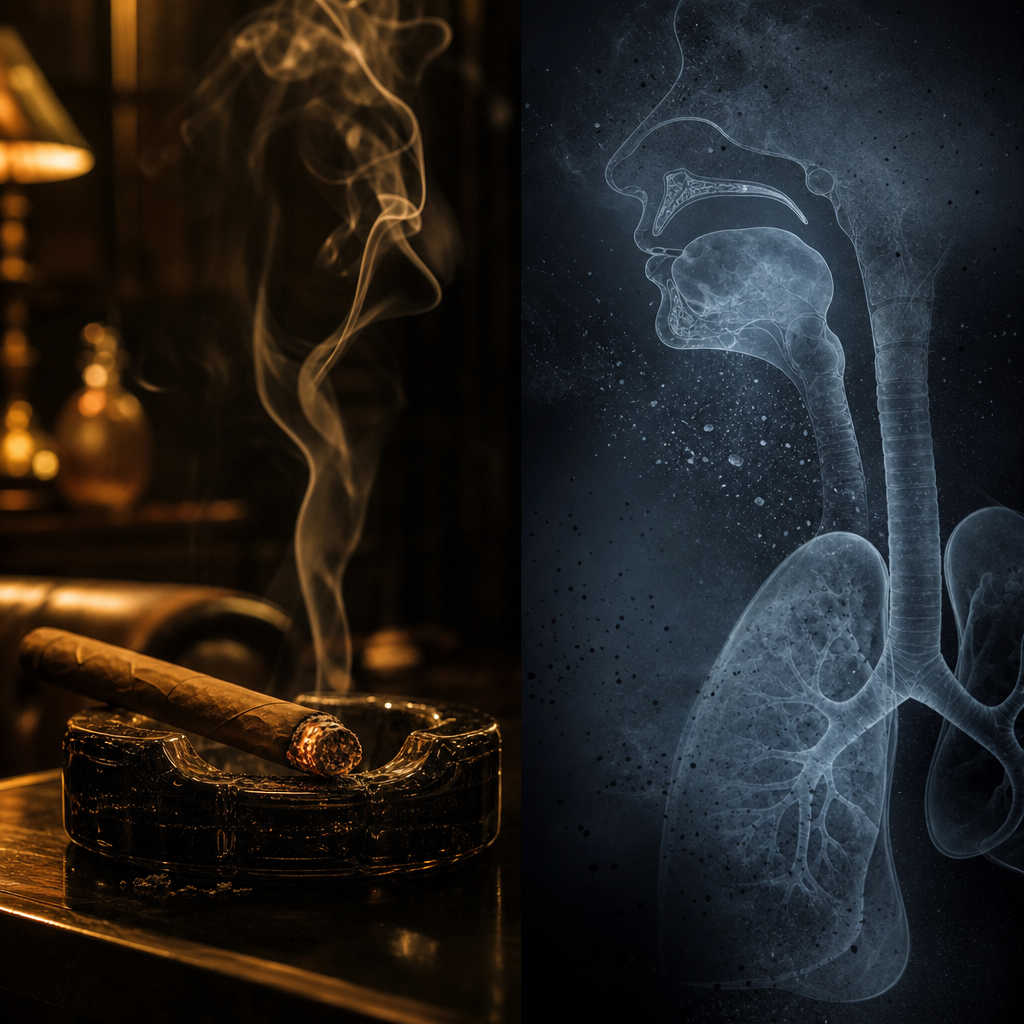
Many seasoned cigar enthusiasts say, "I don't inhale into my lungs, so it's less of a problem." This statement is only half true. Not actively inhaling into the lungs may indeed reduce some lung-related risks, but cigar smoke is alkaline, and nicotine can be absorbed through the oral mucosa; frequent retronasal exhale also repeatedly exposes the nasal cavity and throat.
Not inhaling does not mean no absorption; the nicotine and irritants in cigars can enter the body through the mouth, nose, and upper respiratory tract. A large handmade cigar often contains about 5 to 20 grams of tobacco, while a cigarette contains less than 1 gram. Even if the actual intake ratio differs, the total material amount and burning time remain significant.
I've seen some seasoned smokers, due to their experience, dare to continuously enjoy large vitolas, such as Double Corona, Salomones, or large ring gauge styles like 60 ring gauge. The issue is not just "strength," but also includes single exposure time, alcohol consumption that day, sleep status, and blood pressure response. If experiencing mouth ulcers, throat discomfort, or unstable cardiovascular conditions, enduring the flavor layers is not worthwhile.
Frequency, Size, and Burning Time: How Risks Are Amplified
Discussing health cannot only focus on "whether" but also on "how much, how long, how often." A few cigars a year, one a week, one a day—the risk curves are completely different. Multiple public health studies post-2010 have pointed out that the higher the frequency of cigar use, the closer it is to daily use, the more evident the association with various disease risks; occasional use does not mean no risk, just lower exposure.
| Usage Scenario | Common Size Examples | Single Burning Time | Main Health Considerations |
|---|---|---|---|
| Small Size Short Time | Petit Corona, Half Corona | 25–45 minutes | Shorter exposure time, but still oral and nicotine absorption |
| Medium Classic | Robusto, Corona Gorda | 45–75 minutes | Most common for seasoned smokers, need to pay attention to frequency accumulation |
| Large Size Long Time | Churchill, Double Corona | 75–120 minutes | More noticeable carbon monoxide, oral irritation, and fatigue |
| High-Intensity Blends | High Ligero content styles | Depends on size | Higher likelihood of nicotine impact, dizziness, palpitations |
The most underestimated aspect of cigar risk is "a single session seems leisurely, but the accumulation is considerable." For example, two Robustos a week amount to about 100 a year; if each averages 60 minutes, that's 100 hours of burning smoke environment. This is not a moral judgment, but a calculation of exposure.
Seasoned smokers who want to manage themselves should record three things: brand and size, actual time, and physical reactions. Styles like Padrón 1964 Anniversary Maduro, Oliva Serie V Melanio, Bolívar Belicosos Finos are more likely to cause discomfort when fasting or sleep-deprived. Knowing when to stop is part of maturity.
How Scientific Research Views Cigars: From 1998 to Recent Consensus
The 1998 U.S. National Cancer Institute's "Cigars: Health Effects and Trends" is an important compilation of cigar health research, coinciding with the premium cigar boom in the U.S. during the 1990s. The report pointed out that cigar users, compared to non-users, have higher risks of oral, throat, esophageal, lung diseases, and cardiovascular diseases, and those who inhale have risks closer to cigarette users.
The core of scientific research is not "cigars equal cigarettes," but "cigars are not a harmless alternative." Around 2015, the FDA and public health journals also discussed the regulation and health impact of premium cigars, focusing on youth exposure, packaging, nicotine dependence, and secondhand smoke. Different studies may estimate risk multiples differently, but the direction is quite consistent: there is no safe threshold for burning tobacco.
Seasoned smokers reading research should note three limitations. First, many data lump machine-made cigars, little cigars, and premium hand-rolled cigars together, diluting details. Second, users often have confounding factors like alcohol consumption, diet, and other tobacco history. Third, frequency reporting is often inaccurate. Even so, these limitations do not negate the existence of risk, only remind us not to oversimplify.
Secondhand Smoke and Venues: Gentleman Culture Cannot Ignore Others' Physical Boundaries
Cigar culture often talks about leather chairs, whiskey, jazz, and long conversations, but true gentleman culture must include respect for others. Cigar smoke is voluminous and lingers for a long time; if indoor ventilation is insufficient, clothing, curtains, woodwork, and air conditioning ducts may retain odors and particles. This is not "others don't appreciate it," but the reality of secondhand smoke exposure.
The social value of cigars cannot be built on others' involuntary exposure. For a 6 × 52 Toro, the environmental smoke produced by burning for 70 minutes can cause stress for non-users, pregnant women, children, asthma patients, or cardiovascular disease patients. The more seasoned the cigar enthusiast, the more they should understand space, wind direction, and distance.
In many European cities, indoor smoking restrictions have become stricter since the 2000s, forcing traditional cigar lounges to redesign ventilation and filtration systems. Japan, Hong Kong, Singapore, and other places have their regulations for public spaces. My view is simple: compliance is the baseline, courtesy is the upper limit. Cigars can be a medium for conversation but should not be an excuse for others' health burdens.
Risk Management for Seasoned Smokers: Controllable Habits and Uncontrollable Facts
Health risks cannot disappear through rhetoric but can be reduced through behavior. For seasoned smokers, the real value is not intimidation but establishing an executable rhythm. If you already know your preference for the earthy, woody, and leathery notes of Habanos or the cocoa, pepper, and sweet aromas of New World cigars, you should also know that your body's tolerance has its "flavor wheel."
A mature cigar attitude is to acknowledge risks, control frequency, respect body signals, and not treat tolerance as heroism. The following practices won't bring risks to zero but can avoid many common mistakes among seasoned smokers:
- Avoid an empty stomach, especially with high-intensity, Ligero-notable styles.
- Control frequency, not treating long sizes as a daily routine.
- If feeling dizzy, cold sweat, nausea, or palpitations, stop and hydrate.
- Pay attention to oral leukoplakia, long-term ulcers, swallowing pain, hoarseness, and other warnings.
- Those with hypertension, arrhythmia, chronic lung disease, or cancer history should consult a doctor.
I also recommend seasoned smokers undergo annual health checks, especially for oral mucosa, blood pressure, blood lipids, electrocardiograms, and respiratory functions. Many people maintain their humidors, precisely controlling 65% to 69% relative humidity, yet are unwilling to maintain their bodies. Humidors need hygrometers, and people need honest health data.
Myth Deconstruction: Misunderstandings of Natural, Aging, Brands, and "Premium Feel"
The first myth is "natural tobacco leaves are safer." Handmade cigars often use long fillers, natural fermentation, and manual rolling as selling points, which indeed affect aroma, burning, and layers, but the chemical substances after burning still exist. Cuban seed, Connecticut Shade, Ecuador Habano, Nicaraguan Ligero represent agriculture and terroir, not harmlessness.
Aging can improve aroma integration and irritation, but it cannot turn tobacco risks into health benefits. For example, a box of 2018 Partagás Serie D No.4, after several years of good preservation, may have a more rounded spiciness, and better-integrated woody and sweet notes; but it is still burning tobacco. Excessive humidity may even bring moldy flavors and poor combustion, increasing discomfort.
The second myth is "the more expensive, the cleaner." Price includes origin, rarity, brand, taxes, preservation, and market sentiment, not toxicological indicators. The third myth is "I only smoke good cigars, so I won't get addicted." Nicotine dependence is unrelated to price but related to intake, frequency, psychological rituals, and situational connections. Seasoned smokers should have the ability to appreciate and the ability not to be led by habits.
Frequently Asked Questions
Are cigars safer than cigarettes?
It cannot be simplified like that. Cigars are usually not primarily inhaled into the lungs, and some lung exposures may be lower; but cigars are large, burn long, have high nicotine content, and have obvious oral and upper respiratory tract exposure. When comparing different tobacco products, the focus is not on finding a "safe version," but on acknowledging that burning tobacco poses health risks.
Is there a risk with one cigar a month?
There is a risk, but the exposure is usually lower than for high-frequency users. Health discussions are not switches but accumulations. If only occasionally exposed, still avoid an empty stomach, excessive alcohol, and enclosed spaces, and pay attention to physical reactions. If you have cardiovascular or respiratory diseases, it is advisable to discuss with a doctor first.
Is only doing nasal exhale more dangerous?
Nasal exhale allows for more complete aroma recognition but also exposes the nasal cavity and throat to smoke. If you often feel nasal burning, dryness, nosebleeds, or throat discomfort, you should reduce the frequency. Technique should not override body signals.
Does pairing with spirits increase the burden?
Alcohol can irritate mucous membranes and may increase the risk of oral, throat, and esophageal-related diseases; combined with cigars, the burden may stack. Many seasoned smokers love pairing with whiskey, cognac, or rum, but a more prudent approach is to control alcohol intake, hydrate, and avoid using alcohol to suppress physical discomfort.
Does better preservation reduce health risks?
Good preservation can make burning more stable, reduce spiciness and extinguishing caused by excessive moisture, and avoid mold; but it cannot eliminate the inherent risks of burning tobacco. 65% to 69% relative humidity, about 18 to 21°C environment, is mainly for flavor and condition, not medical protection.
What symptoms should prompt stopping and checking?
If there are oral leukoplakia, ulcers lasting more than two weeks, swallowing pain, hoarseness, chest tightness, persistent cough, palpitations, or breathlessness, you should stop and seek medical evaluation. The true confidence of seasoned smokers is not ignoring warnings but recognizing the body's warnings earlier than novices.
I love the aroma, history, and human touch of cigars and respect the risks they bring. To me, a true gentleman does not deify cigars but remains clear-headed before the flame: knowing when to enjoy, when to moderate, and when to stop. Flavor is worth studying, and health is worth long-term safeguarding.
—Cigar Prince Wilson Tsai
Smoking is harmful to health. Under 20 years old is not allowed to smoke. Quitline: 0800-636363. This article is for reference only for adults over 20 years old regarding cigar culture, preservation, and regulations, not a tobacco advertisement, promotion, or purchase suggestion.