The Fusion of Cigars and Traditional Craftsmanship: Exploring the Unique Rolling Techniques of Different Regions
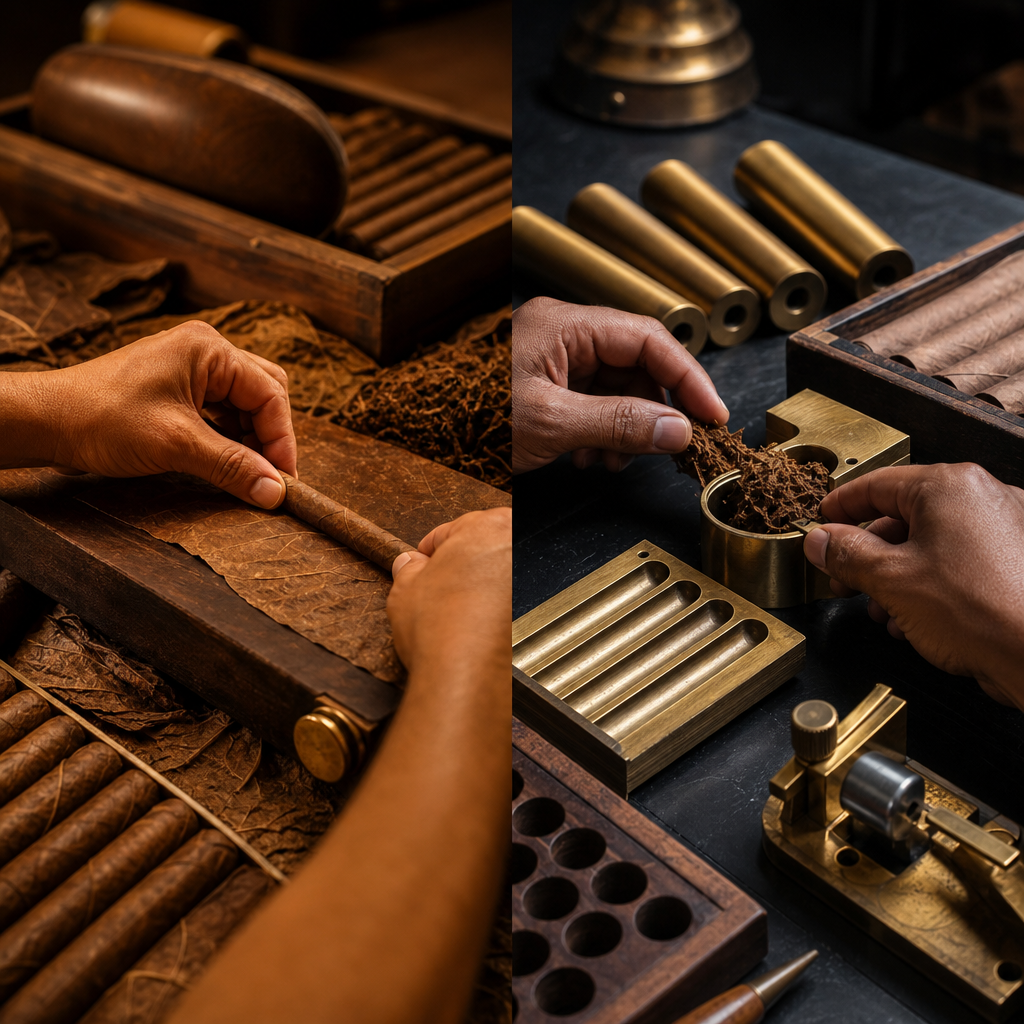
The Fusion of Cigars and Traditional Craftsmanship: Exploring the Unique Rolling Techniques of Different Regions
The flavor of a cigar is not only derived from seeds, soil, and fermentation; it is the rolling craftsmanship that truly transforms the leaves into a work with rhythm, tension, and lingering aftertaste. While seasoned enthusiasts often discuss regional styles, without considering the rolling methods, many differences such as "smoothness," "dullness," "concentration," and "looseness" are difficult to articulate.
As the editor of the "Cigar Bible," what I care about most is: how a cigar's structure is crafted by hand. From Havana's entubado to the precise draw control in the Dominican Republic, and the robust framework in Nicaragua, each region has its own craftsmanship language, shaping the familiar flavor profiles we know.
Havana: Entubado and Classic Balance
The key to traditional Havana rolling is rolling each filler leaf into a thin tube and then bundling them together. This entubado technique is still regarded as a high-level skill in many Cuban factories. It is not simply stuffing leaves into the wrapper but allowing air to flow through multiple small channels, making the burn more stable and the smoke more layered. Established factories like Partagás, H. Upmann, and Romeo y Julieta have cultivated the touch of experienced torcedores using this method.
The core of the Havana style is not about maximizing strength but maintaining a balance of aroma, draw, and burn through the rolling structure. Take the Cohiba Siglo VI as an example; its 52 ring gauge and 150mm size provide ample space for the filler leaves. If the bundle is too tight, the herbal, creamy, and honey notes will be suppressed; if too loose, the aroma will dissipate quickly, and the final segment will lose focus.
Cuban craftsmanship also emphasizes the "triple cap" and the arrangement of the foot. The triple cap is not only a traditional appearance but also reduces the chance of the wrapper cracking after cutting. The arrangement of the foot leaves affects the ignition speed of the first centimeter. Experienced smokers observing a commonly seen Robusto from 2018 onwards can infer the evenness of the leaf bundle from the burn line, ash density, and draw rebound, which often explains quality more than just looking at the brand.
Dominican Republic: Precision, Cleanliness, and "Round Draw"
Dominican craftsmanship has been heavily influenced by Cuban immigrants but gradually developed a style emphasizing consistency after the 1980s. After Davidoff fully shifted production to the Dominican Republic in the 1990s, "clean burn, stable draw, and elegant aroma" became one of the international market standards. Arturo Fuente's launch of OpusX in 1995 further proved that the Dominican Republic can produce not only mild cigars but also those with deep structure and explosive power.
A common feature of Dominican rolling is the meticulous control of bundle pressure. Many factories use molds for long-term shaping, and quality control personnel measure the draw using suction machines; some high-spec production lines control the draw within a very narrow range. The brilliance of the Dominican Republic is minimizing the uncertainty of handcrafting, ensuring each puff has a predictable rhythm.
Taking the Fuente Hemingway series' Perfecto shape as an example, the head and foot gradually narrow, making the rolling more challenging than a typical Parejo. If the leaf bundle distribution is uneven, the front will burn unevenly, and the middle will suddenly heat up. A good Perfecto will gradually increase smoke volume at the start, amplify woody, sweet, and spicy notes in the middle, and maintain a clear profile in the final segment, showcasing the value of precise Dominican craftsmanship.
Nicaragua: Intense Leaf Material and Strong Framework Rolling
Nicaragua rose rapidly after the 1990s, with Estelí, Jalapa, and Condega becoming core regions. Estelí leaves are thick with strong nicotine, Jalapa often carries sweetness and smooth aroma, while Condega has more herbal and mineral notes. These leaves, if rolled too loosely, burn too quickly; if pressed too tightly, they result in blockage and bitter burn, making the rolling framework particularly important.
The box-pressed shapes of Padrón's 1964 Anniversary and 1926 Serie are classic examples of Nicaraguan craftsmanship. Box pressing is not simply flattening a round cigar but maintaining even pressure on all four sides within molds and wooden boxes. The focus of Nicaraguan cigar rolling is ensuring thick filler leaves have sufficient ventilation while retaining concentration and propulsion.
Brands like My Father, Oliva, and Joya de Nicaragua often control burn through different leaf placements. Ligero leaves are usually oily and slow-burning; if concentrated too much in the center, they cause smoke temperature to rise slowly; if placed on the outer layer, they may destabilize the burn line. Skilled rollers interlace seco, viso, and ligero, preventing an explosive start, gradually deepening in the middle, and maintaining controllable strength in the final segment.
Honduras: Corojo Tradition and Endurance-Type Rolling
Honduras' cigar history is closely tied to Cuban Corojo seeds. After the 1960s, many Cuban seeds and techniques were introduced to Central America, with Honduras developing a style with distinct spicy, leather, and earthy notes in regions like Jamastrán Valley and Talanga. Camacho, known for its strong Corojo image, is one of the representatives of Honduras' power.
Honduran leaves are usually straightforward, requiring special handling of leaf veins and humidity during rolling. If veins are not cleanly trimmed, they produce sharp bitterness when burned; if humidity is too high, it leads to dull burning in the middle and end. The charm of Honduran craftsmanship is creating stable long-burning with robust leaves, with endurance in strength.
Taking a 6 x 54 Toro as an example, if the Honduran style is well-handled, the front often has coffee, woody, and pepper notes; the middle transitions to leather, nuts, and earth; the final segment shifts to dark spices. If the leaf bundle is uneven, these layers become a single spiciness. Experienced smokers evaluating Honduran cigars can observe whether the ash column maintains 2 to 3 centimeters and whether the burn line requires frequent correction, reflecting the rolling skill.
Mexican San Andrés: Thick Wrapper and Maduro Craftsmanship
Mexico's San Andrés is known for its dark wrappers, especially common in Maduro styles. These wrappers are thick, oily, with cocoa, molasses, soil, and coffee tones, but are more challenging to handle than Connecticut Shade or Cameroon. If the stretching angle is incorrect during rolling, the wrapper easily cracks; if the glue is too heavy, it affects the head's burn and taste.
A. Turrent is one of Mexico's representative brands, and many Nicaraguan and Dominican brands also use San Andrés wrappers as the outer layer. The value of San Andrés is not just its dark color but its ability to envelop sweetness, bittersweetness, and earthiness around the smoke's edge. This enveloping sensation often requires precise binder and wrapper tension to present.
Maduro craftsmanship often involves longer fermentation and higher temperature management, but the rolling end remains the key to success. If the dark wrapper is slightly too moist, it will have a wet wood taste when lit; if too dry, it easily cracks. Experienced collectors or those aging such cigars are advised to use a relative humidity range of 65% to 69% as a common reference, observing the wrapper's oil sheen and elasticity rather than just judging maturity by color depth.
The Impact of Rolling Methods on Flavor: From Leaf Bundle to Draw Technology Table
Discussing regions cannot only focus on taste but also on rolling methods. The same filler leaves, if using book bunch, accordion, entubado, or mixed methods, will have different smoke concentration, burn speed, and final segment temperature. Experienced smokers often say a cigar "opens slowly" or "the middle suddenly falls apart," often not a formula issue but a result of leaf bundle channels and pressure distribution.
| Rolling Method | Common Regions or Cases | Technical Features | Impact on Flavor and Burn |
|---|---|---|---|
| Entubado | Cuba, high-end lines | Each filler leaf in tube form | Good ventilation, clear layers, high skill requirement |
| Book bunch | Multi-region mass production | Leaves folded like book pages | High efficiency, but channels may be more concentrated |
| Accordion | Dominican Republic, Nicaragua | Leaves folded in a wave pattern | Stable draw, smoother smoke |
| Box press | Padrón and other cases | Pressed into a square shape after forming | Slower burn, concentrated taste, stable grip |
Rolling is not a performance but a flavor engineering; it determines how air passes through the leaves and how aroma is released. For example, a 50 ring gauge Robusto and a 54 ring gauge Toro, even with the same formula, the thicker ring gauge can accommodate more ligero, but if the channel is insufficient, the concentration becomes heavy; the thinner ring gauge easily increases the wrapper ratio, making the aroma more direct.
Practical observation can be done in three steps: first, observe the rebound before lighting; too hard may indicate insufficient ventilation; second, feel the resistance during a cold draw; the ideal state is resistance without effort; third, observe smoke volume and burn line after burning 2 centimeters. These details are more practical than simply chasing high scores and help experienced smokers understand the craftsmanship differences of each region.
Aging, Preservation, and Long-term Performance of Craftsmanship
A well-rolled cigar will further integrate under proper preservation. Here, I use "aging" to describe the process of flavor becoming more harmonious. Different regions perform differently during aging: Cuba often sees floral, honey, and woody notes merging; the Dominican Republic becomes smoother; Nicaragua may submerge pepper notes into cocoa, coffee, and leather layers.
However, aging cannot compensate for severe rolling defects. A cigar with too tight a leaf bundle may still draw poorly after 3 years; wrapper damage or humidity issues will not naturally recover over time. Good craftsmanship will amplify advantages during aging, while bad craftsmanship will only preserve problems. This is why experienced smokers, when looking at boxed cigars, observe color differences in the same box, the neatness of the foot, and the cleanliness of the cap, rather than just looking at the year.
When discussing collection value, one must remain calm. Some early 2000s limited editions, specific year Cohiba or Fuente OpusX, indeed have market discussion; but collection appreciation does not guarantee appreciation, still depending on source preservation and market. From the perspective of a PCC authorized dealer, clear source, stable humidity records, and complete box condition are often more worth serious evaluation than rumored popular years.
Common Questions
Why do cigars of the same brand and size still taste different?
Handmade cigars are affected by leaf batch, humidity, roller's touch, and storage environment. Even the same 2020 Robusto may present more open or tighter smoke due to different leaf bundle densities.
Is Entubado necessarily better than other rolling methods?
Not necessarily. Entubado has excellent ventilation and layer performance but requires skilled execution; if the technique is not up to par, it may cause uneven burning. The best rolling method is the one that serves the formula and regional leaf material.
Why do box-pressed cigars often seem to burn slower?
Box pressing changes the leaf bundle pressure and air channel shape, usually making the burn rhythm more steady. Padrón 1964 and 1926 series are typical examples, but if humidity is high, slow burn can become dull burn.
Does a thicker ring gauge mean richer flavor?
Not necessarily. A 54 or 56 ring gauge can accommodate more filler leaves, providing more formula space; but a 42 to 46 ring gauge, due to a higher wrapper ratio, may make the aroma more concentrated and sharper.
What are the top three things experienced smokers should look at when evaluating craftsmanship?
First, look at the draw, then the burn line, and finally the final segment temperature. If a cigar is smooth in the front, stable in the middle, and not hot or bitter in the final segment, it usually indicates a high level of leaf bundle structure and humidity control.
I have always believed that the most fascinating aspect of cigars is the encounter of agriculture, time, and craftsmanship in a single work. Brands can provide direction, years can provide clues, but what truly leaves an impression is often the structural sense left by a roller: the flow rate of a puff, the weight of the ash column, and the clear aroma in the final segment. Understanding regions also means understanding craftsmanship; understanding craftsmanship allows one to read the people behind the cigars.
—Cigar Prince Wilson Tsai
Smoking is harmful to health. Under twenty years old is not allowed to smoke. Quit smoking hotline: 0800-636363. This article is for reference by adults over twenty years old regarding cigar culture, preservation, and regulations, not an advertisement, promotion, or purchase suggestion for tobacco products.