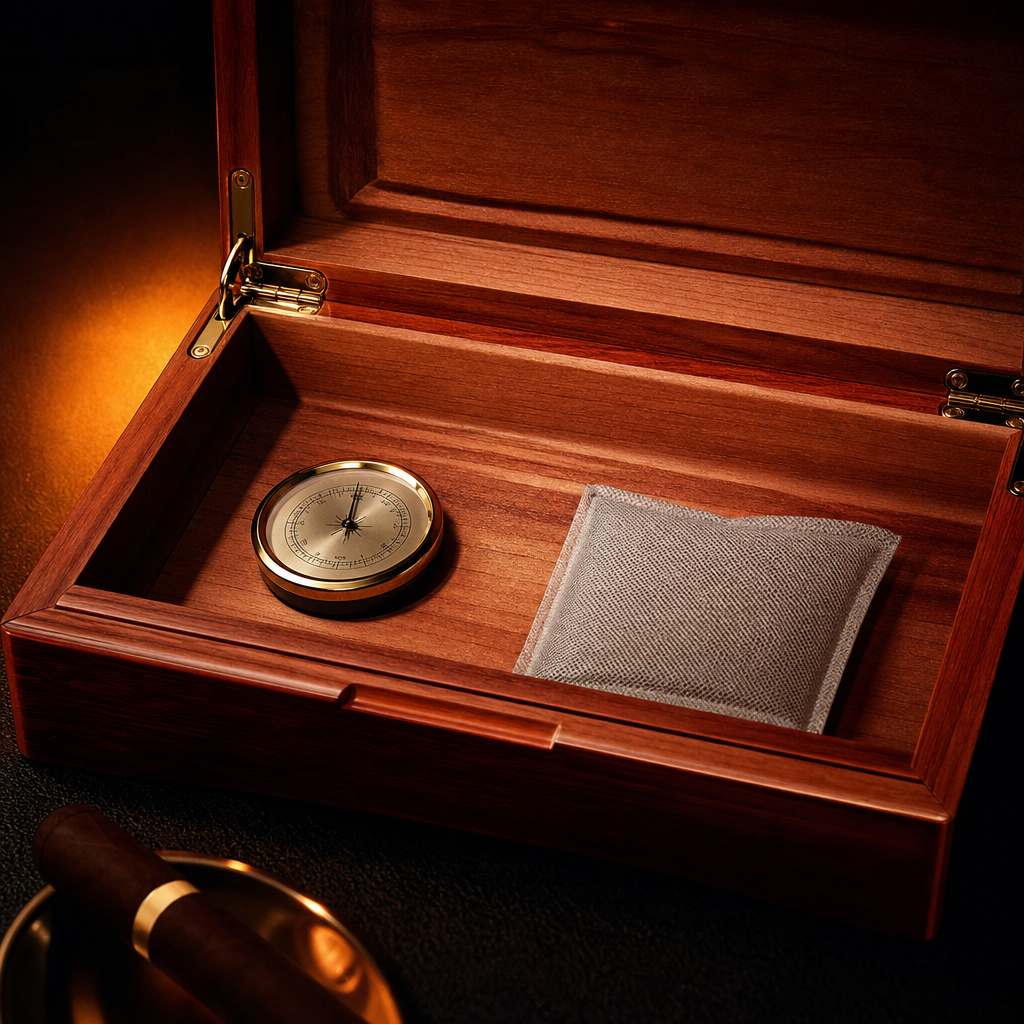
1. Humidity Management: The Golden Range of 65-72%

⚠️ Smoking is prohibited for those under twenty years old, and smoking is harmful to health. Quitline 0800-636363. This article is for research on cigar accessories and knowledge only, and is not intended as a suggestion for the sale or purchase of tobacco products.
1. Humidity Management: The Golden Range of 65-72%
The first step in cigar maintenance is to stabilize humidity, with the recognized golden range being a relative humidity of 65-72% (RH) and a temperature of about 18-20°C.
- Too dry (below 60%): The wrapper becomes brittle, the flavor turns bitter, and it burns too quickly.
- Too wet (above 75%): The draw becomes tight, making it hard to light and prone to mold and tobacco beetles.
Most people aim for around 69% and use two-way humidity packs to maintain it, which is the most worry-free approach. The real key is stability—rather than oscillating within the range, it is better to fix it at one value.
2. What is Aging and How Long is Needed
Aging is the process where, in a stable environment, the components in the tobacco leaves slowly change over time, making the flavor more rounded and harmonious. It is not "the longer, the better," but rather each has its own optimal window.
- Short-term (3-6 months): Let newly acquired cigars rest for a while to stabilize after transportation, commonly known as settling.
- Medium to long-term (1-5 years or more): Some tobacco leaves' edges will be smoothed out, and the layers will blend more.
For an in-depth understanding of the mechanism, see How Cigar Mellowing Works. Reminder: Aging is a personal collection interest, past market performance does not represent the future, collect within your means and at your own risk.
3. Mold vs. Plume: How to Distinguish and Handle
Beginners are most afraid of seeing white stuff on the wrapper, but you need to distinguish first:
- Plume (bloom): Extremely fine, dry, powdery, evenly distributed, falls off with a light brush, no odor. Some collectors see it as a phenomenon of long-term stable preservation, but practically, you should first rule out mold, and once confirmed, just wipe it off.
- Mold: Colored (blue-green, gray-black), may clump or have fuzz, often has a moldy smell, and can even seep into the wrapper. This needs to be handled.
Handling mold: Isolate the moldy cigars, check nearby ones for infection, confirm and reduce humidity (usually caused by too much moisture), and clean the box. For odor removal procedures, see Humidor Odor Removal SOP.
4. Tobacco Beetle: Identification, Prevention, and Emergency Measures
Tobacco beetles are the number one enemy of cigar collections, most likely to hatch in high temperature and humidity (above about 28°C).
- Identification: Small round holes on the wrapper or body, powder residue at the bottom of the box, are warning signs.
- Prevention: Keeping the temperature below 20°C and humidity not exceeding 72% is the most effective prevention. This is also the value of climate-controlled cabinets in Taiwan's climate.
- Emergency Measures: Upon discovery, immediately isolate the affected cigars. Others can be treated with the freezing method—seal and gradually lower the temperature to freeze for several days before warming up, which can terminate the eggs. Warming should be slow to avoid condensation from temperature differences.
5. Gradual Rehydration Rescue of Dry Cigars
Don't rush to throw away dry cigars, and don't raise the humidity all at once—rehydrating too quickly will cause the wrapper to crack due to uneven expansion inside and out. The correct approach is to gradually rehydrate:
- First, place in a lower humidity environment (e.g., 65%) for several days.
- Then move to the target humidity (around 69%).
- Stay at each stage for several days to a week or two, allowing moisture to penetrate evenly from outside to inside.
The entire process may take several weeks or even longer. Don't rush—cigars that are slowly rehydrated won't be wet outside and dry inside when smoked.
6. Daily Maintenance Rhythm and Checklist
- Every day/every time you open the cabinet: Glance at the hygrometer reading.
- Weekly: Check humidity stability and whether the humidity pack is still full.
- Monthly: Rotate positions, check for plume, mold, or small round holes.
- Quarterly: Calibrate the hygrometer, clean the cabinet, and replace the humidity pack as needed.
The spirit of maintenance is stability + regular inspection. Equipment helps you maintain the environment, and your eyes are responsible for early problem detection.
Further Reading and Related Tutorials
For physical options, refer to W Cigar's sister store (specializing in cigar accessories): W Cigar Cigar Care Products Category (Sister Site), W Cigar Humidor/Storage Equipment.
Further reading:
Frequently Asked Questions (FAQ)
Q: What humidity and temperature should cigars be stored at?
The recognized golden range is a relative humidity of 65-72% and a temperature of about 18-20°C, with most people setting the humidity at around 69%. If too dry, the wrapper will become brittle and the flavor bitter; if too wet, the draw becomes tight, hard to light, and prone to mold and beetles. The key is stability, not oscillating within the range.
Q: Is the white substance on the wrapper mold?
You need to distinguish first. Plume (bloom) is extremely fine, dry, powdery, evenly distributed, falls off with a light brush, and has no odor, considered a long-term stable phenomenon, but you should still rule out mold first and confirm before wiping it off. Mold is blue-green or gray-black, may clump or have fuzz, often has a moldy smell, and can seep into the wrapper, requiring isolation and humidity reduction.
Q: What should I do if cigars have tobacco beetles?
Tobacco beetles are most likely to hatch in high temperature and humidity. If you find small round holes on the cigar body or powder residue at the bottom of the box, be alert. Immediately isolate the affected cigars, and others can be treated with the freezing method (seal and gradually lower the temperature to freeze for several days before slowly warming) to terminate the eggs. The prevention method is to keep the temperature below 20°C and humidity not exceeding 72%.
Q: Can dry cigars be rescued?
Yes, but you need to gradually rehydrate them, not raise the humidity all at once. First, place in a lower humidity environment (about 65%) for several days, then move to the target humidity (around 69%), staying at each stage for several days to a week or two, allowing moisture to penetrate evenly from outside to inside. Rushing to rehydrate will cause the wrapper to expand unevenly and crack.
Q: Is aging better the longer it is?
No. Aging is the process where the components in the tobacco leaves become more rounded and harmonious over time in a stable environment, but each cigar has its own optimal window and is not better indefinitely. Aging is a personal collection interest, and past market performance does not represent the future, so collect within your means and at your own risk.
Q: What daily maintenance checks should be done?
Every time you open the cabinet, glance at the hygrometer; weekly, check humidity stability and whether the humidity pack is full; monthly, rotate positions, check for plume, mold, or small round holes; quarterly, calibrate the hygrometer, clean the cabinet, and replace the humidity pack as needed. The spirit is stability plus regular inspection.